Navalgund, a town in Dharwad district, weaves flat cotton rugs called durries or jamkhana, in bold geometric patterns and bright colours. They are not garments, but they belong to the same North Karnataka cotton world as Kasuti and Ilkal, and their patterns are a rich source for designers.
What you’ll learn
- What a Navalgund durrie is, and who weaves it.
- How it is woven, and how that shapes its patterns.
- Its motifs and colours.
- How a fashion studio can use durrie patterns honestly.
The durrie
A durrie (also dhurrie or jamkhana) is a flat-woven cotton rug: no pile, light enough to roll up, and tough enough to sit on. In Karnataka it is the mat spread for guests, for weddings and for prayers. Navalgund’s durries are among the best known, and are reported to hold a GI.
The weaving is traditionally reported to be done largely by women of a Muslim weaving community in Navalgund, working at home.
How it is woven
- A strong cotton warp is set up on the loom.
- The weaver packs coloured cotton weft tightly so that it hides the warp completely – this is called a weft-faced weave.
- Each colour is woven only where it is needed, and the colours meet or interlock at their edges.
- The result is a firm, reversible rug with the pattern on both sides.
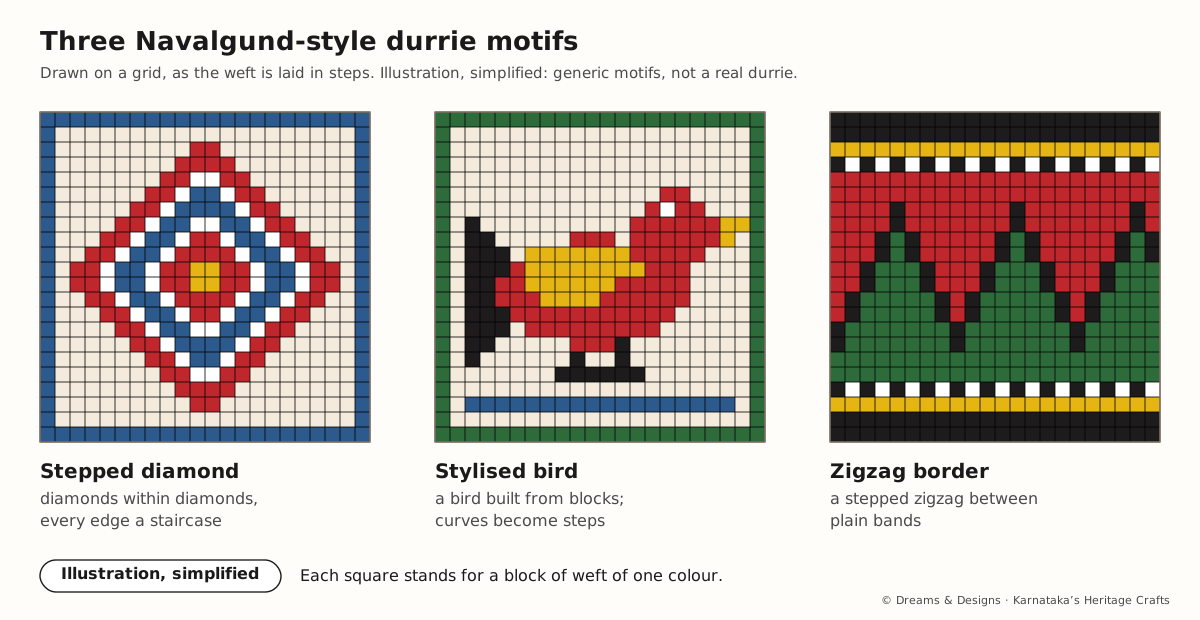
Because the weft is laid in steps across the warp, the patterns are geometric: diamonds, triangles, zigzags, stepped shapes and stylised birds and animals. Curves become staircases.
Colours
Traditional durries use strong, clear colours – red, yellow, green, blue, black and white – often in bands and borders. Newer pieces use softer palettes for city homes.
Why a fashion studio should care
Durrie patterns are a ready library of bold, counted geometry from North Karnataka. They can inspire a Kasuti border, a block-print design for a kurta, a woven-look appliqué or the colour plan of a festive outfit. Used this way, they connect a garment to its region. The rule is the same as for every craft in this course: be inspired, credit the source, and never sell a copy as the real thing.
In more depth: the stepped line
A stepped, counted line links many North Karnataka crafts. Kasuti builds its motifs on a grid of threads; Ilkal’s pallus and borders are built in woven rows; the durrie builds its patterns from blocks of weft. A designer who notices this can make a garment that “belongs” to North Karnataka without copying any one piece.
Motifs
Motifs reported in Navalgund durries include diamonds and lozenges, stepped crosses, birds, animals and stylised plants. Families and weavers name them in their own ways; ask the weaver.
Designing from a durrie: a simple exercise
- Photograph a durrie (with the owner’s or weaver’s permission) or look at one in a shop.
- On squared paper, copy one motif, one square per block of colour.
- Simplify: keep the outline, drop small details.
- Choose three colours from the durrie for your palette.
- Try the motif as a Kasuti border (Gavanti outline) or as a repeat for block printing.
- Label your design “inspired by Navalgund durries”.
This exercise teaches learners to see the grid hidden in woven patterns, which helps with Kasuti charting too.
Caring for a durrie
- Shake or vacuum it regularly to remove grit, which wears the fibres.
- Turn it now and then so it wears and fades evenly.
- Wash small durries by hand in cold water, or have large ones professionally cleaned; test colours first.
- Dry flat, in the shade.
- Store rolled, not folded, in cotton.
Tips for learners and teachers
- Turn the durrie over. A real weft-faced durrie shows the pattern on both sides.
- Feel the weight. It should be firm and dense, not loose or floppy.
- Look for the warp at the ends. The fringes or finished ends show the warp threads.
- Use durrie patterns as inspiration for Kasuti borders or block prints, and say so.
- For teachers: durrie patterns are excellent for teaching how to “step” a curve on a grid.
Common misunderstandings
“Durries are only floor mats.”
They are also used as wall hangings, bedcovers, and in smaller sizes as table runners and bags.
“A printed rug with the same pattern is the same.”
No. A printed rug has a plain back; a woven durrie carries its pattern through the cloth.
For earning and teaching
For earning: a studio can use small durrie pieces for bags, cushion backs or as décor at events. Buy from the weavers or their groups and credit the town.
For teaching: durries are a good bridge between weaving and embroidery in a heritage class.
Sources and uncertain points
- The Navalgund durrie GI is reported around 2011; check the GI Registry.
- The weaving community is as reported; not checked for this lesson.
- The loom type and the exact join between colours vary and were not checked.
- Motif names are not given because they were not confirmed.
Check yourself
- Can you say where Navalgund is?
- Can you explain what “weft-faced” means?
- Do you know why durrie patterns are geometric?
- Can you tell a woven durrie from a printed rug?