Chittara is a women’s painted art from the Malnad hills, made on mud walls and floors for weddings and festivals. Its fine lines and dense geometry tell the story of a wedding. This lesson explains where it comes from, how it is made, and how it moves today from wall to paper, cloth and garment.
What you’ll learn
- Who makes Chittara, and where.
- Its traditional colours and brushes.
- Its patterns and what they show.
- How Chittara is used today, including on cloth.
The art and its makers
Chittara (also called Hase Chittara) is a painted art from the Malnad hills around Sagar, made by women of the Deevaru community. It is painted on mud walls and floors for weddings, festivals and new beginnings.
Colours and tools
- Natural colours – white from rice paste, red from red earth, black from burnt rice, and yellow from local plants.
- Simple brushes made from plant fibre.
- Dense, geometric patterns – fine parallel lines, triangles and grids – that tell the story of a wedding: the bride and groom, the palanquin, the tulsi plant, the ritual objects.
Because each piece was painted for a family’s special occasion, Chittara carries a feeling of blessing and celebration.
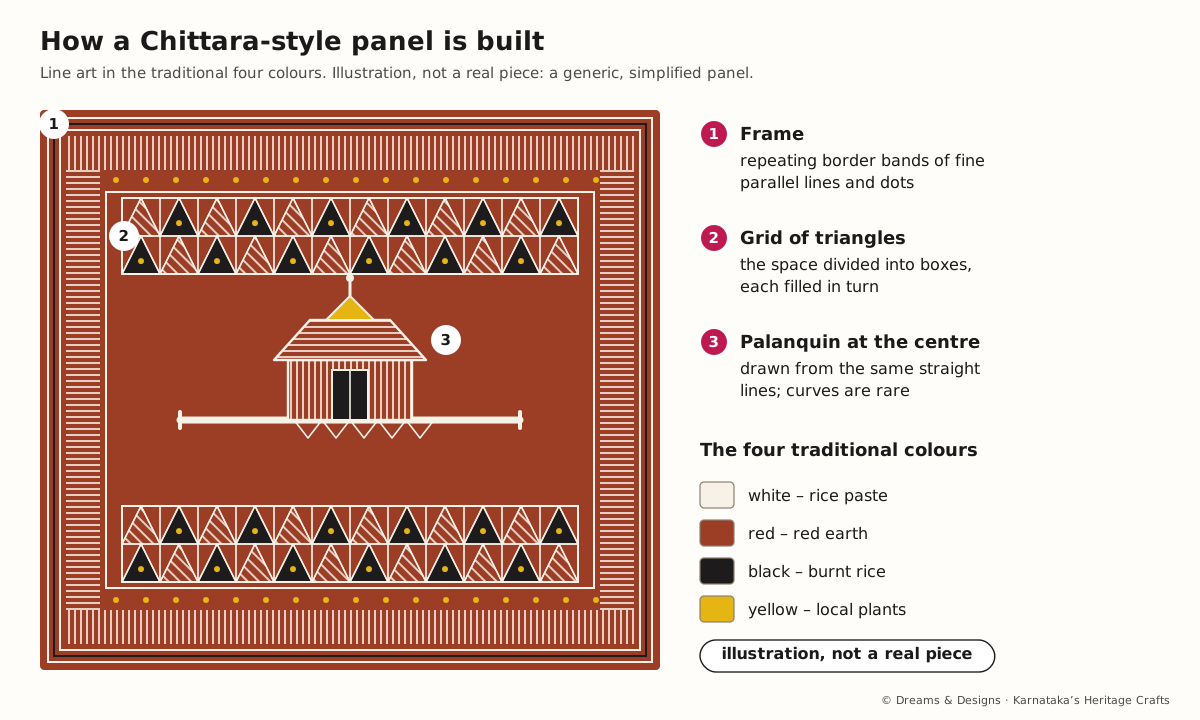
How a panel is built
- Prepare the ground. Traditionally a wall or floor plastered with mud and coated with red earth; today paper, canvas or wood painted with an earth-red base.
- Divide the space into bands and boxes with straight lines.
- Fill each band with fine parallel lines, triangles, dots and lozenges.
- Add the figures – couple, palanquin, tulsi, lamps – drawn from the same straight lines.
- Frame the whole with repeating border bands.
Work slowly. The beauty of Chittara is in even, patient line work, not in speed.
Chittara today
Today the same patterns are painted on paper, canvas, wood and cloth – as wedding décor, gifts, wall pieces and painted garments. At our studio we paint Chittara wedding pieces, décor and gifts, and teach it as a course for all ages.
In more depth: the line, the grid and the story
Built from lines
A Chittara painting is built up from straight lines. The painter divides the space into bands and boxes, then fills each with fine parallel lines, triangles, dots and lozenges. Curves are rare. The effect is like a woven textile drawn by hand, which is one reason Chittara translates so well onto cloth.
The wedding story
Traditional panels show the things of a wedding: the couple, the palanquin, the mantapa (wedding canopy), the tulsi plant, lamps, pots, and the ritual objects of the ceremony. Some panels are said to be painted for particular rites. Meanings are traditionally said and vary between families.
“Hase”
The name Hase Chittara is linked to the hase, often explained as a floor or a ritual seat. Sources explain the word in slightly different ways.
Revival
As mud homes gave way to cement, wall painting faded. In recent decades, artists and groups in and around Sagar have trained new painters and moved Chittara onto paper and cloth. If you visit, ask local artists about their work.
Chittara on cloth and garments
- Choose a smooth, close-woven cloth – cotton, linen or silk – so lines stay sharp.
- Pre-wash and press the cloth to remove sizing; paint will not bond well over it.
- Stretch the cloth on a frame or tape it to a board, with paper beneath to stop paint seeping through.
- Use fabric paint and fix it with heat as the maker says; natural colours are not wash-fast on cloth.
- Place panels carefully: a yoke, a dupatta border, a saree pallu or a jacket back.
- Tell the customer how to wash it: gently, inside out, in cold water.
Describe painted garments as “Chittara-inspired, painted with fabric paint” unless they are made by Chittara artists in the traditional way.
Tips for learners and teachers
- Start with lines, not pictures. Fill a page with parallel-line bands before you try a full panel.
- Keep to four colours at first: white, red, black and yellow on an earth-red ground.
- Use a fine, flat brush or a thin stick with a fibre tip for clean, even lines.
- Use a ruler lightly for the main bands; fill freehand.
- On cloth, use fabric paint and heat-set it as the paint maker says. Test on a scrap.
- For teachers: Chittara is calm and repetitive, which makes it good for children and for adults who want a slow, quiet hobby.
Common misunderstandings
“Chittara is the same as Warli.”
Both are wall arts, but Warli (from Maharashtra) uses white stick figures on a mud ground, while Chittara uses four colours and dense line-filled geometry.
“Chittara is a textile craft.”
It began on walls and floors. Its use on cloth is new, and it should be described that way.
“Any geometric painting is Chittara.”
Chittara has its own colours, line work and wedding themes. Call other work “inspired by Chittara”.
For earning and teaching
For earning: Chittara wedding pieces, name boards, return gifts and painted garments are a natural service for a studio with a painter. Describe the colours honestly (natural or fabric paint).
For teaching: Chittara suits short workshops, school groups and family sessions. Begin with the story, then the lines.
Sources and uncertain points
- The Deevaru community of Sagar taluk is named in the sources we used; some sources give related community names.
- The meaning of “hase” is explained differently in different sources.
- Natural colour sources (rice paste, red earth, burnt rice, plant yellows) are as traditionally described; methods vary.
- We have not found a GI for Chittara; unconfirmed.
- Revival groups are not named because they were not checked.
Check yourself
- Can you say who traditionally painted Chittara, and where?
- Can you name its four traditional colours and their sources?
- Can you name three things a Chittara panel may show?
- Do you know how Chittara differs from Warli?