Before we meet Karnataka’s sarees one by one, it helps to know how any handloom saree is made. A few words – warp, weft, body, border, pallu – unlock everything else in this module, and they are the words a weaver will use if you visit.
What you’ll learn
- Warp and weft, and how a loom interlaces them.
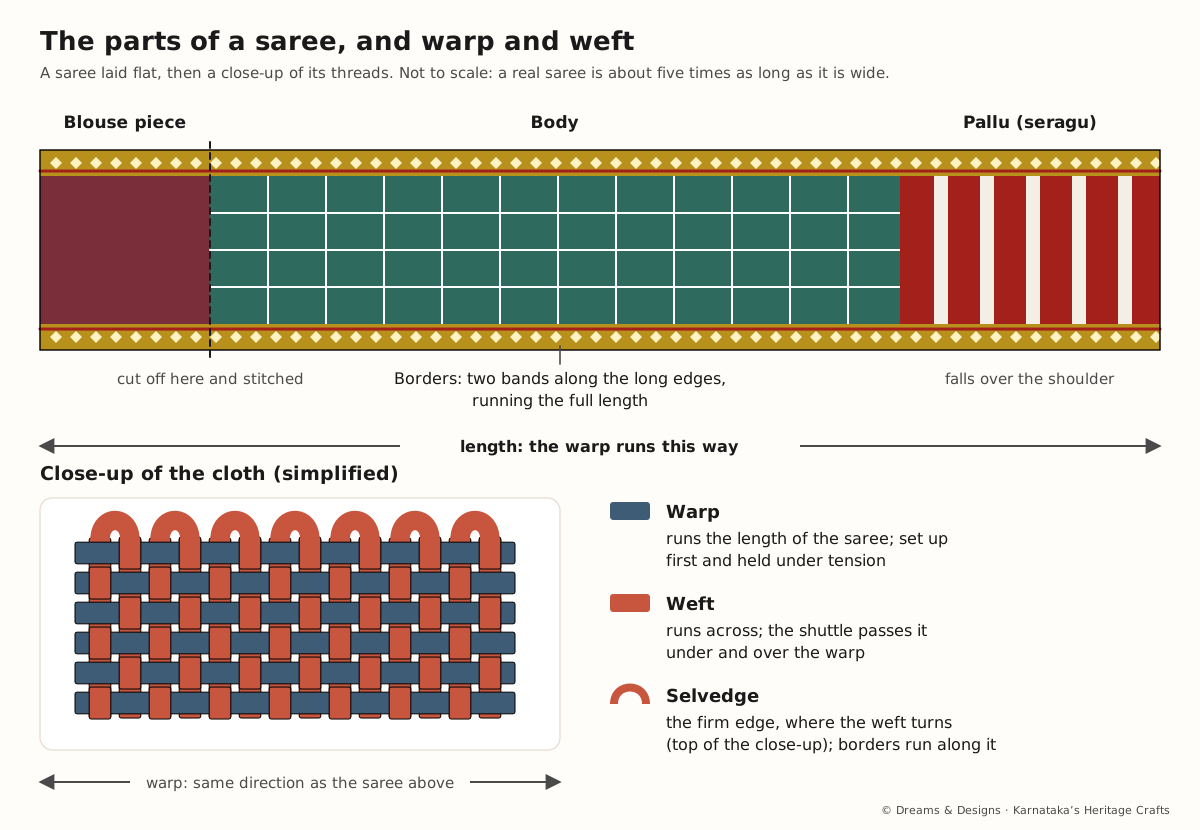
- The parts of a saree: body, border, pallu and blouse piece.
- The main loom types you will see in Karnataka.
- How a weaver makes a border and pallu in a different colour from the body.
Warp and weft
All woven cloth is two sets of threads crossing at right angles.
- The warp runs the length of the saree. It is set up on the loom first and held under tension.
- The weft runs across. The weaver passes it from side to side with a shuttle, under and over the warp.
A handloom is worked entirely by the weaver’s hands and feet: the feet lift sets of warp threads, the hands throw the shuttle and beat the weft into place. A powerloom does the same with a motor. The difference matters because handloom cloth has small, natural irregularities and a softer feel, and it supports the weaver’s family directly.
The parts of a saree
- Body – the main length, plain, checked, striped or with small motifs.
- Borders – two bands along the long edges, often in a contrast colour and a richer yarn.
- Pallu (also seragu in Kannada) – the decorated end that falls over the shoulder.
- Blouse piece – on many modern sarees, a length woven at the other end to be cut off and stitched.
Loom types in Karnataka
- Pit loom – the weaver sits at ground level with the treadles in a pit. Common in older weaving towns in the north.
- Frame loom – a raised wooden or metal frame, easier to move and to set up for wider cloth.
- Jacquard attachment – a set of punched cards above the loom that lifts individual warp threads, so the weaver can make complex motifs. It is still a handloom if worked by hand and foot.
- Dobby – a simpler device for small repeating patterns.
Contrast borders and pallus
To put a red border on a black body, weavers use different methods. The border colour can be set in the warp at the edges; the pallu can be woven with a different weft; and in some towns the pallu is woven separately and joined in, as in Ilkal’s kondi join (next lesson). Each town’s method is part of what makes its saree recognisable.
In more depth: from yarn to saree
- Yarn is bought as hanks of cotton, silk or art silk, and zari for metallic work.
- Dyeing – the hanks are dyed, often in the weaving town itself.
- Winding – the yarn is wound onto bobbins and pirns (small spools for the shuttle).
- Warping – hundreds or thousands of warp threads are measured to the same length and laid side by side.
- Sizing – the warp is stiffened with a starch paste so it does not break.
- Drafting and denting – each warp thread is passed through the heddles and the reed, one by one. For a new design this can take days.
- Weaving – the weaver works the treadles, shuttle and beater.
- Finishing – the saree is cut from the loom, checked, folded and sometimes pressed.
Many of these steps are done by other family members, often women. A saree is the work of a household, not one person.
Words you will hear
- Count – the fineness of yarn. A higher count is a finer thread.
- Extra weft – an additional weft thread laid in only where a motif is wanted.
- Selvedge – the firm edge of the cloth, where the weft turns.
- Zari – metallic thread. Pure zari is silver wire, gilded with gold, wound on silk; tested zari uses copper coated with silver; imitation zari is metallised plastic film. Exact standards vary; ask the seller which kind it is.
Tips for learners and teachers
- Find the warp. On any saree, the warp runs along the borders. Pull gently lengthwise and crosswise – the warp usually has less give.
- Look at the selvedge. Handloom selvedges are usually firm but slightly uneven; powerloom selvedges are very straight.
- Turn the border over. Extra-weft motifs show floats (loose threads) on the back. A printed border shows nothing.
- Use a simple magnifier. Counting threads per centimetre is a good habit for buyers and tailors.
- For teachers: a simple cardboard loom with a few warp threads explains weaving better than any picture.
Common misunderstandings
“A jacquard saree is machine-made.”
Not necessarily. A jacquard is a device that can sit on a handloom. Ask whether the loom is hand- or power-driven.
“Handloom is always cotton.”
No. Handlooms weave cotton, silk, art silk, blends and zari.
“Small irregularities are faults.”
Slight variations in weave are a normal sign of handwork. Holes, broken warp threads and big colour bands are faults.
For earning and teaching
For earning: a tailor who can find the warp, the selvedge and the border structure cuts handloom correctly the first time. That saves a customer’s saree.
For teaching: start any saree or textile class with warp and weft. Everything else builds on it.
Sources and uncertain points
- General weaving knowledge; methods vary from town to town and even loom to loom.
- The Kannada word seragu for pallu is common; local words differ.
- For fibres and burn tests, see our course Know Your Fabrics.
Check yourself
- Can you say which way the warp runs on a saree?
- Can you name the four parts of a saree?
- Do you know the difference between a handloom and a powerloom?
- Can you explain what a jacquard does?
- Can you name one way a weaver makes a pallu in a different colour?