The lengths decide where the blouse shapes itself to you: where the bust darts point, where the shoulder seam sits, and where the blouse ends. Lengths are easy to take, and easy to take from the wrong starting point. This lesson fixes that.
The numbers in brackets match the 14-point diagram in the previous lesson, The measurements that go all the way round.
What you’ll learn
- Where each length starts and ends.
- The difference between the shoulder and the shoulder point.
- Why shoulder to apex matters as much as the bust.
- The common mistakes, and how to avoid them.
The six lengths
The arrows in the diagram are lengths. Start each one at the shoulder: the point where the shoulder meets the neck, unless it says shoulder point (the outer edge of the shoulder).
- Apex to apex (4) – straight across between the two bust points.
- Shoulder to apex (5) – from the neck end of the shoulder down to the bust point.
- Front length (6) – from the same shoulder spot, over the bust, down to the waist.
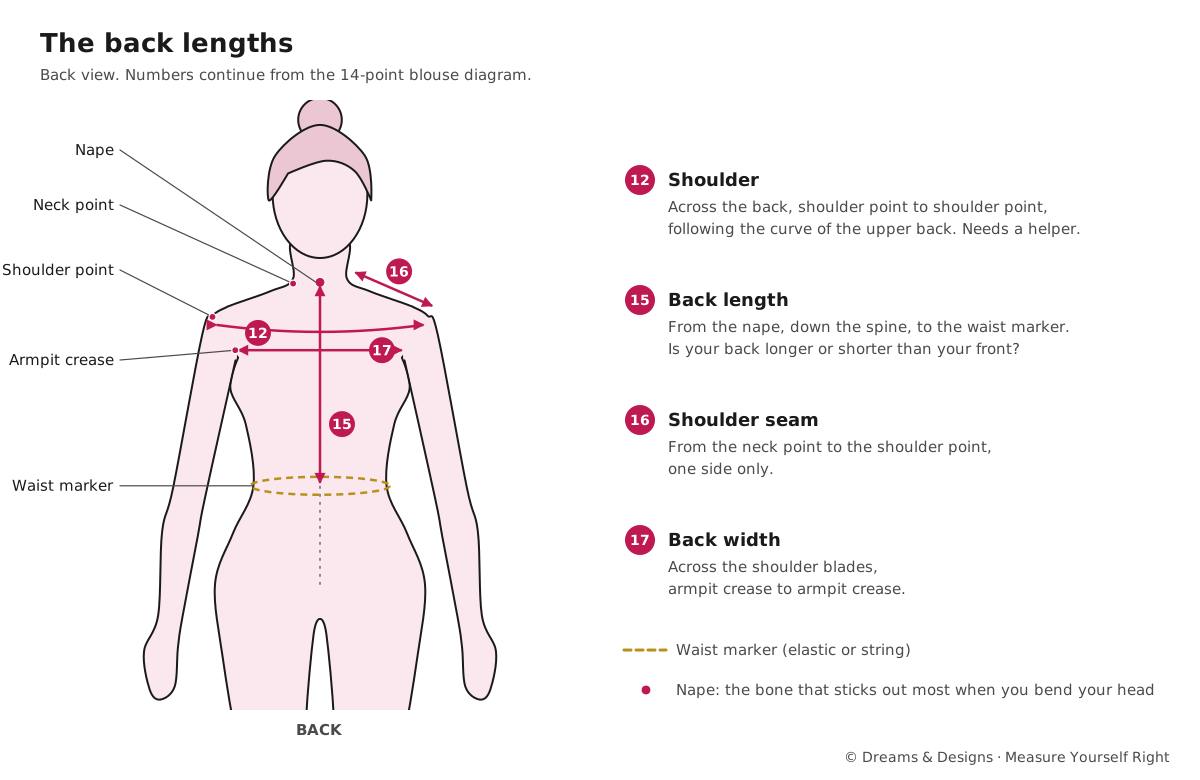
- Shoulder (12) – across the back, from one shoulder point to the other.
- Blouse length (14) – from the shoulder down to where you want the blouse to end.
- Sleeve length (9) – from the shoulder point down to where the sleeve should end, with the arm hanging straight.
Common mistakes: measuring over a thick top; letting the tape twist; measuring the bust over a different bra; and holding the breath. Take each one twice – if the two numbers differ, take it a third time.
How to take them well
- Apex to apex: in the bra you’ll wear. Straight across, not following the dip between.
- Shoulder to apex: start at the neck point, run straight down to the apex. This places the bust darts. A blouse whose darts point above or below the bust never looks right, however good the bust round is.
- Front length: from the neck point, over the apex, to the waist marker. Let the tape follow the bust; don’t cut across under it.
- Shoulder: across the back, shoulder point to shoulder point, following the curve of the upper back. A helper is needed.
- Blouse length: usually measured at the front or the side; say which. Saree blouses often end at or just above the natural waist; ask yourself how much midriff you want to show, and say so.
- Sleeve length: for short sleeves, to where you want them; for long sleeves, to the wrist bone with the arm hanging straight. For three-quarter sleeves, just below the elbow.
Useful extra lengths
Many tailors take one or two more lengths. They help most on bodies whose front and back differ.
- Back length: from the nape down the spine to the waist marker. Tells the tailor if the back is longer or shorter than the front.
- Side length: from under the armpit straight down to the waist.
- Shoulder seam: from the neck point to the shoulder point, one side only.
- Back width: across the shoulder blades, armpit crease to armpit crease (see previous lesson).
- Elbow round: for fitted three-quarter or full sleeves.
The same lengths on different bodies
- Petite: lengths are shorter, and small errors matter more. A ½ in error in shoulder to apex on a petite figure is very visible.
- Tall: check the blouse length carefully against the saree or lehenga you’ll wear, so the midriff gap is what you want.
- Fuller bust: the front length is much longer than the back length. Give both; the tailor balances them.
- Rounded upper back or forward shoulders (common with age and desk work): the back length is longer and the front shorter. Give both, and the shoulder seam.
- Sloping or square shoulders: say so; the shoulder seam angle changes, not just the length.
- One shoulder lower: measure both shoulder to apex and both front lengths.
- Seated wearers: measure blouse and sleeve length seated, in the position you usually sit.
- Nursing: apex positions change; measure close to when you’ll wear the blouse.
Tips, tricks and hacks
- Dot the apex with a sticker on your top before measuring 4, 5 and 6.
- Use a thin chain round the neck: the neck point is where it touches the side of the neck.
- Measure the shoulder following the body, not as a straight line through the air.
- Sleeve length with a slight bend for full sleeves you’ll move in; with the arm straight for a fitted look. Say which.
- Front and back neck points must be the same for every length that starts at the shoulder.
- Blouse length test: wear the saree petticoat or lehenga skirt, and measure the blouse length to where you want it to end.
- Write “front” or “side” next to the blouse length.
- Measure apex to apex in a straight line, holding the tape slightly away from the body between the points.
- Check shoulder to apex on both sides. They often differ slightly.
- Keep the head level while the shoulder is measured; tilting changes it.
Problems and how to fix them
The darts in my last blouse pointed above my bust.
- Your shoulder to apex was probably too short. Re-measure from the neck point, in the bra you’ll wear.
- Check the apex was the fullest point, not the top of the bust.
- Prevention: dot the apex before measuring.
The blouse is short at the front and fine at the back.
- The front length needs to follow over the bust; measure again.
- Give a back length as well, so the tailor sees the difference.
- Prevention: on a fuller bust, always give both lengths.
The shoulder seams fall off my shoulders.
- The shoulder measurement was too wide. Re-measure point to point, with the shoulder points dotted.
- Measure a blouse whose shoulders fit, laid flat.
- Prevention: find the shoulder point with the arm-lift test.
The sleeves are too short when I lift my arms.
- Add a little to the sleeve length for movement, or choose a slightly bent arm when measuring.
- Check the armhole isn’t too tight, which pulls the sleeve up.
- Prevention: say how you use your arms (dancing, cooking, carrying a baby).
My two shoulder-to-apex readings differ.
- Give both, marked left and right.
- Check the bra straps are adjusted evenly.
- Prevention: adjust straps before measuring.
The blouse length shows more midriff than I wanted.
- Measure the length with the petticoat on, at the height you’ll tie it.
- Ask for a little extra length at the hem; it can be taken up.
- Prevention: say how much gap you want, in inches.
The tape twists over the bust.
- Hold it at the neck point and at the apex, and let it fall.
- Use a fibreglass tape; it lies flatter.
- Prevention: measure in a thin, smooth top.
Beginner mistakes and myths
- Starting at the shoulder point for lengths that start at the neck point.
- “Blouse length is the same for everyone.” It’s a style choice, and depends on height and what you wear it with.
- Measuring the shoulder across the front. It’s across the back.
- “Shoulder to apex doesn’t matter if the bust is right.” It decides where the shaping goes.
Practice drills
- Six lengths, twice, on yourself with a helper.
- Front against back: take front length and back length. How different are they?
- Shoulder on a blouse: measure the shoulder on a blouse that fits, and compare with your body measurement.
As a hobby, for earning, for teaching
As a hobby: shoulder to apex and front length are the measurements that make a home-sewn blouse look professional.
For earning: keep both front and back lengths on every client’s card. Returning clients with changed posture are easy to spot.
For teaching: show a blouse with darts too high and one with darts right. Learners see at once why shoulder to apex matters.
Lengths for other tops
- Crop tops and cholis: the same lengths; the blouse length is shorter, so the under-bust round matters more.
- Princess-cut blouses: shoulder to apex, apex to apex and front length are essential; the panels pass through the apex.
- Katori blouses: the cups are shaped round the bust; give under-bust and shoulder to apex very carefully.
- Men’s and boys’ tops: no apex; the key lengths are shoulder, back length, sleeve and garment length (Module 4).
- Girls’ blouses: for pavade and lehenga blouses, shoulder, blouse length and sleeve are often enough until the bust develops (Module 5).
Quick quiz (with answers)
- Where does a length from “the shoulder” start? At the neck point, where the shoulder meets the neck.
- What does shoulder to apex control? Where the bust darts point.
- How is the shoulder (12) measured? Across the back, from shoulder point to shoulder point.
- Why give a back length too? On fuller busts and rounded backs, front and back lengths differ.
Check yourself
- Did each length start at the right point: neck point or shoulder point?
- Was the apex dotted, in the bra you’ll wear?
- Did you say where the blouse length was measured?
- Did you take each length twice?
Key terms
- Apex to apex: the distance between the bust points.
- Shoulder to apex: from the neck point to the bust point.
- Front length: from the neck point over the bust to the waist.
- Back length: from the nape to the waist.
- Dart: a stitched fold that shapes cloth to the bust or waist.
Sources and uncertain points
- The six lengths and their numbers are from the first version of this course and its diagram.
- Some tailors measure blouse length from the shoulder point, or from the nape at the back. Teacher to check the studio’s method.
- The extra lengths are optional additions; teacher to check which the studio uses.