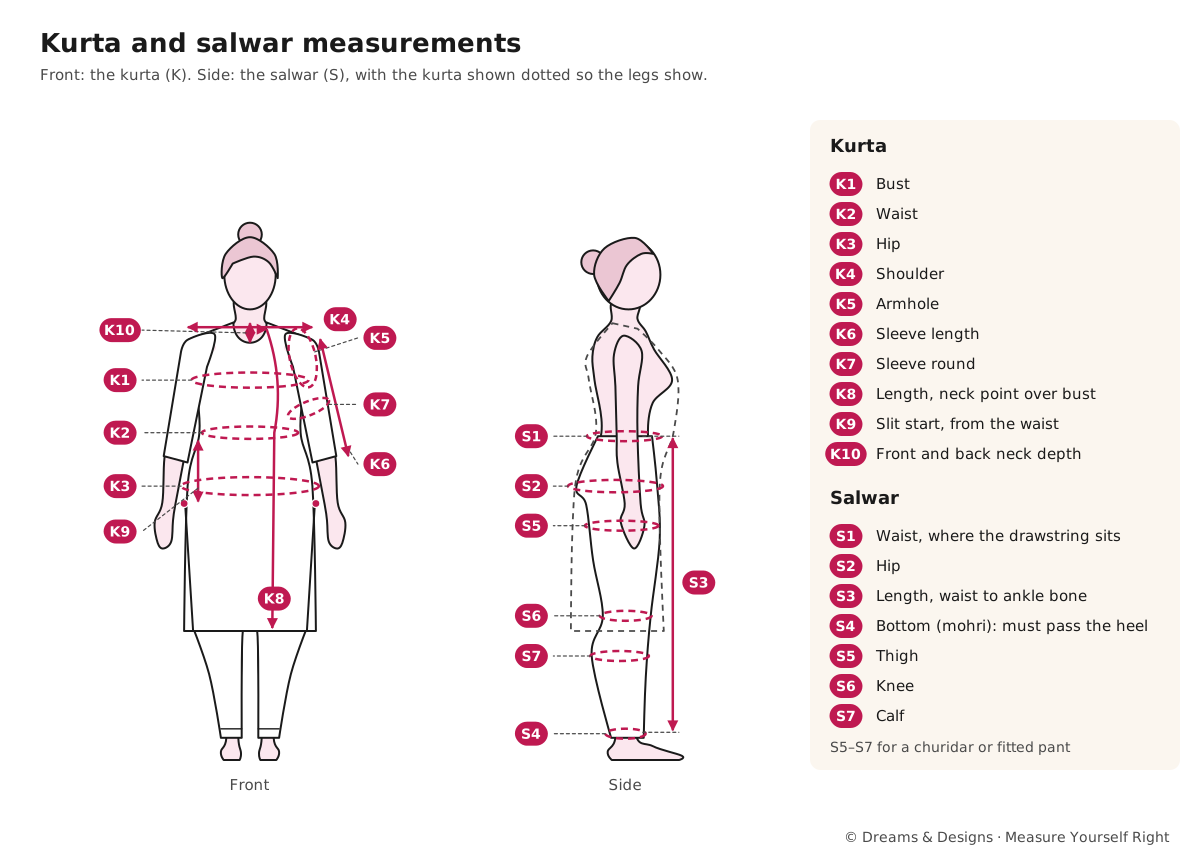
A kurta uses most of the blouse measurements, plus the hip and the length. A salwar adds a few lower-body numbers. This lesson gives the full list for a women’s kurta, salwar and churidar, and shows where each one goes. Men’s kurtas are in Module 4.
What you’ll learn
- The measurements for a kurta, and which ones are new.
- The measurements for a salwar, churidar and straight pant.
- How to measure the hip and where it sits.
- How to choose kurta length and slit height.
Kurta: the measurements
From the blouse list (Module 2), you need: bust, waist, shoulder, armhole, sleeve length, sleeve round, sleeve end round, front neck depth and back neck depth. A kurta adds:
- Hip: round the fullest part of the hips and seat, tape level. A straight or fitted kurta must pass over the hip without pulling.
- Waist to hip: the length from the waist marker down to the hip line, at the side. It tells the tailor where to place the hip width.
- Kurta length: from the neck point at the front, over the bust, to where you want the kurta to end. Short kurtis end at the hip; long kurtas at the knee or below; anarkalis can reach the ankle.
- Slit: where the side slit should start, measured from the waist down (or from the hem up; say which). A slit that starts at or just below the hip line lets you walk and sit easily.
- Collar or neck round (for a mandarin or band collar): round the base of the neck, with one finger under the tape.
Salwar and churidar: the measurements
- Waist: where the drawstring or elastic will sit. Often at or a little below the natural waist.
- Hip: as for the kurta.
- Length: from that waist line down the side of the leg to the ankle bone, barefoot. For a churidar, the tailor adds extra length for the gathers at the ankle: give the true leg length and say “churidar”.
- Bottom (mohri): round the ankle or foot where the hem will sit. It must pass over the heel: measure round the heel and instep with the foot pointed, and give both.
- For a churidar or fitted pant, also: thigh (fullest part, near the top), knee, calf (fullest part) and ankle.
- Crotch depth (seated, waist to chair): for fitted styles. See the next lesson.
A Patiala or very full salwar needs only waist, hip, length and bottom; the fullness is part of the cut.
Kurta styles and what changes
| Style | Most important numbers |
|---|---|
| Straight kurta | Bust, hip, length, slit |
| A-line kurta | Bust, waist, length; hip only for the slit area |
| Anarkali | Bust, under-bust or waist (where the flare starts), length |
| Princess-cut / fitted kurta | Bust, waist, hip, shoulder to apex, waist to hip |
| Short kurti | Bust, hip, length |
| Kaftan or loose kurta | Shoulder, length, hip (for the minimum width) |
For the anarkali, measure where the flare should start: from the neck point down to the under-bust or the waist.
On different bodies
- Fuller hips than bust (pear-shaped): the hip decides the width at the bottom; the bust decides the top. Give both; the tailor grades between them.
- Fuller bust than hips: the bust decides; an A-line or flared shape balances the fall.
- Straight figures: waist and hip close together; a straight kurta needs only small shaping.
- Petite: kurta length and slit height matter most. A knee-length kurta on a petite frame may need to stop above the knee to look in proportion; it is a choice.
- Tall: check the salwar length against footwear, and the sleeve length.
- Plus-size: the hip and the tummy round may both matter. If the fullest part is the tummy rather than the hip, give it as a separate “tummy” round.
- Pregnancy: elastic or drawstring waists, and an extra tummy round taken every few weeks (Module 6).
- Seated wearers: measure kurta length and slit height seated; slits at the side help a kurta lie flat on the lap.
Tips, tricks and hacks
- Measure kurta length with the footwear on if it is long, so it ends where you want when you are standing in it.
- Dot the hip line with a sticker at the side; measure waist to hip to the dot.
- Slit and pocket: if you want side-seam pockets, say so; the slit then starts below them.
- Bottom (mohri) check: slip your foot through a loop of tape at the size you plan. If it won’t pass the heel, it’s too small.
- Churidar gathers: say how many rings of gathers you like (few or many); it changes the extra length.
- Salwar waist: measure where you’ll actually tie it, which may not be the natural waist.
- Elastic or drawstring? Give the waist either way; the tailor works out the elastic.
- Use a kurta that fits (Module 6, Measuring other garments that fit) to check your numbers.
- Write the slit as “from waist” or “from hem”; both are used.
- Sleeve length on a kurta is often a little longer than on a blouse; measure for the style.
Problems and how to fix them
The kurta pulls across the hips when I sit.
- The hip round was taken too high or too tight; re-measure at the fullest part, seen from the side.
- Start the slits higher, at or just below the hip line.
- Prevention: give the waist-to-hip length so the width sits in the right place.
The salwar won’t go over my foot.
- The bottom is too small; give the heel-and-instep round as well as the ankle.
- Ask for a small slit or zip at the ankle.
- Prevention: test with a loop of tape before ordering.
The churidar bunches above the knee.
- The thigh or knee measurement was too small, so the fabric is pulling up. Re-measure.
- Ask the tailor to cut it on the bias (a diagonal grain), as churidars traditionally are.
- Prevention: give thigh, knee, calf and ankle for every churidar.
The kurta is shorter than I expected.
- Check where the length was measured from: neck point at the front, over the bust.
- Ask for a deeper hem allowance next time.
- Prevention: measure against a kurta you like.
The anarkali flare starts too low.
- Give the flare start length: neck point to under-bust or waist.
- Choose a style with a defined waist seam.
- Prevention: point to where you want it in the mirror and measure to that point.
The slit shows more than I want.
- Lower the slit start.
- Ask for a small overlap or a hidden press stud.
- Prevention: test the height by sitting and walking.
The salwar waist is too loose with elastic.
- Give the real waist; the tailor sizes the elastic.
- Ask for a drawstring and elastic together.
- Prevention: don’t add ease to waist numbers yourself.
Beginner mistakes and myths
- Taking the hip at the hip bones instead of the fullest part.
- Forgetting the heel when giving the bottom.
- “Churidar length is my leg length.” It is, but the tailor adds extra for the gathers. Don’t add it twice.
- “A loose kurta needs no measurements.” It still needs shoulder, length and the minimum hip width.
Practice drills
- Full kurta set: take every kurta measurement, then check against a kurta you own.
- Salwar set: take waist, hip, length, bottom and heel round.
- Churidar extra: add thigh, knee, calf and ankle, on both legs.
As a hobby, for earning, for teaching
As a hobby: a straight kurta is one of the best first garments to sew; these numbers are all you need.
For earning: kurta-salwar sets are everyday orders. A clear card with slit height and bottom saves fitting time.
For teaching: teach the hip line from the side, using the mirror; it is the most often wrong.
Kurtas for men and children
- Men’s kurtas use the shirt measurements plus length and slit (Module 4, Men’s trousers and kurtas).
- Children’s kurtas need chest, shoulder, sleeve, length and hip; add growth room in the hem and side seams (Module 5).
- Unisex kurtas are usually cut on a men’s block; anyone may wear one. Women may want to add bust and shoulder to apex for a better fit.
Quick quiz (with answers)
- Which measurement places the hip width in a kurta? Waist to hip, at the side.
- What must a salwar bottom pass over? The heel and instep, foot pointed.
- Which extra rounds does a churidar need? Thigh, knee, calf and ankle.
- Where should a kurta slit usually start? At or just below the hip line, so you can sit and walk.
For readers abroad
Dressmakers abroad may call a kurta a tunic and a churidar a fitted legging. The measurements are the same. Give the slit height and the salwar bottom clearly; these are often new to them.
Check yourself
- Did you measure the hip at the fullest part, seen from the side?
- Did you give waist to hip?
- Did you say where the slit should start, and from where?
- Will the salwar bottom pass over your heel?
Key terms
- Mohri (bottom): the opening at the ankle of a salwar or pant.
- Churidar: a close-fitting pant, cut long so it gathers at the ankle.
- Anarkali: a kurta fitted to the under-bust or waist, flaring below.
- Slit: the side opening at the hem of a kurta.
- Kali: a flared panel used in anarkalis and some kurtas.
Sources and uncertain points
- General tailoring practice in India.
- Whether slit height is given from the waist or the hem differs between tailors. Teacher to check the studio’s card.
- Churidars are traditionally cut on the bias; some modern ones use stretch fabric on the straight grain.