When a garment doesn’t fit, the cause is often one measurement. Wrinkles and gaps point to it like arrows. This lesson is a master list: what you see, which measurement is usually behind it, how to fix the garment, and how to measure next time so it doesn’t happen again.
What you’ll learn
- How to read wrinkles: which way they point, and why.
- The most common faults for each garment.
- The measurement behind each fault.
- Fixes for now, and prevention for next time.
How to read wrinkles
- Pull lines (tight): diagonal or horizontal lines stretched across the body point towards where there is too little room.
- Folds (loose): soft, hanging folds show where there is too much fabric, often too much length.
- Gaps: an edge standing away from the body (a neckline, armhole or waistband) usually means it’s too long for the body there.
- Riding: a garment that moves up or round when you move is short of room somewhere else.
Look in the mirror, front, side and back, standing and seated. Ask someone to photograph the back.
The master list: the most common
| You see | Check this measurement |
|---|---|
| Blouse pulls across the bust | Bust; apex to apex |
| Darts point above or below the bust | Shoulder to apex |
| Armhole cuts in or gapes | Armhole |
| Shoulder seams slip off | Shoulder; neck width |
| Kurta pulls at the hips | Hip; waist to hip; slit height |
| Trousers pull down at the back when seated | Crotch depth (seated); crotch length |
| Folds under the seat | Back rise; seat |
| Shirt buttons pull | Chest; stomach |
| Collar too tight | Neck |
| Hem uneven | Front and back lengths |
Most faults come from four places: a round taken too tight, a length taken from the wrong start point, a missing measurement (the back length, the seated rise, the stomach), or a body that has changed since the card was written. When a garment doesn’t fit, check those four before anything else. Then fix the garment, and fix the card, so the next one is right.
Use the table as a first guide. The folded sections below give each fault in full: the usual cause, several fixes, and how to prevent it next time.
Blouses and cholis
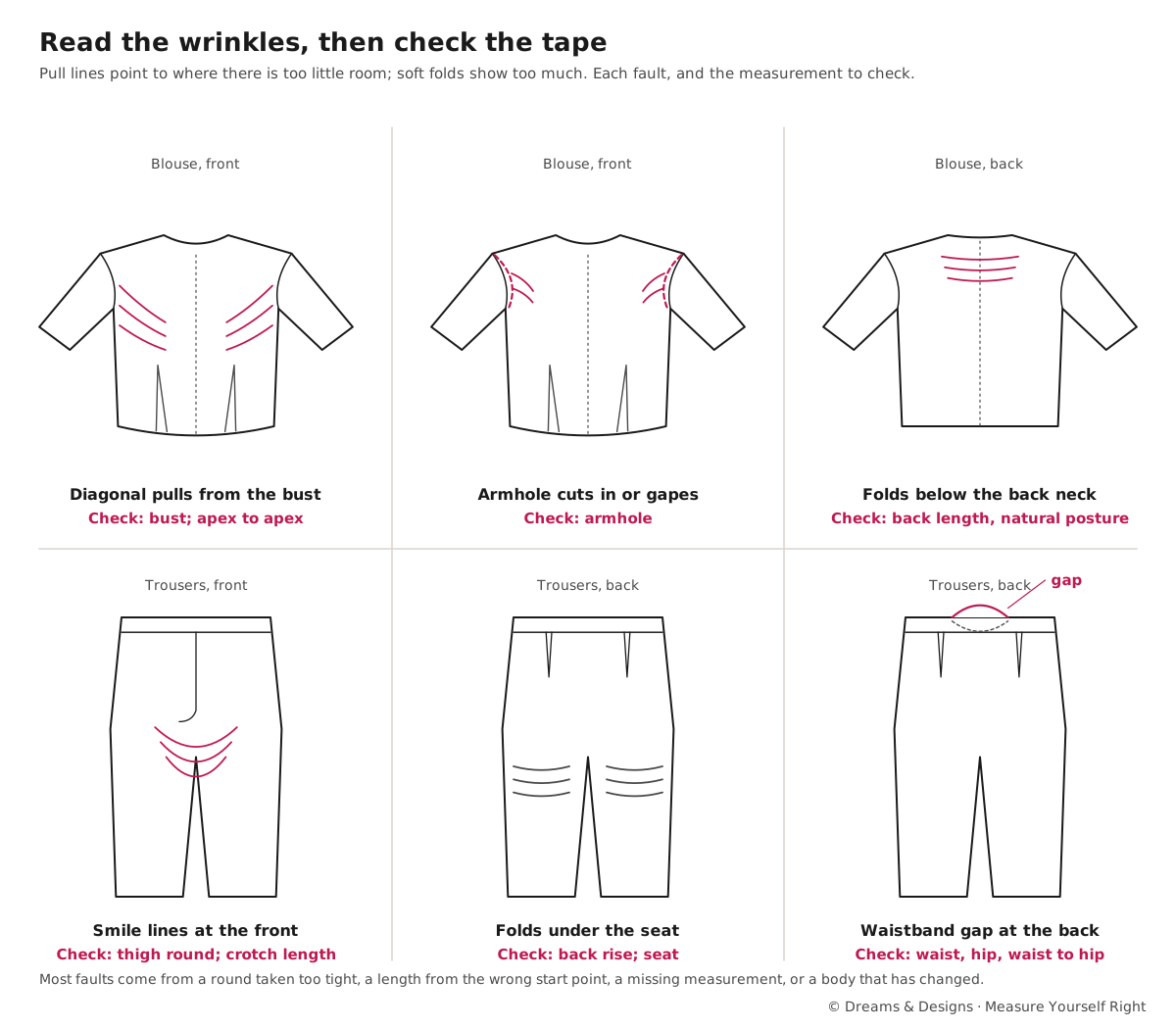
Diagonal pulls from the bust to the side seams
- Cause: bust too small, or apex to apex too narrow.
- Fixes: let out the side seams; move the darts apart; add a side panel.
- Prevention: measure the bust in the right bra; give apex to apex.
Horizontal folds above the bust
- Cause: shoulder to apex too long, or shoulders sloping.
- Fixes: take in at the shoulder seam; raise the darts.
- Prevention: dot the apex; say if your shoulders slope.
The blouse rides up when you lift your arms
- Cause: armhole too low and tight, or sleeve round too small.
- Fixes: add an underarm gusset; re-set the sleeve.
- Prevention: measure the armhole close under the arm, and the bicep relaxed.
Gap at the front neckline
- Cause: neck too wide or too deep for the shape; or a hollow chest.
- Fixes: a small dart or tuck at the neckline; a narrow facing.
- Prevention: give neck width and depth with their start points.
Kurtas, salwars and lehengas
Kurta pulls across the hips
- Cause: hip too small, or placed too high.
- Fixes: let out the side seams; raise the slits.
- Prevention: hip from the side at the fullest; waist to hip.
Kurta flares out at the back hem
- Cause: fuller seat lifting the back; back length too short.
- Fixes: let down the back hem; add back length.
- Prevention: front and back lengths.
Churidar bunches at the thigh
- Cause: thigh too tight, so it rides up.
- Fixes: let out the inner leg seam.
- Prevention: give thigh, knee and calf.
Lehenga skirt slips down
- Cause: waist too loose, or measured at the wrong height.
- Fixes: take in the waistband; add hooks or a drawstring.
- Prevention: measure where it will sit, and say how heavy it is.
Trousers
Pulls down at the back when seated
- Cause: back rise too short.
- Fixes: let out the back seam, if allowance exists; add a contoured waistband.
- Prevention: crotch depth seated on a hard chair.
Smile lines at the front crotch
- Cause: thigh or front rise too tight.
- Fixes: let out the inner leg; lower the crotch slightly.
- Prevention: thigh round and crotch length.
Folds under the seat
- Cause: too much length in the back rise, or a flatter seat.
- Fixes: take a wedge out of the back below the waistband.
- Prevention: send trousers that fit at the back.
Gap at the back waist
- Cause: waist much smaller than seat.
- Fixes: contoured waistband; bigger back darts.
- Prevention: waist, hip and waist to hip.
Shirts and jackets
Buttons pull open
- Cause: chest or stomach too small.
- Fixes: move the buttons; let out side seams.
- Prevention: chest and stomach separately, on a relaxed breath.
Collar too tight
- Cause: neck measured too tight.
- Fixes: move the collar button.
- Prevention: one finger under the tape.
A ridge below the collar at the back
- Cause: posture (rounded back) or too-long back.
- Fixes: lift the collar at the back seam.
- Prevention: back length, measured in natural posture.
Sleeves twist
- Cause: sleeves set at the wrong angle for how the arms hang.
- Fixes: re-set the sleeves.
- Prevention: note if your arms hang forward.
Children’s garments
Too tight across the chest after a month
- Cause: growth; or chest taken snug instead of loose.
- Fixes: let out the side seams.
- Prevention: measure close to sewing; build in seam allowance.
Head won’t pass through
- Cause: neck opening sized to the neck, not the head.
- Fixes: add a back opening.
- Prevention: head round on the card.
Tips, tricks and hacks
- Photograph the fault from the front, side and back, and send it with your measurements.
- Pinch out loose folds with pins to see how much to take in.
- Follow the pull lines with a finger: they end where room is missing.
- Check seated and moving, not just standing.
- One fault at a time: fixing the shoulder often fixes the neckline too.
- Keep a fault diary per client or per garment type.
- Re-measure before blaming the tailor; bodies change.
- Bring the faulty garment to the next order: it is a map of what to change.
- Look at the fabric: some faults are stretch or grain, not measurement.
- Ask the tailor to explain the fix; you’ll measure better next time.
Beginner mistakes and myths
- “It’s too tight, so add width everywhere.” Fix the one place the pull points to.
- Blaming the body. The garment is the thing that needs to change.
- Checking fit standing only.
As a hobby, for earning, for teaching
As a hobby: learning to read wrinkles turns you from a sewist into a fitter.
For earning: a calm, clear diagnosis at fittings builds trust; record the fix on the client’s card.
For teaching: make deliberately faulty samples and have learners diagnose them.
Practice drills
- Read a wrinkle: put on a garment that doesn’t fit well. Follow the pull lines with a finger. Where do they end?
- Find the measurement: for each fault, name the measurement you would check.
- Re-measure and compare: re-take that measurement and compare with the card the garment was made from.
- Write the fix: add a note to your card so the next garment avoids it.
Fit issues by wearer
- Women: most faults are at the bust (darts, apex) and the back waist of trousers.
- Men: most faults are at the stomach, the collar and the shoulder.
- Children: most faults are growth: too short, too tight at the chest, or a neck that won’t pass the head.
- Seated wearers: bunching at the lap and pulling at the back waist.
- Older wearers: hems that rise at the back and necklines that gape with posture.
Quick quiz (with answers)
- What do pull lines show? Where there is too little room; they point towards it.
- What do loose folds show? Too much fabric, often too much length.
- Darts point above the bust: which measurement? Shoulder to apex.
- Trousers pull down at the back when seated: which measurement? Crotch depth (seated) and crotch length.
Fixing the card, not just the garment
- Write the fault and the fix on the card: “darts 1 in high – shoulder to apex now 10½ in”.
- Change the number that caused the fault, and date it.
- Keep the old number crossed through, not erased, so you can see the change.
- Add the missing measurement if the fault came from one you didn’t take.
- Tell the tailor before the next order: “last blouse pulled at the armhole; armhole now …”.
For readers abroad
Many sewing books abroad call this skill “fitting” or “pattern alteration”, and show the same wrinkles with names like “drag lines” and “smile lines”. The measurement behind each is the same as in this lesson.
Check yourself
- Can you tell a pull line from a loose fold?
- Can you name the measurement behind three common faults?
- Did you check fit seated and moving?
- Did you write the fix on the card for next time?
Key terms
- Pull line: a stretched wrinkle showing missing room.
- Fold: a loose wrinkle showing extra fabric.
- Gusset: a small inserted piece adding room, often under the arm.
- Contoured waistband: a curved band, higher at the back.
Sources and uncertain points
- General fitting practice. Many faults have more than one cause; the list gives the usual one.
- Teacher to check: the fixes the studio prefers.