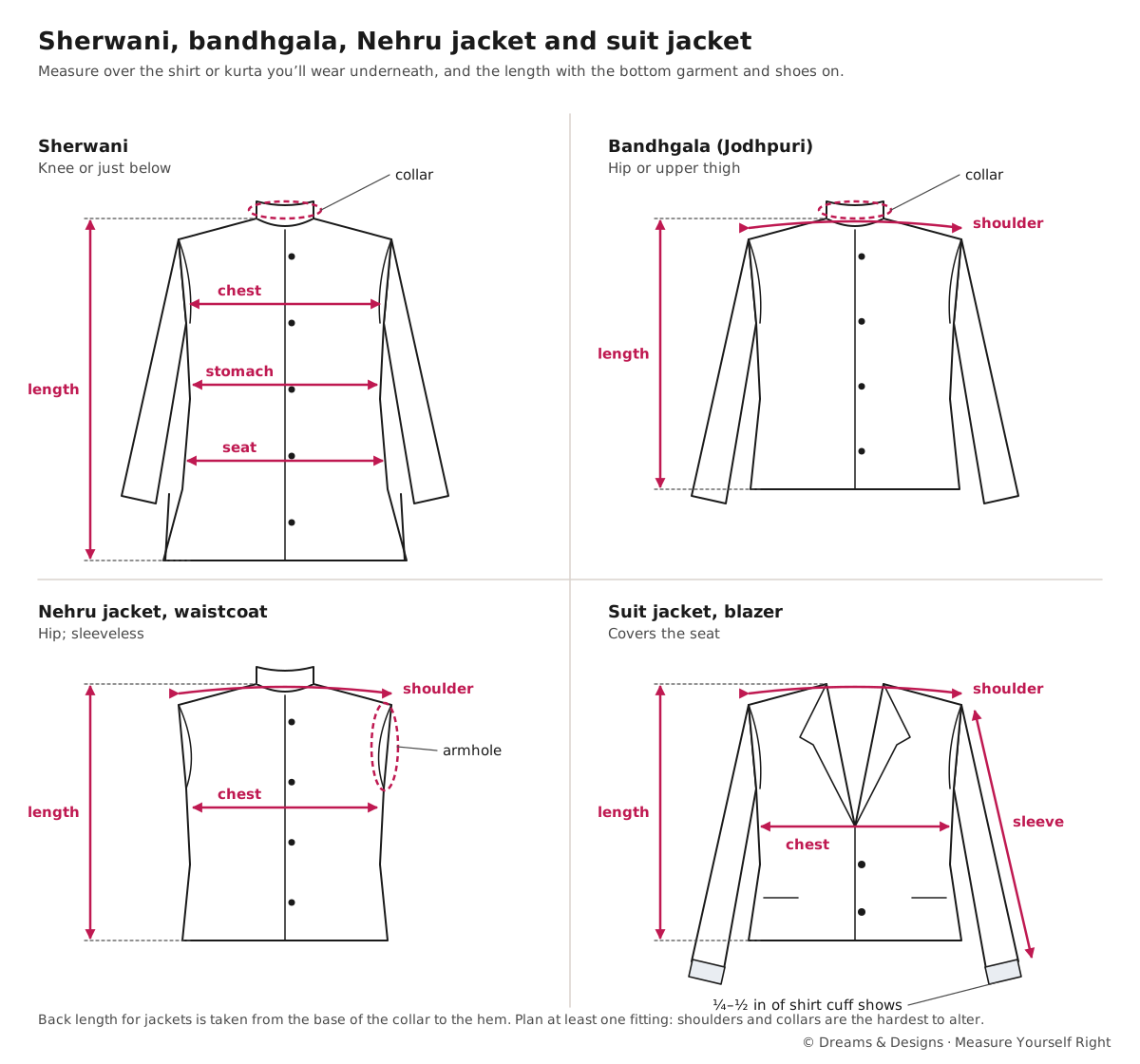
Jackets are worn over other clothes, so they are measured a little differently: over the shirt or kurta you’ll wear beneath, with extra care at the shoulder and the collar. This lesson covers the sherwani, the bandhgala (Jodhpuri), the Nehru jacket and waistcoat, and the Western suit jacket and blazer.
What you’ll learn
- Why jackets are measured over the layers beneath.
- The measurement list for each style.
- How to measure the collar of a sherwani or bandhgala.
- The common jacket fit problems, and the measurement behind each.
Measure over the right layer
Wear the shirt or kurta you will wear under the jacket. Measure the chest, stomach and seat over it. Take the collar over the inner collar too, if it will sit on top. If you can’t wear the inner layer, give body measurements and tell the tailor what will go under.
The core jacket list
- Chest: fullest part, under the arms, over the inner layer.
- Stomach: fullest part of the belly.
- Seat: fullest part of the seat; needed for any jacket that reaches the hip or below.
- Shoulder: across the back, point to point.
- Back width: armpit crease to armpit crease.
- Sleeve length: from the shoulder point to where the sleeve should end. For a suit jacket, usually so about ¼–½ in (6–12 mm) of shirt cuff shows.
- Bicep and armhole.
- Jacket length: at the back, from the base of the collar to the hem.
- Collar (for standing collars): round the neck where the collar will sit, over the inner layer, one finger under the tape.
Style by style
| Style | Typical length | Extra care |
|---|---|---|
| Sherwani | Knee or just below | Seat, stomach, collar, slit height |
| Bandhgala (Jodhpuri) | Hip or upper thigh | Collar, shoulder |
| Nehru jacket, waistcoat | Hip | Chest, armhole (sleeveless) |
| Suit jacket, blazer | Covers the seat | Shoulder, sleeve, chest |
| Achkan | Knee or below | As sherwani |
For each, give the trouser, churidar or dhoti measurements too (previous lesson), and measure the length with the bottom garment and shoes on.
Jackets are the hardest garments to alter after cutting, especially at the shoulders and the collar. So take these measurements slowly, twice, and plan at least one fitting before the jacket is finished.
Collars and closures, in more depth
- Standing collars (sherwani, bandhgala, Nehru jacket) close at the throat. Too tight and it is unbearable for a day-long wedding; too loose and it stands away. Measure over the inner collar, one finger under the tape, and test by turning your head.
- Collar height: a style choice, typically 1–2 in (2.5–5 cm). A shorter neck may find a lower collar more comfortable.
- Front closure: buttons, hooks or hidden fastenings. Say if dressing quickly or with limited hand movement matters; magnetic or hook-and-loop closures can be hidden under decorative buttons.
- Waistcoats: the armhole is the only “sleeve”; take it carefully, and check the back length covers the trouser waistband.
On different bodies
- Broad shoulders and chest: the jacket must fit the shoulders first; everything else can be adjusted. Give back width.
- Fuller stomach: a single-breasted jacket with one or two buttons often sits better; give stomach so the buttons don’t pull.
- Sloping shoulders: say so; the tailor can add a little shoulder padding.
- Short: a jacket length that just covers the seat, and sherwanis at or just below the knee, keep proportions balanced; a choice.
- Tall: longer sleeves and jackets; check fabric quantities early.
- Older bodies: a rounded upper back needs extra back length; take front and back lengths.
- Seated wearers: shorter jacket backs and side vents sit better in a chair; measure length seated.
- Women’s jackets and blazers use the bust and shoulder-to-apex measurements (Module 2) with the same jacket list.
- Boys’ sherwanis need growth room (Module 5).
Tips, tricks and hacks
- Wear the inner layer every time you measure for a jacket.
- Hug test: at the fitting, cross your arms and reach forward. A jacket for a wedding must allow hugging.
- Sit test for sherwanis: sit on a low seat, as at a mandap.
- Pocket rule: don’t fill jacket pockets at the fitting; they distort the line.
- Cuff check: wear the shirt with the watch you’ll wear.
- Collar test: turn your head side to side and look down.
- Length check: stand with arms down; a suit jacket often ends near the knuckles, but posture and style vary.
- Measure a jacket that fits flat: shoulder, chest (armpit to armpit, doubled), sleeve, length.
- Layered outfits (kurta + Nehru jacket + shawl): measure each layer over the one below.
- Re-check before the event, two to four weeks ahead.
Problems and how to fix them
The collar is too tight by the evening.
- Ask for the collar hook to be moved out slightly.
- Re-measure over the inner collar, with one finger under the tape.
- Prevention: test the collar for an hour at the fitting.
The jacket pulls into an X at the button.
- Stomach or chest is too tight; give stomach separately.
- Move the button slightly, if the tailor advises it.
- Prevention: measure over the inner layer.
There is a ridge below the collar at the back.
- Often a posture or shoulder issue; give back length and say if you have a rounded upper back.
- The tailor can adjust at the collar seam.
- Prevention: measure in natural posture.
The sleeves hide the shirt cuff completely.
- Shorten the sleeve.
- Check the shirt sleeve isn’t too short instead.
- Prevention: measure jacket sleeves over the shirt you’ll wear.
The sherwani is tight when I sit.
- Raise the side slits.
- Give seat as well as chest.
- Prevention: sit-test at the fitting.
The shoulders are too wide and dent below the seam.
- Re-measure shoulder point to point.
- Reduce shoulder padding.
- Prevention: fit the shoulders first, always.
The waistcoat gapes at the armholes.
- The armhole is too large; re-measure.
- Ask the tailor to take in the side seams.
- Prevention: measure the armhole over the shirt, arm hanging.
Beginner mistakes and myths
- Measuring for a jacket in a vest instead of the shirt or kurta beneath.
- “Shoulders can be fixed later.” They are the hardest part of a jacket to alter.
- “A sherwani is just a long kurta.” It is structured and lined; it needs seat and collar measurements.
As a hobby, for earning, for teaching
As a hobby: a waistcoat or Nehru jacket is the easiest jacket to begin with; no sleeves to set.
For earning: grooms’ outfits are high-value work; a measurement plan with two fittings protects both sides.
For teaching: demonstrate the “hug test” and “sit test”; they teach why ease exists.
Practice drills
- Over and under: measure your chest over a vest, then over a shirt. Note the difference.
- Collar test: measure your neck over a shirt collar with one finger under the tape; turn your head and look down. Comfortable?
- Jacket that fits: lay it flat; measure shoulder, chest (×2), sleeve and back length.
- Length check: stand with arms down; where would you like a Nehru jacket, a bandhgala and a sherwani to end?
Care and storage
- Hang jackets on shaped hangers so the shoulders keep their form.
- Keep the measurement card with the outfit’s order papers; it helps with any later alterations.
- Before a second wedding season, try the sherwani on a month ahead; re-measure the chest and stomach if it feels different.
- Heavy embroidery adds weight to the shoulders; say so, so the tailor can support it.
Quick quiz (with answers)
- Why measure a jacket over the shirt or kurta? The jacket is worn over it, so the rounds must include it.
- What should be fitted first on any jacket? The shoulders.
- Which extra does a sherwani need beyond a bandhgala? Seat and slit height, because it is longer.
- How tight should a standing collar be? One finger under the tape, over the inner collar.
Women’s and children’s jackets
- Women’s blazers and jackets: the core list, with bust, shoulder to apex and front and back lengths from Module 2; waist and hip for fitted styles.
- Women’s sherwani-style and jacket-style kurtas: measured like a kurta, then the jacket ease added.
- Boys’ sherwanis and Nehru jackets: chest, shoulder, sleeve, length and collar, over the kurta; growth room in seams and hems; collar never tight (Module 5).
- Girls’ jackets and waistcoats over lehengas: chest, shoulder and length over the choli.
For readers abroad
A bespoke tailor abroad will know jacket measuring well. Show them a photo of the style and explain the standing collar. Many will treat a bandhgala like a closed-collar military-style jacket, and a Nehru jacket like a waistcoat with a band collar. For a sherwani, explain the length and the side slits.
Check yourself
- Did you measure over the inner layer?
- Did you take the collar with one finger under the tape?
- Did you give seat for long jackets?
- Did you plan a re-check before the event?
Key terms
- Sherwani: a long, structured coat, usually knee-length.
- Achkan: a long coat similar to the sherwani; names overlap.
- Bandhgala (Jodhpuri): a closed-neck jacket.
- Nehru jacket: a sleeveless, hip-length jacket with a standing collar.
- Vent: a slit at the back or sides of a jacket hem.
Sources and uncertain points
- General tailoring practice. The names sherwani, achkan and bandhgala overlap; regions and tailors use them differently.
- Shirt cuff showing ¼–½ in is a common Western tailoring convention; styles differ.
- Teacher to check: the studio’s jacket measurement list.