Men’s trousers use the same lower-body measurements as women’s, with two differences: where the waistband sits, and how much room the seat and stomach need. Men’s kurtas use the shirt measurements plus length and slit. This lesson covers both, with pyjamas, churidars and dhotis.
What you’ll learn
- The trouser measurements for men, and the order to take them.
- Where a man’s trouser waist sits, and why it matters.
- The kurta measurements, built from the shirt list.
- What a pyjama, churidar and dhoti need.
Men’s trousers
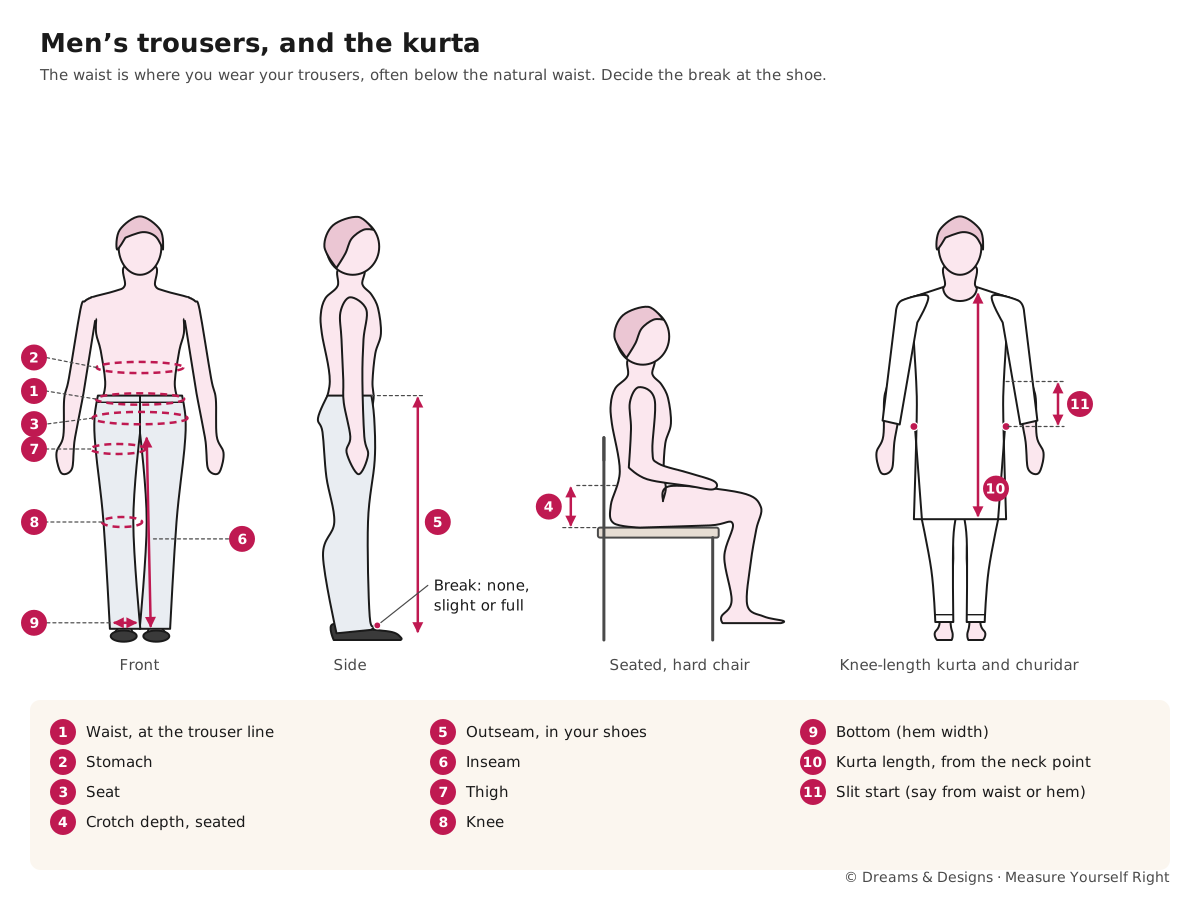
- Waist (trouser line): where you wear your trousers. For many men this is below the natural waist, at or under the navel. Tie a marker there.
- Stomach: round the fullest part of the belly, if it is above the trouser line. It tells the tailor how the front will sit.
- Seat: round the fullest part of the seat, tape level.
- Crotch depth: seated on a hard chair, from the waist marker straight down to the seat (Module 3, Trousers, palazzos and pants).
- Crotch length: front waist marker, between the legs, to the back waist marker. The person being measured holds the tape at the front.
- Outseam: waist marker to the hem, at the side, in the shoes you’ll wear.
- Inseam: crotch to hem, inside the leg; easiest from trousers that fit.
- Thigh: round the fullest part, near the crotch.
- Knee: round the knee.
- Bottom (hem width): round the trouser hem, a style choice: narrow for slim trousers, wider for formal or straight.
Break: decide how the hem meets the shoe: no break (just touching), slight break, or full break (resting in a fold). Say which.
Men’s kurtas
Start with the shirt list (Module 4, Men’s shirt measurements): neck, chest, stomach, seat, shoulder, sleeve length, bicep, wrist, armhole. Then add:
- Kurta length: at the front, from the neck point to where you want it: hip length (short kurta), mid-thigh, knee, or below the knee.
- Slit: where the side slit starts, from the waist or the hem (say which).
- Collar: neck round for a band collar; none for a round neck.
- Front opening (placket) length if you have a preference.
Pyjamas, churidars and dhotis
- Pyjama (straight): waist (drawstring line), seat, length to the ankle, bottom.
- Churidar: as above, plus thigh, knee, calf and ankle; the tailor adds length for the gathers.
- Dhoti and mundu (veshti): traditional draped dhotis and mundus are not stitched to size; they are sold by length. Ready-to-wear (stitched) dhotis need waist, seat and length.
- Pathani salwar: waist, seat, length and bottom; the fullness is part of the cut.
On different bodies
- Fuller stomach: the waistband may sit under the stomach. Give both stomach and waist, and the front crotch length, so the front isn’t pulled down.
- Flatter seat: the back rise can be reduced to avoid sagging. Tell the tailor.
- Athletic thighs: give thigh and knee; slim trousers cut to a standard block may pull.
- Tall: outseam and kurta length both run longer; check fabric length before buying.
- Short: a shorter kurta and a slight-break or no-break hem keep the proportions balanced; a choice, not a rule.
- Older bodies: elastic or adjustable waistbands; side tabs instead of belts if wished.
- Seated wearers: higher back rise, lower front; outseam measured seated plus room over the knee; side zips can help dressing.
- Boys: see Module 5.
Tips, tricks and hacks
- Belt or no belt: say if you wear braces (suspenders) or side adjusters instead.
- Measure the waist where your current trousers sit as a starting point; check it suits you.
- Phone and wallet: if you carry them in front pockets, say so; the tailor adds room.
- Kurta and pyjama together: measure the kurta length over the pyjama or churidar you’ll wear.
- Bottom width check: it must pass over your shoe, or your foot for a churidar.
- Turn-ups (cuffs) on trousers need a little extra length; say so.
- Kurta slit for cycling or bikes: a higher slit is easier to sit in.
- Measure trousers that fit flat as a check (Module 6).
- Write the shoes next to outseam: “in black formal shoes”.
- For a wedding outfit, re-check two to four weeks before.
Problems and how to fix them
The trousers slip down under the stomach.
- Measure the waist exactly where they sit, and add side adjusters or braces.
- Give the front crotch length so the front isn’t too short.
- Prevention: say “waistband under stomach” on the card.
The trousers sag at the seat.
- The back rise is too long for a flatter seat; tell the tailor.
- Check the seat number wasn’t too large.
- Prevention: send trousers that fit well at the back to copy.
The kurta pulls at the seat when I sit.
- Start the slits higher.
- Give a seat measurement as well as chest.
- Prevention: measure seat for every kurta longer than hip length.
The churidar is tight at the knee when I sit cross-legged.
- Give a bent-knee round.
- Ask for bias cutting, which stretches more.
- Prevention: say if you’ll sit on the floor (puja, wedding rituals).
The hem drags on the floor.
- Re-measure outseam in the shoes.
- Choose a slight break or no break.
- Prevention: decide the break before ordering.
The front pleats spread open.
- The waist or seat is too tight; give the stomach.
- Choose flat-front trousers.
- Prevention: measure on a relaxed breath, standing naturally.
The kurta sleeves are too short.
- Kurta sleeves are often worn a little longer than shirt sleeves; add for style.
- Measure with the elbow bent.
- Prevention: say “to the wrist bone” or “to the base of the thumb”.
Beginner mistakes and myths
- Giving the natural waist for trousers worn lower.
- Using a trouser label size as a waist measurement; labels often differ from the real waist.
- “A dhoti is made to measure.” A traditional one is draped; only stitched versions need numbers.
- Measuring outseam barefoot for formal trousers.
As a hobby, for earning, for teaching
As a hobby: a kurta-pyjama set is a good first menswear project; it needs few fitting skills.
For earning: groom’s and family outfits are a busy season. One card per person, re-checked before the event, prevents last-minute alterations.
For teaching: teach the trouser line versus natural waist; learners are often surprised by the difference.
Practice drills
- Two waists: measure the natural waist and the trouser line. Note the distance between them.
- Seated rise: crotch depth three times on a hard chair. Within ¼ in?
- Outseam in shoes: barefoot, then in formal shoes. Note the difference.
- Kurta set: the shirt list plus kurta length and slit; check against a kurta you own.
- Churidar set: thigh, knee (straight and bent), calf and ankle on both legs.
Kurta lengths and occasions
- Short kurta (hip length): casual, office, with jeans or trousers.
- Mid-thigh: everyday and festive, with pyjama or churidar.
- Knee length: festive and wedding wear; often with churidar.
- Below the knee: formal and ceremonial, close to a sherwani line.
These are common choices, not rules. Measure to the length you want, in the shoes you’ll wear, and say the occasion so the tailor can advise.
Care and record keeping
- Keep one card per outfit, not one for everything: a churidar card is different from a formal trouser card.
- Note what you wore when measuring: the shoes, the belt line, the inner layer.
- Keep a pair of trousers that fit as your reference; don’t alter it.
- Wash new fabric first if it may shrink, so the finished length stays true.
Quick quiz (with answers)
- Where is a man’s trouser waist measured? Where the trousers are worn, often below the natural waist.
- What is the break? How the trouser hem meets the shoe.
- What does a kurta add to the shirt list? Kurta length, slit, collar and placket preferences.
- Is a traditional dhoti made to measure? No; draped dhotis are sold by length. Stitched ones need waist, seat and length.
Variations: regional and occasion wear
- Panche and mundu (veshti): draped; only the length and border style matter. A shirt or kurta worn with it is measured as usual.
- Jodhpur breeches style: fitted from knee to ankle, full at the thigh; give thigh, knee, calf and ankle.
- Pathani suit: a long kurta with a collar and a full salwar; shirt list plus kurta length and salwar waist, seat, length and bottom.
- Uniform trousers: waist, seat, outseam and bottom; check the employer’s rules on fit.
For readers abroad
Trouser waist sizes in the UK and US are in inches; in Europe often in their own numbers (Module 7). “Break” and “cuffs” (turn-ups in the UK) are common words with tailors abroad. Kurta-pyjama sets are easier to order from India than to explain to a dressmaker new to them; send the shirt list plus kurta length and slit.
Check yourself
- Did you measure the waist where the trousers will sit?
- Did you take stomach and seat separately?
- Did you measure crotch depth seated?
- Did you say the break and the shoes?
Key terms
- Trouser line: where a man wears his trouser waist.
- Bottom (hem width): the width at the trouser hem.
- Break: how the hem meets the shoe.
- Placket: the front opening of a kurta or shirt.
- Mundu, veshti, dhoti: draped lower garments; names vary by region.
Sources and uncertain points
- General tailoring practice. Regional names for draped garments vary.
- Teacher to check: whether the studio measures kurta length from the neck point or the shoulder seam.