In south India, many girls wear their first blouse with a silk pavadai (skirt) for festivals, and later the half-saree. These little blouses need their own cut: room to grow, easy closures and nothing that could hurt a child. This lesson covers girls’ blouses from toddler to teen, and ends with a short note on men.
What you’ll learn
- The girls’ outfits: pattu pavadai, langa voni and lange ravike.
- How a girl’s blouse is cut at each stage, with growth room.
- Safety rules for children’s clothes.
- Why the blouse is mostly not a men’s garment, and the men’s equivalents.
The outfits
- Pattu pavadai (Tamil and Kannada use): a long silk skirt with a matching blouse, for small girls. Called langa or lange in Telugu and Kannada; pavadai sattai in Tamil.
- Langa voni / langa davani / half-saree: the skirt and blouse with a half-length drape (voni, davani) over one shoulder, worn by older girls and teens.
- Lange ravike (Kannada): skirt and blouse.
In many families the first half-saree marks a coming-of-age, and girls wear these outfits to festivals, weddings and temple visits.
The cut, stage by stage
| Stage | Blouse | Notes |
|---|---|---|
| Baby and toddler | Loose, no darts; often joined to the skirt as a frock | Back opening with press studs or a few large hooks |
| Child (about 3–8) | Simple, no darts or tiny ones; puff or short sleeves | Growth room in the side seams and hem |
| Pre-teen (about 9–12) | Small darts begin; elbow or puff sleeves | Re-measure every few months |
| Teen | A full adult cut, usually modest necks | Fit a comfortable bra first |
Growth room
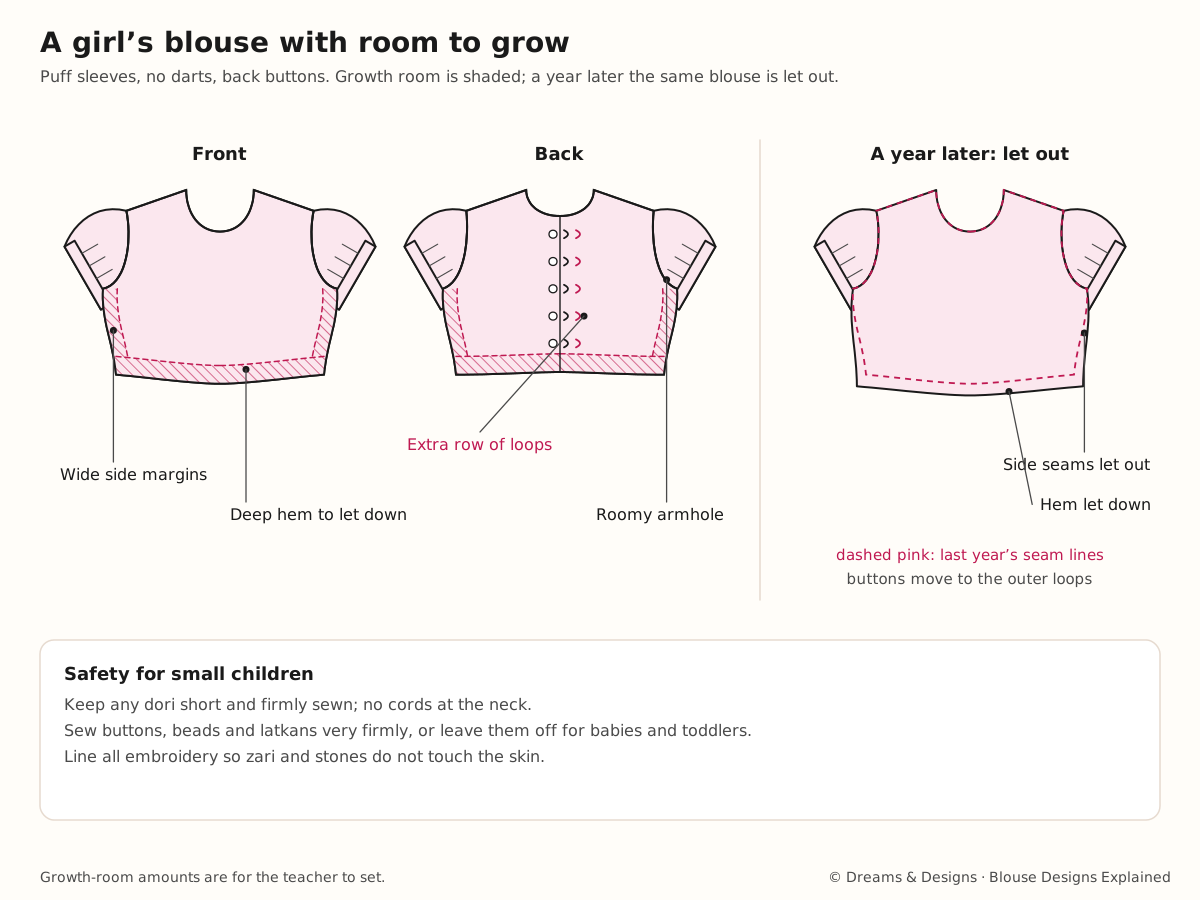
- Wide margins in the side and sleeve seams, so the blouse can be let out.
- A deep hem at the waist edge that can be let down.
- Adjustable backs: a dori back or buttons with two rows of loops.
- A slightly roomy armhole, because children move all the time.
Measuring a child: take the chest (instead of bust), waist, shoulder, blouse length, armhole, sleeve length and sleeve round. Pre-teens and teens need the full 14 measurements, as in Module 2, Measuring for a blouse.
Children’s safety
- Cords and drawstrings: no cords at the neck or hood for young children. Dori ties on the back should be short, sewn firmly, and never long enough to catch. Many countries have rules on this; in Europe and the UK the standard is EN 14682, and in the US ASTM F1816. Check which apply to you before selling.
- Small parts: buttons, beads, sequins, stones and latkans can come off and be swallowed. For babies and toddlers, avoid them or sew them on very firmly and check after every wash.
- Flammability: silk and cotton burn; some synthetics melt. Keep girls in festive clothes away from lamps (deepa), candles and fireworks. Nightwear has its own flammability rules in many countries.
- Scratchy work: line all embroidery so zari and stones do not touch the skin.
- Pins: never leave a pin in a child’s garment during a fitting. Count them out and back.
Safety standards differ by country and change over time. If you make children’s clothes to sell, check the current rules for where you sell (in India, ask the Bureau of Indian Standards).
A note on men
The saree blouse is a women’s garment; in Indian dress, men do not usually wear one. So most of this course is not relevant to men’s dress, except as a skill for tailors of any gender.
The men’s equivalents of a fitted upper garment are:
- The angarakha: a crossover, tied upper garment, in some ways a relative of the choli.
- The kediyu: the gathered men’s jacket of Kutch.
- The bandi, Nehru jacket and waistcoat: fitted, sleeveless, often worn over a kurta.
- The shirt and kurta.
Many blouse skills, such as fitting the shoulder, setting a sleeve and finishing a neckline, carry over to these. Anyone may wear any style, and fashion designers have shown men in blouse-style tops; the fitting principles are the same.
Tips for learners and teachers
- Measure children quickly. Make it a game; take the rounds and lengths first.
- Use the saree border cleverly: a child’s pavadai can be cut from an old silk saree, with the border at the hem and the sleeve.
- Puff sleeves need room; gather them into a band that is a little loose.
- Front closures for older girls who dress themselves; back for little ones.
- Teachers: a girl’s blouse is a good first project: small, quick and simple.
Common misunderstandings
“A child’s blouse is just a small adult blouse.”
No. Children’s proportions are different: shorter, rounder bodies, and no bust shaping until the pre-teen years.
“Heavy embroidery is fine if it is lined.”
Lining helps comfort, but loose stones and beads are still a choking risk for small children.
“Long dori latkans look sweet on a child.”
They can catch and pull. Keep them short and firmly sewn.
For earning and teaching
For earning: festival seasons bring many orders for girls’ pavadai sets. Matching mother-and-daughter blouses are popular for weddings.
For teaching: a doll-sized or child-sized blouse teaches every step of a blouse in less time and fabric.
Sources and uncertain points
- Names of the girls’ outfits vary by language and region; those given are common uses.
- Age ranges for each stage are rough.
- To check: EN 14682 and ASTM F1816 are the usual cord and drawstring standards; confirm current versions, and check the Indian position with the Bureau of Indian Standards.
- Teacher to check: growth-room amounts.
Check yourself
- Can you name the girls’ outfits in two languages?
- Do you know three ways to add growth room?
- Can you name three safety rules for children’s blouses?
- Can you name two men’s equivalents of a fitted upper garment?
Key terms
- Pattu pavadai / langa / lange: a girl’s silk skirt and blouse.
- Voni / davani: the half-saree drape.
- Growth room: margins left so a child’s garment can be let out.
- Angarakha: a crossover tied upper garment.
- Bandi: a short sleeveless jacket.