How a fabric is woven or decorated changes its look as much as the fibre does. This lesson shows how to tell a pattern that is woven in from one that is printed on, what handloom really means, and the three kinds of zari.


What you’ll learn
- Brocade, jacquard and handloom, and how to recognise each.
- The main kinds of print, in one line each.
- Real, tested and imitation zari, and when each makes sense.
- How to look at the back of a fabric and learn its story.
Woven patterns and prints
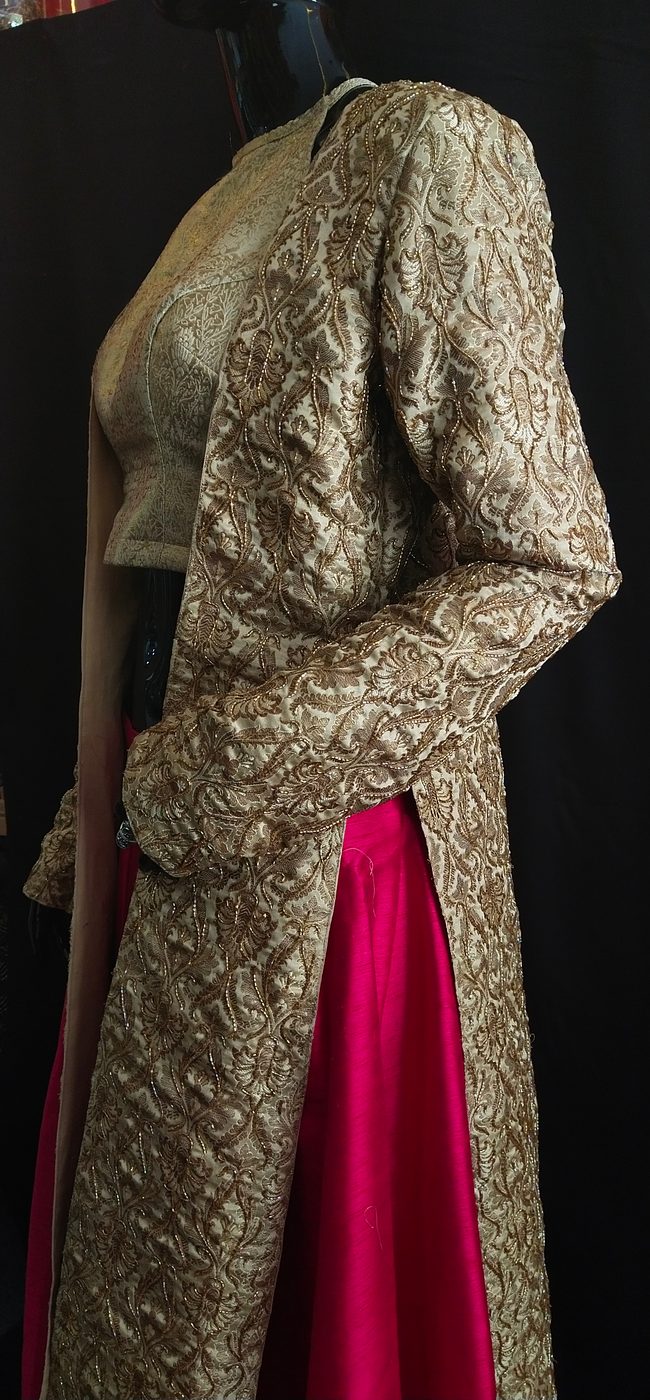
- Brocade – raised patterns woven into the cloth, often with zari. Look at the back: you will see the loose threads of the pattern.
- Jacquard – patterns woven in on a jacquard loom; can be any fibre.
- Handloom – woven by hand, with tiny irregularities that show it is real. Ilkal, khadi and many silks are handloom.
- Prints – block print (stamped by hand with carved blocks), screen print, and digital print (any design, any colour).
- Zari – metallic thread. Real zari has silver and gold on silk; tested zari is copper-based; imitation zari is plastic film. All three have their place – just know which you are paying for.
Modules 3 and 4 introduce India’s great woven traditions, and Module 7 covers prints in depth.
Woven, printed or embroidered? The back tells you
- Woven pattern: the back shows the same motif in reverse colours, or floats of pattern thread. Cut the floats and the pattern pulls out.
- Printed pattern: the colour sits on the face; the back is paler or plain. The weave underneath is ordinary.
- Embroidery: the back shows stitches, knots or a backing.
Why it matters: a woven pattern lasts as long as the cloth, a print can fade, and the type of zari changes weight, feel, care and value.
In more depth: brocade and its family
- Brocade – an extra pattern thread (often zari or coloured silk) is woven in only where the motif is. Banarasi brocade is the best known in India.
- Kinkhwab (kimkhab) – a heavy brocade so rich in zari that the ground barely shows; traditionally for royal wear.
- Tanchoi – a brocade with small, dense, all-over patterns woven with several coloured weft threads; associated with Banaras, with roots traditionally traced to China.
- Damask – a reversible pattern made by changing between satin and sateen weaves in one colour; tablecloths and some suiting.
- Jamdani – extra-weft motifs worked by hand into fine cotton, from Bengal; sheer ground, opaque motifs.
- Jacquard – the name of the loom mechanism that controls each warp thread separately, from a punched card or a computer. Most large woven patterns today, including power-loom brocade, are made this way.
Handloom and power loom
On a handloom, the weaver throws the shuttle and beats each row by hand or foot. Small variations in tension and beat, slight slubs and an edge that is not machine-perfect are normal. Power looms make faster, more even cloth. Some power-loom cloth is sold as handloom; see Module 3, Handloom cottons, for how to check.
In more depth: the three kinds of zari
| Kind | Made of | Feel and age | Fits |
|---|---|---|---|
| Real (pure) zari | Silver wire, gold-plated, wrapped on silk | Soft, heavy; darkens gently with age; has resale value | Heirloom and bridal silk |
| Tested zari | Copper wire, silver- or gold-coloured coating | Bright; may show red at worn spots | Most festive sarees and lehengas |
| Imitation zari | Metallised plastic film | Light, very bright, doesn’t tarnish; can scratch skin | Everyday and budget wear, trims |
Module 4, Real or imitation?, explains simple checks and why only a laboratory can say exactly how much silver or gold a zari holds.
Tips, tricks and hacks
- Always turn it over. Ask to see the back of every patterned fabric before buying.
- Protect floats. Line brocade blouses and jackets so the floats on the back don’t catch on jewellery or fingers.
- Fuse the back of loose brocade with a light interfacing before cutting to stop floats pulling out.
- Place motifs. Lay brocade so the main motifs fall in the centre front and back, never cut in half at a seam.
- Press zari face down on a towel so it isn’t flattened.
- Bind zari edges soon after cutting; metal threads fray quickly.
Common misunderstandings
“Jacquard means machine-made and cheap.”
Jacquard is a mechanism. Many fine handlooms use a jacquard attachment.
“Bright zari is real zari.”
Imitation zari is often the brightest. Real zari has a softer glow and grows mellow with age.
“Irregularities mean poor quality.”
On handloom, small irregularities are the signature of the hand. Large flaws are different.
For earning and teaching
For earning: a tailor who places brocade motifs perfectly, and lines the floats, makes a jacket that looks far more expensive.
For teaching: collect small offcuts of brocade, print and embroidery and let learners sort them by looking at the back alone.
Sources and uncertain points
- General textile knowledge. Tanchoi’s Chinese origin is traditionally told; sources differ on details.
- The materials of each zari type are as generally described in the trade; exact mixes vary.
Check yourself
- Can you tell a woven pattern from a printed one by the back?
- Do you know what a jacquard loom does?
- Can you name the three kinds of zari?
- Do you know why brocade needs a lining?
Key terms
- Brocade: a woven pattern made with an extra thread.
- Float: pattern thread lying loose on the back.
- Jacquard: a loom mechanism for large patterns.
- Zari: metallic thread.
- Jamdani: hand-inserted extra-weft motifs on fine cotton.