The saree and blouse are worn together but chosen differently. The saree is about drape, occasion and weather. The blouse is about fit, comfort and structure – and it often has to match a saree piece that came with it. This lesson helps with both.
What you’ll learn
- Saree fabrics by occasion, weather and wearer.
- Blouse fabrics by design and by saree.
- When to use the attached blouse piece, and when to choose another.
- Lining and fit notes for each.
Sarees by occasion
| Occasion | Good fabrics | Why |
|---|---|---|
| Daily, home, office | Cotton, handloom cotton, linen, light crepe | Cool, easy care, crisp or soft as liked |
| Puja, temple | Silk, cotton-silk, Ilkal, Mysore silk | Traditional, modest, comfortable seated |
| Wedding guest | Silk, Banarasi, Kanjeevaram, tissue, georgette | Festive sheen and colour |
| Bride | Kanjeevaram, Banarasi, Mysore silk, heavy tissue | Heirloom weight, zari |
| Party, reception | Georgette, chiffon, organza, net, satin | Fluid drape, modern look |
| Travel | Crepe, georgette, cotton blends | Doesn’t crease much, packs small |
The wearer matters too. First-time saree wearers find soft cotton, crepe and georgette easier to drape than stiff silk or organza. Older wearers often prefer lighter silks. Heavy silks hold pleats beautifully but are tiring over a long day.
Blouses by design
- Simple everyday blouse: cotton cambric, poplin or the saree’s own cotton piece, lined in cotton.
- Princess-cut, structured, padded: fabrics with body – raw silk, dupion, khana, brocade, cotton-silk – with cotton lining and cups.
- Stretch blouse: cotton-lycra, knit, or stretch satin; less ease in the pattern.
- Sheer sleeves or back: net, organza or georgette panels, with neat binding.
- Velvet or brocade blouse: for winter weddings and contrast looks.
Using the blouse piece
Most silk and many cotton sarees come with an attached blouse piece (often 0.8–1 m). Use it when it matches perfectly and is enough for the design. Choose a separate fabric when you want long sleeves, a lining-free sheer design, a contrast look, or more structure than the piece gives.
Three questions settle most choices: Where will it be worn, and for how long? How should it fall – close, or standing away? And how confident is the wearer with draping or with a fitted blouse?
In more depth: matching blouse to saree
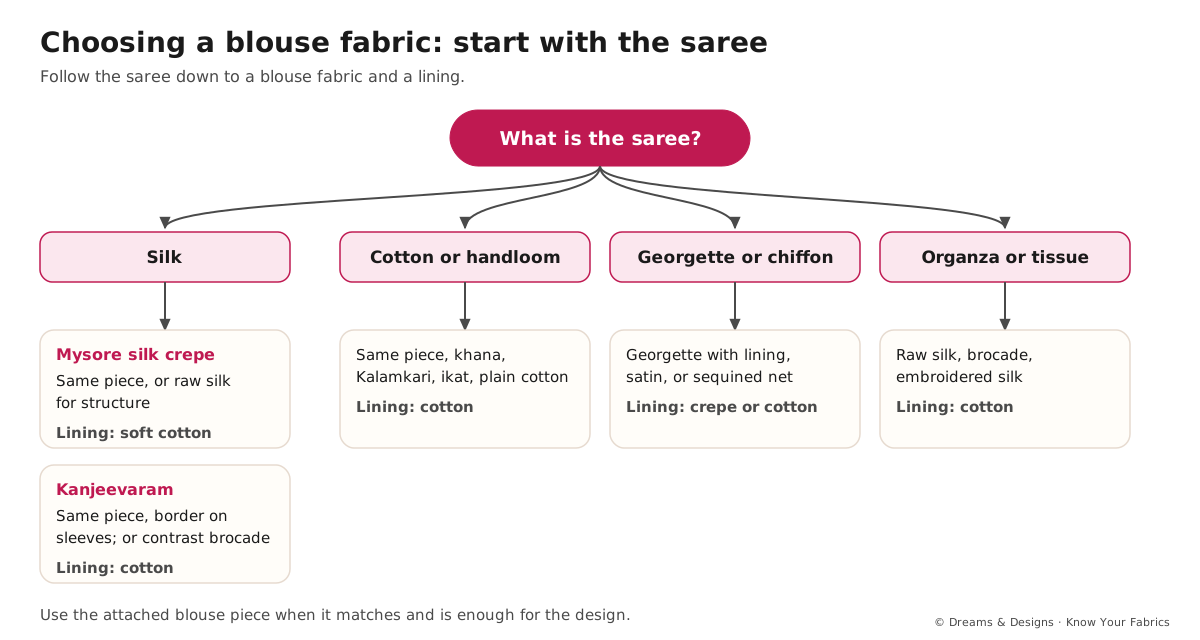
| Saree | Blouse fabric | Lining |
|---|---|---|
| Cotton or handloom | Same piece, khana, Kalamkari, ikat, plain cotton | Cotton |
| Mysore silk crepe | Same piece, or raw silk for structure | Soft cotton |
| Kanjeevaram | Same piece, border on sleeves; or contrast brocade | Cotton |
| Georgette, chiffon | Georgette with lining, or satin, or sequined net | Crepe or cotton |
| Organza, tissue | Raw silk, brocade, embroidered silk | Cotton |
Saree finishing
Most sarees need a fall (a cotton strip along the inner hem) and pico (a finished edge) before wearing. Light sarees may need a lighter fall. Match the fall colour to the saree.
Tips, tricks and hacks
- Check the blouse piece length before planning sleeves.
- Use the saree border on sleeves, neckline or back for a matched look.
- Pre-wash cotton saree blouse pieces separately; they can shrink more than the body.
- Try the drape before cutting; the pallu may be a better blouse source than the piece.
- Avoid heavy zari under arms; it scratches and wears.
- For hot days, choose cotton or silk blouses with cotton lining, not polyester.
- Keep a matching swatch when you go to buy lining and falls.
Common misunderstandings
“The blouse must match the saree exactly.”
Contrast blouses are traditional too – think Ilkal with khana.
“Georgette sarees don’t need a fall.”
Most do; it helps the pleats hang and protects the edge.
For earning and teaching
For earning: saree blouses are the most frequent order in many Indian tailoring shops. Advising the right fabric and lining reduces alteration visits.
For teaching: bring three sarees with their blouse pieces and ask learners to plan a blouse for each.
Problems and how to fix them
The blouse is hot and sticky
- Replace a polyester lining with cotton.
- Add underarm shields.
- Prevention: choose cotton lining for all-day wear.
The saree won’t hold its pleats
- Pin pleats and press lightly with a cloth.
- Add or change the fall to a slightly heavier one.
- Prevention: choose crepe, georgette or soft silk for first-time drapers.
The structured blouse collapses
- Add a firmer lining or a light interfacing to the front.
- Use princess seams for shape.
- Prevention: choose a fabric with more body.
The blouse piece colour doesn’t match in daylight
- Choose a deliberate contrast instead.
- Use the saree border as a link between the two.
- Prevention: check colours outside the shop.
Regional saree and blouse traditions
- Karnataka: Mysore silk and Ilkal; khana blouses with Ilkal; the Kodagu drape.
- Tamil Nadu: Kanjeevaram silks; Chettinad cottons; the madisar (nine-yard) drape.
- Kerala: kasavu settu mundu and saree, often with a contrast or matching blouse.
- Andhra Pradesh and Telangana: Mangalagiri, Venkatagiri, Pochampally ikat, Gadwal.
- Maharashtra: Paithani silk; the nauvari drape.
- Bengal: tant and jamdani, Baluchari silk.
- Gujarat and Rajasthan: bandhani, leheriya, Patola.
- Uttar Pradesh: Banarasi.
Blouse styles vary just as much: high necks and long sleeves in some regions and generations, short sleeves and deep backs in others. Ask the wearer what she wants rather than assuming.
Sources and uncertain points
- General tailoring knowledge. Blouse piece lengths vary by maker. Teacher to check against D&D’s practice.
- Occasion customs differ between communities and regions.
Check yourself
- Can you choose a saree fabric for an office day and for a wedding?
- Can you choose a blouse fabric for a structured design?
- Do you know when not to use the attached blouse piece?
- Do you know what a fall and pico are?
Key terms
- Blouse piece: fabric attached to a saree for its blouse.
- Fall: a strip sewn inside the saree hem.
- Pico: a finished saree edge.
- Ravike (ರವಿಕೆ): Kannada for blouse.