What is inside a garment decides how it feels, hangs and lasts. A lining hides seams and lets the garment slide on; an interfacing stiffens collars and openings; an interlining adds warmth or body. Indian tailoring uses all three, often under their market names: astar, “cotton lining”, “shantoon”, “buckram”, “can-can”.
What you’ll learn
- Lining, underlining, interlining and interfacing: the difference.
- Which lining fabric for which garment.
- Kinds of interfacing, and how to choose a weight.
- Can-can, padding and the other inner layers of Indian wear.
Four inner layers
- Lining – a separate inner garment, sewn at the edges. Hides seams, covers floats and embroidery backs, helps the garment slide on. Hindi astar.
- Underlining – cut the same as each outer piece and sewn together as one; adds opacity and body to sheer or soft fabrics.
- Interlining – a layer between outer and lining for warmth (flannel, wadding) or volume.
- Interfacing – a stiffener on small areas: collars, cuffs, plackets, waistbands, blouse openings.
Choosing a lining
| Lining | Feel | Best for |
|---|---|---|
| Cotton (cambric, mul, “cotton lining”) | Breathes, absorbs sweat, a little grip | Blouses, kurtas, kidswear, anything in heat |
| Shantoon / satin lining | Smooth, slides, slight sheen | Lehengas, gowns, anarkalis, jackets |
| Crepe or butter crepe | Soft, fluid, opaque | Georgette and chiffon garments |
| Polyester taffeta, “lining cloth” | Slippery, cheap, hot | Jackets, coats; not next to skin in summer |
| Cupro, viscose lining | Silky and breathable | Good suits and jackets |
| Silk (habotai, crepe) | Light, luxurious | Silk garments, bridal |
Rule of thumb: next to the skin in Indian heat, choose cotton. For smooth movement and glide, choose a satin-type lining but accept it is warmer. Match the lining’s care to the outer fabric: don’t put a shrinking cotton lining in a dry-clean-only silk without pre-washing it.
Choosing interfacing
- Fusible or sew-in. Fusible has glue dots and is ironed on; sew-in is stitched. Use sew-in on velvet, sequins, and fabrics that can’t take heat.
- Woven, knit or non-woven. Woven behaves like fabric and has a grain; knit stretches with knits; non-woven is cheap and stiff.
- Weight. Choose interfacing a little lighter than the fabric. Test on a scrap: fuse, cool, and bend.
A lining also protects: it takes the sweat, hides embroidery backs and zari floats, and stops the outer fabric stretching. For most Indian festive wear, it is not optional.
In more depth: the inner layers of Indian wear
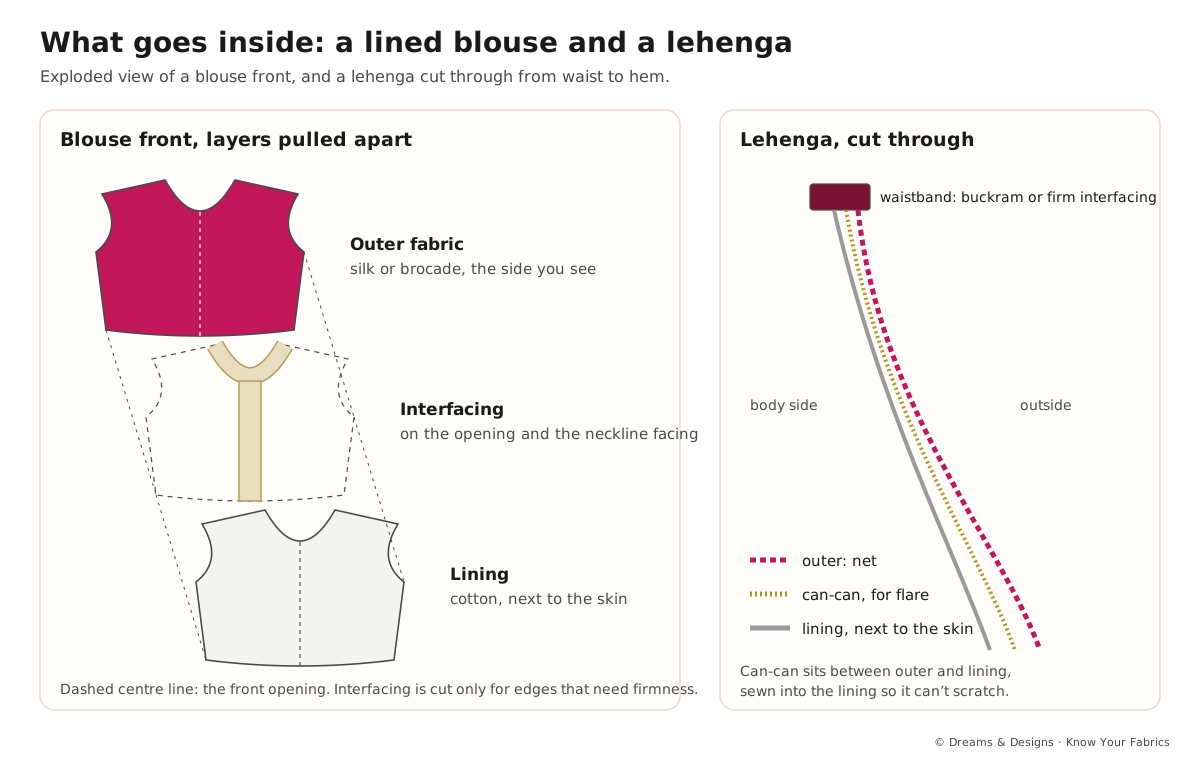
- Blouse lining: most blouses are fully lined in cotton; padded blouses add cups sewn into the lining.
- Buckram: stiff, resin-treated cotton used for collars, belts and lehenga waistbands; also fusible.
- Can-can: stiff net between lehenga and lining for flare. Sew it into the lining so it doesn’t scratch.
- Canvas and hair canvas: for sherwani and suit fronts; shapes the chest.
- Wadding / batting: quilted jackets and winter blouses.
- Saree fall: a strip of cotton sewn inside the saree hem to add weight and protect the edge.
- Organza or silk organza: a light underlining that adds crispness without weight.
Tips, tricks and hacks
- Pre-wash cotton linings before cutting.
- Cut linings slightly smaller in length so they don’t peep below the hem.
- Add a pleat at the lining back of jackets for movement.
- Match lining colour to the fabric, or a shade lighter; dark lining shows through light sheers.
- Fuse with a press cloth, pressing (not ironing) for 10–15 seconds per spot.
- Let fused pieces cool flat before moving them.
- Use self-fabric as lining for very sheer dupattas or sleeves when you want the same colour.
- Use a cotton lining under polyester for comfort in summer.
Problems and how to fix them
The interfacing bubbles after washing
- Re-press with steam and a cloth.
- Replace with a better-quality interfacing.
- Prevention: pre-shrink interfacing (soak in warm water, dry flat) and fuse long enough.
The lining shows at the hem
- Shorten the lining hem.
- Tack lining to outer at side seams.
- Prevention: cut lining 1–2 cm shorter.
The lining pulls the garment
- Release the lining at the hem or add a pleat.
- Let out lining side seams.
- Prevention: lining needs a little ease too.
Can-can scratches
- Cover its top with binding.
- Add a soft lining layer inside.
- Prevention: always enclose can-can.
Common misunderstandings
“Lining is only for expensive garments.”
A simple cotton lining makes an everyday blouse last longer and feel better.
“Stiffer interfacing is always better.”
Too stiff and collars stand up like cardboard. Lighter is usually right.
For earning and teaching
For earning: customers notice comfort and finish inside. A well-chosen lining is a quiet sign of quality.
For teaching: let learners fuse three weights of interfacing to one fabric and compare.
Lining by garment, at a glance
| Garment | Lining | Interfacing |
|---|---|---|
| Everyday blouse | Cotton | Light, at the opening |
| Silk or brocade blouse | Cotton | Light woven at opening and neckline |
| Georgette anarkali | Crepe, cotton or shantoon | Neckline facing |
| Lehenga | Shantoon or cotton, plus can-can | Buckram or firm interfacing at waistband |
| Men’s shirt | None | Collar, cuffs, placket |
| Sherwani, jacket | Viscose, cupro or satin | Canvas front, fusible facings |
| Kidswear | Soft cotton | Minimal, soft |
Sources and uncertain points
- General tailoring knowledge. “Shantoon” and “butter crepe” are Indian market names; fibre content varies.
- Teacher to check lining choices against D&D’s studio practice.
Check yourself
- Can you explain the four inner layers?
- Can you pick a lining for a summer blouse and for a lehenga?
- Do you know when to use sew-in interfacing?
- Do you know how to stop can-can scratching?
Key terms
- Astar: Hindi for lining.
- Underlining: a layer sewn as one with the outer.
- Interfacing: a stiffener for small areas.
- Buckram: stiff cotton for belts and collars.
- Fall: the strip inside a saree hem.