All woven cloth is two sets of threads crossing at right angles. How they cross – the weave – decides whether a cotton becomes crisp poplin, sturdy denim or glossy sateen. And the direction of the threads – the grain – decides how a garment hangs.

What you’ll learn
- Warp, weft, selvedge and bias, and why they matter when you cut.
- The three basic weaves and the fabrics each makes.
- How to spot a weave by looking closely.
- The local words for warp and weft.
Warp, weft and selvedge
- Warp – the threads stretched lengthwise on the loom. They are strong and tight. In Kannada, haasu (ಹಾಸು).
- Weft – the threads woven across, over and under the warp. In Kannada, hokku (ಹೊಕ್ಕು); in Hindi, bana (the warp is tana).
- Selvedge – the firm finished edge where the weft turns back. It runs along the length.
- Bias – the diagonal. True bias is at 45°. Cloth stretches most on the bias and drapes softly.
Most garments are cut with the warp running up and down the body, the straight grain. That gives stability and a straight hang. Cut off-grain, a kurta twists and a hem dips.
The three basic weaves
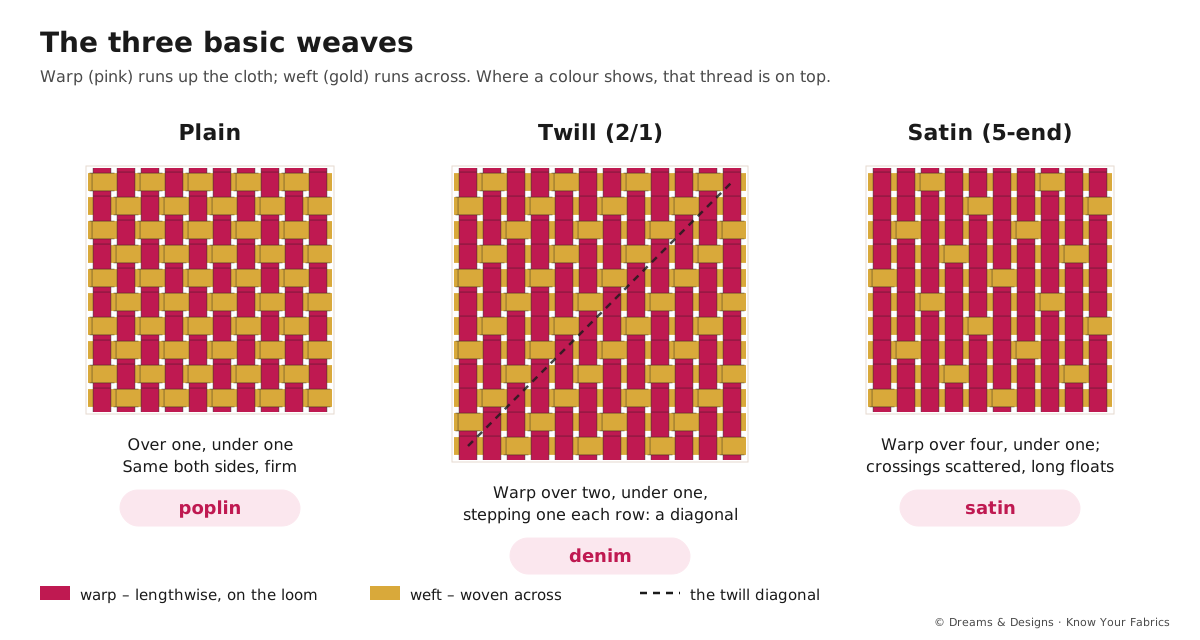
| Weave | How it crosses | Looks and behaves | Fabrics |
|---|---|---|---|
| Plain | Over one, under one | Same both sides, firm, matte | Poplin, cambric, mulmul, voile, chiffon, organza, taffeta |
| Twill | Over two or more, stepping one each row | Diagonal lines, strong, hides dirt, drapes well | Denim, drill, gabardine, serge, chino |
| Satin | Long floats over four or more | Smooth, shiny face, matte back; snags | Satin (silk or polyester), sateen (cotton) |
Variations of plain weave: basket (two threads together, as in oxford shirting and matty), rib (thick and thin threads, as in poplin’s fine ribs and grosgrain) and leno (pairs of warp twisted, an open gauze).
Look closely
Use a phone camera zoomed in, or a small magnifier. Plain weave shows a tidy chequerboard. Twill shows diagonal ridges – on denim, they run from bottom left to top right on most fabric. Satin shows almost no crossing on the front, just smooth floats.
Once you can name the weave, you can predict a lot: plain weaves fray less and press flat, twills wear well and drape, satins shine and snag.
In more depth: other weaves you will meet
- Dobby – small geometric patterns (dots, diamonds) woven in using a dobby attachment.
- Jacquard and brocade – large woven patterns; see the next lesson, Weaves, patterns and zari.
- Pile – extra yarn loops or cut tufts standing up: velvet, corduroy, terry towelling.
- Double cloth – two layers woven together; reversible jackets and shawls.
- Crepe – a crinkly surface from highly twisted yarn or a special weave.
- Extra weft (buti) work – small motifs woven in with an extra thread, typical of Indian handloom such as Chanderi and Banarasi butis.
Thread count
Thread count is the number of warp and weft threads per square inch. Higher counts usually feel finer, but a high count made with thin, weak yarn is not better. Fibre quality matters more than the number.
Finding the grain when there is no selvedge
Pull a single weft thread across the cut end and cut along the line it leaves, or tear cotton across (only for plain cottons that tear cleanly). The cut is then on the crosswise grain. Fold so the cut edge meets itself to find the lengthwise grain.
Tips, tricks and hacks
- Stretch to find the warp. Pull gently each way: the warp usually stretches less than the weft.
- Selvedge words. Many mills print the brand or fibre on the selvedge. Read it.
- Snip the selvedge. Selvedges can be tighter than the cloth; clip them every few inches if the fabric puckers after washing.
- Use bias for curves. Bias strips bend around necklines without puckering.
- Use twill for hard wear. Trousers and uniforms last longer in twill than in plain weave of the same weight.
- Handle satin gently. Its floats catch on rings and rough fingers.
Common misunderstandings
“Satin is a fibre.”
Satin is a weave. It can be silk, polyester, acetate or cotton (then called sateen).
“Bias-cut always looks slimmer.”
Bias follows the body closely, so it shows every curve. It suits some designs, not all.
“Higher thread count is always better.”
Only when the yarns are good. See the note on thread count.
For earning and teaching
For earning: a garment cut on grain hangs straight after many washes; one cut off grain twists. Quality starts at the layout.
For teaching: give learners a strip of paper weaving – two colours, over-under – to make plain, twill and satin themselves. They never forget it.
Problems and how to fix them
The kurta hem dips on one side
- Re-mark the hem from the floor and re-hem.
- Check whether one side seam is off grain and re-cut if possible.
- Prevention: lay every piece with the grain line parallel to the selvedge.
The fabric was printed off grain
- Follow the grain, not the print, for plain designs.
- Follow the print for bold checks, and accept a slight twist.
- Prevention: check print and grain together in the shop.
Bias edges stretched while sewing
- Ease them back with a gathering thread and steam.
- Add a stay tape.
- Prevention: stay-stitch bias edges right after cutting.
Weaving in India
Indian handlooms include the pit loom (the weaver sits with legs in a pit), the frame loom, and the throw-shuttle and fly-shuttle looms. Patterns are added with a dobby or jacquard attachment, or by hand with extra weft threads. The loom is magga (ಮಗ್ಗ) in Kannada. Many weaving families have worked the same type of loom for generations, and the loom shapes what can be woven: a narrow loom makes narrower cloth, and a jacquard loom makes large motifs possible.
Sources and uncertain points
- General textile knowledge.
- Kannada haasu–hokku and Hindi tana–bana are the usual words; local weavers may use others. Teacher to check.
- The direction of twill lines varies by mill and fabric.
Check yourself
- Can you find the warp, weft and selvedge on a piece of cloth?
- Can you name the three basic weaves and one fabric for each?
- Do you know where the true bias is, and what it does?
- Can you say why satin snags?
Key terms
- Warp (haasu, tana) and weft (hokku, bana).
- Selvedge: the finished side edge.
- Grain: the direction of the threads.
- Bias: the diagonal.
- Float: a thread passing over several others.