A kurta, a lehenga and a pair of trousers ask very different things of a fabric. A kurta needs comfort and the right fall; a lehenga needs volume, weight and colour that moves; trousers need strength, a good press and the right amount of stretch. Here is how to choose for each, and for the person wearing it.
What you’ll learn
- Kurta fabrics by style and season.
- Lehenga fabrics, layers and weight.
- Trouser, salwar and palazzo fabrics.
- How body, movement and sewing skill change the choice.
Kurtas
| Style | Good fabrics | Notes |
|---|---|---|
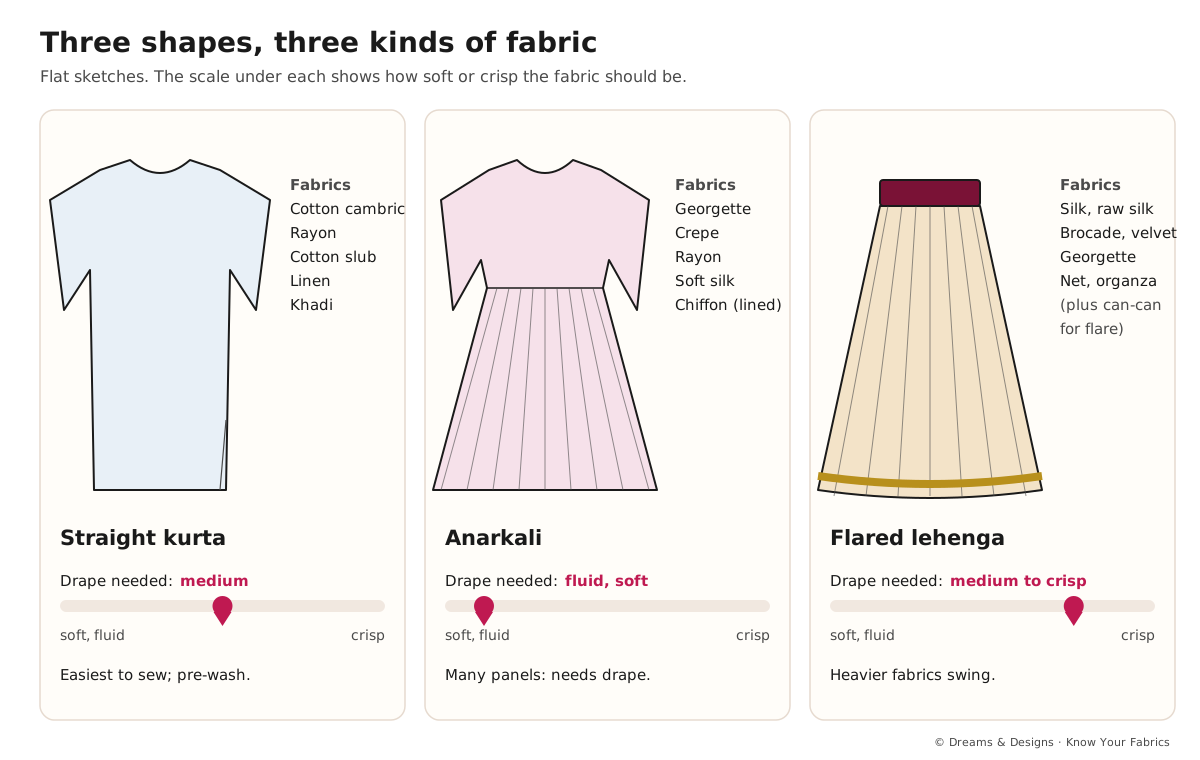
| Straight, A-line, everyday | Cotton cambric, rayon, cotton slub, linen, khadi | Easiest to sew; pre-wash |
| Anarkali, flared | Georgette, crepe, rayon, soft silk, chiffon (lined) | Needs drape; many panels |
| Festive straight | Chanderi, silk, brocade, cotton-silk, tussar | Line sheer and brocade |
| Shirt-style, structured | Poplin, linen, khadi, raw silk | Holds collar and placket |
| Men’s kurta | Cotton, linen, khadi, tussar, silk, jacquard | See next lesson |
Lehengas
A lehenga is usually three layers: the outer fabric, an optional can-can for flare, and a lining. Common outers: silk, raw silk, brocade, velvet, georgette, net and organza. The flare comes from the number of panels (kalis) and the fabric’s body. Heavier fabrics swing; lighter ones float.
- Dancing (sangeet): lighter outer, soft lining, moderate flare.
- Bridal: heavy silk, velvet or brocade, with can-can; weight can be considerable, so plan a firm waistband and comfortable lining.
- Kids and teens: soft cotton or silk-cotton, light lining, no scratchy net near skin.
Trousers, salwars and palazzos
- Fitted trousers, cigarette pants: cotton-lycra, twill, drill, suiting blends.
- Salwar, Patiala: soft cotton, rayon, silk-cotton; Patiala needs plenty of fabric.
- Churidar: cut on the bias from soft cotton, rayon or knit; stretch helps.
- Palazzo: rayon, crepe, georgette, linen; needs drape.
- Dhoti pants: soft cotton, rayon, silk for festive.
A quick guide: straight shapes forgive most fabrics; flared shapes need drape; structured shapes need body; fitted shapes need either stretch or careful ease.
Season matters too: cotton, linen and Chanderi in summer; silk, brocade and velvet for winter weddings (Module 6, Climate and season).
In more depth: body, movement and skill
- Every body: fluid fabrics follow the body closely; crisp fabrics stand away from it. Choose by the silhouette the wearer wants, not by rules about “hiding”. A soft drape suits someone who wants a close, flowing line; structure suits someone who wants shape held away from the body.
- Movement and comfort: for people who sit for long hours, wheelchair users, or anyone who needs easy movement, choose fabrics with some stretch or softness, avoid heavy zari at the seat and back, and prefer breathable linings.
- Pregnancy and postpartum: soft knits, rayon and cotton with stretch; adjustable waists.
- Older wearers: lighter fabrics, easy-care blends, smooth linings that slide on.
- Skill: beginners start with cotton cambric or poplin; rayon next; georgette and velvet after a few garments.
Tips, tricks and hacks
- Test the fall: drape the fabric from your waist in the shop before choosing a lehenga or anarkali.
- Weigh bridal fabric mentally: multiply the outer by the number of metres. Heavy adds up fast.
- Use a cotton lining in summer lehengas, satin in winter.
- Choose twill for trousers that must last.
- Add 2–3 % elastane for fitted trousers if comfort matters more than a sharp crease.
- Use rayon for palazzos but pre-wash it well.
- Cut churidars on the bias for the classic gathered look.
Common misunderstandings
“More flare needs a heavier fabric.”
Flare comes from panels and cut. Fabric weight decides how the flare moves.
“Net lehengas are always light.”
Heavily embroidered net with can-can and lining can be very heavy.
For earning and teaching
For earning: lehenga orders are high value; advising the right weight for the event (dancing or ceremony) makes a happy customer.
For teaching: make two small sample skirts – one in georgette, one in raw silk – from the same pattern to show how fabric changes the line.
Problems and how to fix them
The anarkali flare looks flat
- Add more kalis or a soft can-can layer.
- Use a slightly heavier lining.
- Prevention: choose a fabric with enough weight to swing.
The lehenga is too heavy to dance in
- Remove the can-can or replace it with a lighter net.
- Change to a lighter lining.
- Prevention: ask about the event before choosing the outer fabric.
Trousers bag at the knee
- Take in slightly and press.
- Choose a fabric with better recovery next time.
- Prevention: do the stretch-and-recovery test on stretch fabrics.
The palazzo clings to the legs
- Add a lining or slip.
- Use an anti-static spray or softener.
- Prevention: choose rayon or crepe over polyester for palazzos.
Regional styles and their fabrics
- Pavada / langa davani (South India): silk or silk-cotton skirt with a half-saree; Mysore silk, Kanjeevaram, Gadwal.
- Ghagra-choli (Rajasthan, Gujarat): cotton, bandhani, mirror-work fabrics.
- Salwar kameez (Punjab and across India): cotton, rayon, silk; phulkari dupattas.
- Sharara and gharara (Lucknow, Hyderabad): silk, brocade, georgette with chikankari.
- Mekhela chador (Assam): muga, eri, mulberry silk, cotton.
Sources and uncertain points
- General tailoring knowledge. Teacher to check against D&D’s studio practice.
Check yourself
- Can you choose a fabric for an anarkali and for a straight kurta?
- Can you name the three layers of a lehenga?
- Do you know which fabric suits palazzos?
- Can you say how to choose for comfort when seated all day?
Key terms
- Kali: a panel in a lehenga or anarkali.
- Flare: the width at the hem.
- Silhouette: the outline of a garment on the body.