Not all silk comes from cultivated mulberry silkworms. India’s wild (vanya) silks come from silkworms that feed on forest trees and castor. They have natural golden and beige colours, a textured, earthy look, and a story tied to tribal and rural communities of eastern and north-eastern India.
What you’ll learn
- Tussar: where it comes from and how it looks.
- What “Bhagalpuri silk” means.
- Muga, Assam’s golden silk, and eri, the warm “peace” silk.
- How wild silks sew, wear and age.
Tussar (tasar)
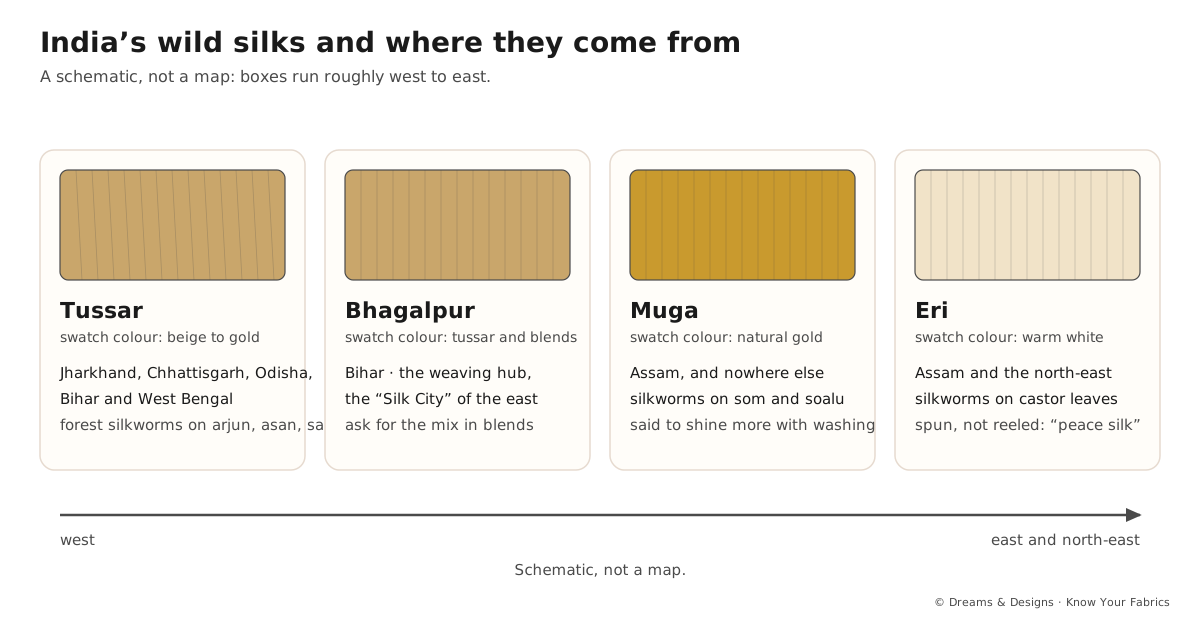
Tussar comes from silkworms of the Antheraea family that feed on trees such as arjun, asan and sal. Most is reared in the forests of Jharkhand, Chhattisgarh, Odisha, Bihar and West Bengal. Tussar has a natural beige-gold colour, a slightly coarse, dry texture and a soft sheen. It takes dye less brightly than mulberry silk, so it is often left natural or printed and painted.
Tussar is used for sarees, kurtas, jackets and men’s kurtas. It holds shape better than mulberry crepe and has a rustic elegance. Tussar ghicha is a coarser yarn spun from the cocoon waste, with a heavier, nubbly look.
Bhagalpuri
Bhagalpur in Bihar is called the “Silk City” of the east. It is the main weaving centre for tussar and tussar blends, and “Bhagalpuri silk” usually means tussar or tussar-blend fabric from there. Some fabric sold as Bhagalpuri today is a blend with cotton, viscose or polyester, so ask for the mix. Bhagalpur silk has a GI.
Muga
Muga is the golden silk of Assam, from silkworms fed on som and soalu leaves. It is found nowhere else. Its natural colour is a deep, shining gold, and it is traditionally said to grow shinier with every wash. It is strong, long-lasting and costly, used for the Assamese mekhela chador and for heirloom pieces. Muga silk holds a GI.
Eri
Eri comes from silkworms fed on castor leaves, mainly in Assam and the north-east. The moth is allowed to leave the cocoon, so the filament is broken and must be spun, not reeled. This is why eri is often called ahimsa or peace silk. Eri feels soft, warm and matte, almost like a fine wool-cotton, and is lovely for shawls, stoles and winter kurtas.
Wild silks are prized for their natural colour and texture rather than high shine. They suit simple cuts that let the cloth speak, and they pair beautifully with hand-painting, block printing and embroidery.
In more depth: comparing the wild silks
| Silk | Colour | Feel | Best for |
|---|---|---|---|
| Tussar | Beige to gold | Dry, textured, soft sheen | Sarees, kurtas, jackets |
| Ghicha | Beige, uneven | Coarse, nubbly | Jackets, stoles, men’s kurtas |
| Muga | Natural gold | Smooth, glossy, strong | Mekhela chador, heirloom sarees |
| Eri | Warm white, takes dye | Soft, warm, matte | Shawls, stoles, winter wear |
Oak tussar
A tussar from oak-feeding silkworms in the sub-Himalayan states is also produced. It is finer and paler than tropical tussar.
Tips, tricks and hacks
- Pre-test pressing: tussar marks with high heat and water spots; use a dry iron and a cloth first.
- Finish edges quickly; tussar frays readily.
- Interface lightly for collars and plackets; tussar is soft but not stiff.
- Keep the natural colour and add colour with embroidery or a printed border.
- Hand-wash eri in cool water with mild detergent; dry flat.
- Dry-clean heavy muga with zari; plain muga can be gently hand-washed.
Common misunderstandings
“Tussar is a low-grade silk.”
It is a different silk, not a lower one. Fine tussar is a luxury.
“All Bhagalpuri is pure silk.”
Much is blended today. Ask, and look for the Silk Mark.
“Peace silk means no harm at all.”
Peace silk lets the moth emerge, but farming practices vary. Ask the seller how it is made.
For earning and teaching
For earning: tussar kurtas and jackets for men and women are steady festive orders. Hand-painted and Madhubani-printed tussar sarees need gentle handling.
For teaching: the four silks of India make a good one-page chart; a small swatch of each makes it unforgettable.
Problems and how to fix them
Tussar shows shiny marks from the iron
- Steam lightly from the back and brush.
- Press only through a cloth.
- Prevention: use a dry iron at medium heat.
Painted tussar colour runs
- Dry-clean only.
- Do not soak or rub.
- Prevention: ask the seller how the paint was fixed.
Eri pills where it rubs
- Remove pills gently by hand.
- Wash inside out, by hand.
- Prevention: use eri for shawls and loose garments, not tight ones.
Wild silks and the communities who make them
Tussar rearing is largely done by forest-dwelling and tribal communities in central and eastern India, and eri rearing is often a household activity in Assam. Weaving is done in centres such as Bhagalpur and Sualkuchi (Assam’s famous weaving village). Buying from cooperatives and recognised clusters supports these communities directly.
Sources and uncertain points
- Producing states and host trees are as described by the Central Silk Board; shares change.
- Muga “growing shinier with washing” is traditionally said.
- GI status of Bhagalpur silk and Muga silk is as reported; check the Registry.
Check yourself
- Can you name the four Indian wild silks?
- Do you know where muga is made?
- Can you say why eri is spun, not reeled?
- Do you know why tussar must be pressed with care?
Key terms
- Vanya silk: wild (non-mulberry) silk.
- Ghicha: coarse tussar yarn from waste.
- Mekhela chador: Assamese two-piece garment.
- Ahimsa (peace) silk: silk from cocoons the moth has left.