From the north and centre of India come three weaves every tailor meets: the rich brocades of Banaras, and the light, sheer silk-cottons of Chanderi and Maheshwar in Madhya Pradesh. One is for grandeur, the other two for grace.
What you’ll learn
- The main kinds of Banarasi, and how they are woven.
- Why Chanderi is so light and sheer.
- What makes a Maheshwari saree, including its reversible border.
- Which garments each suits.
Banarasi
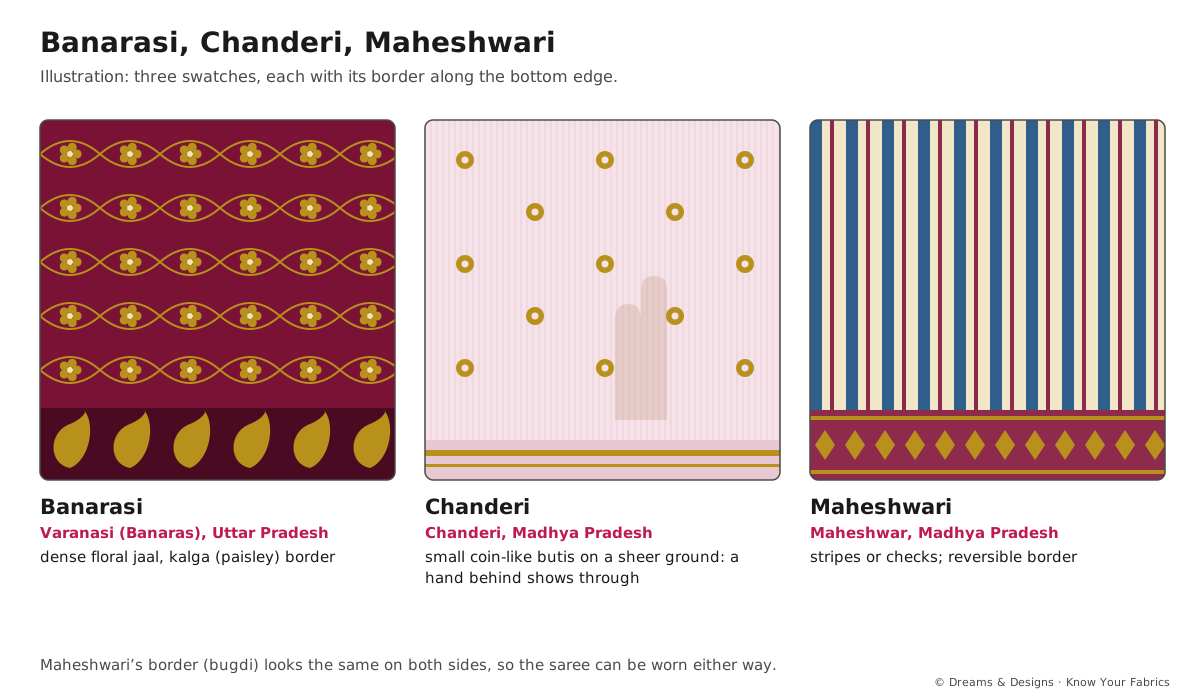
Banarasi sarees and fabrics are woven in and around Varanasi (Banaras), Uttar Pradesh. They are famous for brocade: patterns woven in with zari and coloured silk – floral trailing patterns (jaal), small motifs (buti, buta), paisley (kalga or kairi) and grand pallus. The style is often linked to Mughal-era design.
Types you will hear:
- Katan – pure silk, plain-woven; the classic Banarasi base.
- Kora (organza) – sheer, crisp, with zari motifs.
- Georgette – soft Banarasi in georgette yarn; drapes more easily.
- Shattir – lighter, contemporary weave.
- Tanchoi and jamawar-style – dense, many-coloured woven patterns.
Two weaving methods: kadhua (kadwa), where each motif is woven in separately by hand so the back is neat, and fekwa, where the pattern thread runs across the whole width and the floats on the back are later cut. Kadhua is slower and more prized. Banarasi brocade has a GI.
Chanderi
Chanderi, a town in Madhya Pradesh, weaves light, sheer fabrics in cotton, silk-cotton and silk. The secret is very fine yarn, traditionally unde-gummed silk warp with a fine cotton weft, which gives a glassy transparency and slight crispness. Small woven butis – coins, flowers, peacocks – are scattered on the body, with fine zari borders. Chanderi suits kurtas, dupattas, sarees and light jackets. It holds a GI.
Maheshwari
Maheshwari sarees come from Maheshwar on the Narmada, Madhya Pradesh. Their revival is traditionally linked to Queen Ahilyabai Holkar in the 18th century, and in modern times to a weavers’ society set up in the late 1970s. They are light silk-cotton or cotton, often in stripes and checks, with a reversible border (bugdi) that looks the same on both sides, so the saree can be worn either way. Designs are said to draw on the carvings of the Maheshwar fort. Maheshwari has a GI.
In more depth: choosing and stitching
| Fabric | Weight and drape | Best garments | Lining |
|---|---|---|---|
| Banarasi katan | Medium to heavy, holds shape | Bridal sarees, lehengas, jackets, blouses | Yes, to cover floats |
| Banarasi georgette | Light, fluid | Sarees, anarkalis, dupattas | For kurtas |
| Chanderi | Very light, slightly crisp, sheer | Kurtas, dupattas, sarees | For kurtas |
| Maheshwari | Light, soft | Sarees, kurtas, dupattas | Usually |
Banarasi brocade fabric (sold by the metre) is a favourite for lehengas, sherwanis, Nehru jackets and blouses. Place motifs carefully and finish edges at once; zari frays.
Tips, tricks and hacks
- Check the back of a Banarasi: neat back means kadhua; cut float ends mean fekwa.
- Use the Chanderi selvedge or zari border as a hem for dupattas.
- Use French seams on Chanderi; ordinary seams show through the sheer cloth.
- Cut Chanderi with butis in mind; avoid a buti sitting right at a dart point.
- Use Maheshwari’s border both ways – it is finished on both sides.
- Press Chanderi on medium heat without steam first; some silk-cottons spot.
Common misunderstandings
“All Banarasi is heavy.”
Banarasi georgette, organza and shattir are light.
“Chanderi is always silk.”
It comes in cotton, silk-cotton and silk. Ask for the mix.
“Banarasi means any brocade.”
Banarasi is a place-based tradition with a GI. Brocade is made in many places.
For earning and teaching
For earning: Banarasi lehengas and jackets, and Chanderi kurta sets, sell well for weddings and festivals. Tell the customer what they are wearing.
For teaching: show a kadhua back and a fekwa back side by side; it is the clearest lesson in how weaving method shows.
Problems and how to fix them
Brocade floats catch on jewellery
- Line the garment fully.
- Fuse a light interfacing to the back of loose areas.
- Prevention: always line Banarasi brocade blouses and jackets.
Chanderi seams show through
- Change to French seams.
- Trim allowances evenly and narrowly.
- Prevention: plan seams for sheer fabric from the start.
Zari frays at cut edges
- Overlock or zig-zag at once.
- Bind with bias tape.
- Prevention: finish every edge before sewing.
Common misunderstandings about cost and labour
A kadhua Banarasi or a fine Chanderi can take many days or weeks on the loom, depending on design and weaver. That time, not just the zari, is what a buyer pays for. Power-loom versions can look similar at first glance but differ on the back, at the edges and in feel. Neither is wrong; they are different products and should be named honestly.
Sources and uncertain points
- Mughal links to Banarasi design are traditionally told; Banaras weaving is older.
- Chanderi’s traditional yarn mix (unde-gummed silk warp, fine cotton weft) is as commonly described; makers vary.
- Ahilyabai Holkar’s role in Maheshwar weaving and the late-1970s revival society are as reported.
- GI status of Banarasi brocade, Chanderi and Maheshwar sarees is as reported; check the Registry.
Check yourself
- Can you name three kinds of Banarasi?
- Do you know the difference between kadhua and fekwa?
- Can you say why Chanderi is sheer?
- Do you know what is special about a Maheshwari border?
Key terms
- Jaal: an all-over trailing pattern.
- Buti / buta: small / larger woven motif.
- Kadhua / fekwa: motif-by-motif / full-width brocade weaving.
- Katan: plain-woven pure silk.
- Bugdi: Maheshwari’s reversible border.