Cotton is the everyday fabric of India – cool, soft and easy to stitch. The same fibre becomes a dozen different fabrics, and choosing the right one is what makes a kurta crisp or soft, a shirt smart or casual.
What you’ll learn
- The main kinds of cotton fabric, from mulmul to denim.
- Which garment each one suits.
- How to tell good cotton from poor.
- Why cotton shrinks, and what to do about it.
The main kinds
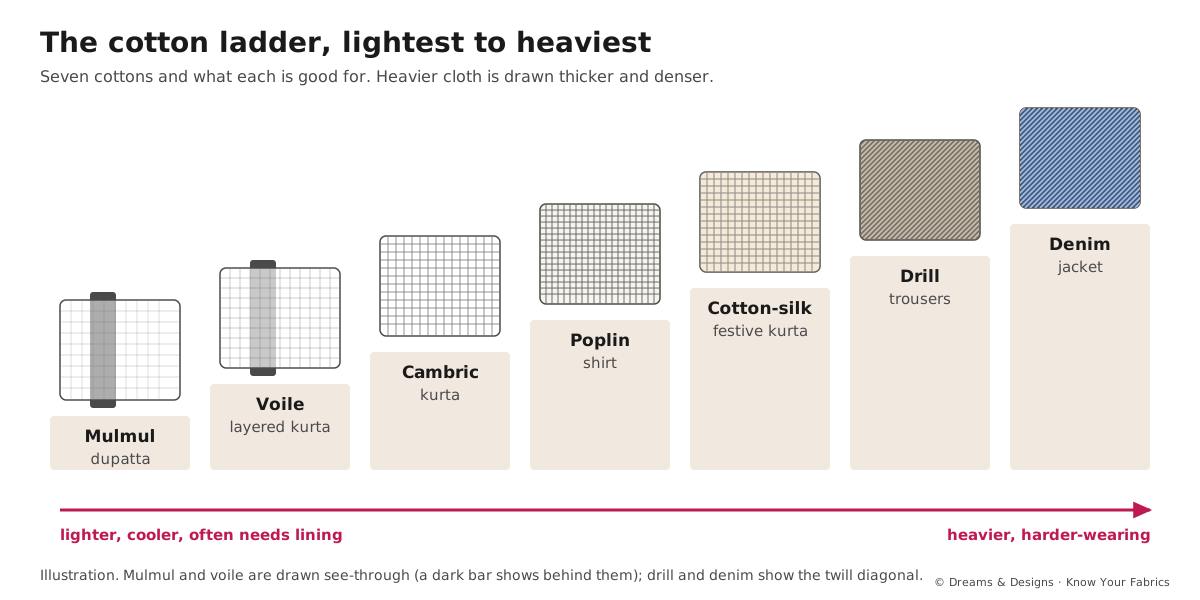
- Mul (mulmul) – very fine and soft; lovely for summer kurtas and dupattas.
- Cambric – smooth and slightly stiff; good for kurtas, linings and blouses.
- Poplin – firm and smooth; shirts and structured tops.
- Voile – light and slightly see-through; layered kurtas and dupattas.
- Khadi – hand-spun and handwoven, with a textured feel; it gets softer with every wash.
- Cotton-silk – a blend with a soft sheen; dressier than cotton, easier than pure silk.
- Denim and drill – heavy cottons for jackets, bags and bottoms.
More cottons you will meet
| Fabric | What it is | Good for |
|---|---|---|
| Lawn | Fine, crisp plain weave, finer than cambric | Summer suits, shirts |
| Cotton slub | Uneven yarn gives a textured look | Casual kurtas, shirts |
| Cotton flex / matty | Basket weave, linen-like | Kurtas, shirts, trousers |
| Oxford | Soft basket-weave shirting | Men’s casual shirts |
| Twill and chino | Medium-weight diagonal weave | Trousers, uniforms |
| Cotton satin / sateen | Satin weave in cotton; soft sheen | Blouses, lining for silk |
| Hosiery / jersey | Cotton knit | T-shirts, innerwear, kids’ wear |
| Organdy | Sheer, stiff, finished cotton | Collars, dupattas, interfacing |
Tip: most cottons shrink a little. Wash the fabric once before it is cut and stitched.
Handloom cottons – khadi, mulmul, Kota and the rest – have their own lesson next. See also Module 8, Shrinkage and pre-washing.
Choosing quickly: for softness and summer, go light (mulmul, voile, lawn); for a clean everyday shape, go medium (cambric, poplin, slub); for hard wear, go heavy (twill, drill, denim). Then decide on lining: most light cottons need one for kurtas, most medium cottons don’t.
In more depth: judging cotton quality
- Hold it to the light. Even weave, no thin patches (except handloom slubs).
- Scratch it. If white powder or flakes come off, it is heavily starched or sized; the real fabric is thinner.
- Crush it. Good cotton creases but smooths out with a hand press. Very weak cotton stays crushed and looks tired.
- Rub it. Short fibres fluff and will pill.
- Check colour. Rub a damp white cloth on dark cotton; colour coming off means it will bleed.
- Check print registration. Colours should line up; blurred or shifted outlines look cheap.
Why cotton shrinks
During weaving and finishing, cotton yarns are stretched. Water relaxes them, so they shrink back. Typical cotton loses a few per cent in length; loose handlooms and khadi can lose more. Fabric labelled sanforised or pre-shrunk has been treated to shrink very little.
Tips, tricks and hacks
- Iron cotton slightly damp, at a high setting, for a crisp finish.
- Use cambric for linings of cotton blouses and kurtas; it breathes and matches the shrinkage.
- Use mulmul as a pressing cloth. An old mul dupatta is perfect.
- Choose voile for layers, not for a single-layer kurta unless you want it sheer.
- Pick poplin for shirts that must look sharp all day.
- Starch for shape. A light rice starch (kanji) gives cotton sarees and dhotis crispness.
- Wash dark cottons inside out to keep colour.
Common misunderstandings
“All cotton is the same.”
The weave, the yarn and the finish make cotton fabrics very different.
“100 % cotton never pills.”
Short-staple cotton does pill. Long-staple, combed cotton pills less.
“Sanforised means no pre-wash.”
It shrinks very little, but a quick pre-wash still removes finishing and loose dye.
For earning and teaching
For earning: cotton kurtas, blouses and shirts are the bread and butter of a tailoring business. Being able to recommend the right cotton for each design wins repeat customers.
For teaching: every beginner should sew their first garment in cambric or poplin – stable, easy to press, and forgiving.
Problems and how to fix them
The kurta became see-through after washing
- Add a cotton lining or a slip.
- Wear a matching inner layer.
- Prevention: do the light test after a trial wash of a scrap; starch hides thinness.
Colour ran into the white piping
- Soak at once in cold water and rinse repeatedly.
- Use a colour-catcher sheet in the next washes.
- Prevention: bleed-test dark cottons and pre-wash separately.
The fabric pills on the inner thighs or underarms
- Remove pills gently with a fabric shaver.
- Wash inside out on a gentle cycle.
- Prevention: choose combed, long-staple cotton for hard-wearing garments.
Creases won’t press out
- Dampen and press with a hot iron.
- Use a little spray starch.
- Prevention: remove from the line slightly damp and fold flat.
Cottons by garment and season
| Garment | Summer | Cooler months |
|---|---|---|
| Kurta | Mulmul (lined), cambric, lawn | Slub, khadi, cotton-silk |
| Blouse | Cambric, poplin, handloom | Cotton-silk, khana, cotton satin |
| Shirt | Poplin, voile, lawn | Oxford, twill, flannel |
| Trousers | Light twill, matty | Drill, denim, corduroy |
| Dupatta | Mulmul, voile, Kota | Khadi, cotton-silk |
| Kidswear | Mulmul, jersey | Interlock, soft denim |
Sources and uncertain points
- General textile knowledge. Market names (flex, matty, slub) differ from shop to shop; check by handling.
- Typical shrinkage percentages vary by fabric and source; see Module 8.
Check yourself
- Can you name five cotton fabrics and one use for each?
- Do you know the difference between cambric and voile?
- Can you check a cotton for starch and colour bleeding?
- Do you know what sanforised means?
Key terms
- Mulmul: very fine soft cotton.
- Cambric: smooth, slightly stiff cotton.
- Poplin: firm, fine-ribbed cotton.
- Sizing: starch added to yarn or cloth in finishing.
- Sanforised: treated to shrink very little.