As Kasuti has become popular, machine-embroidered and printed copies have come onto the market. This lesson gives you five checks that tell real hand-worked Kasuti from an imitation in a minute or two – useful when you buy, when you source for a client, and when you judge your own work.
What you’ll learn
- The single most reliable test, and why it works.
- Four more checks that back it up.
- The usual kinds of imitation, and what each one gives away.
- What the GI tag can and cannot tell you.
- How to describe a piece honestly when it is not traditional Kasuti.
The five checks
You need good daylight, the piece in your hands, and, if you have one, a small magnifier. Do the checks in this order.
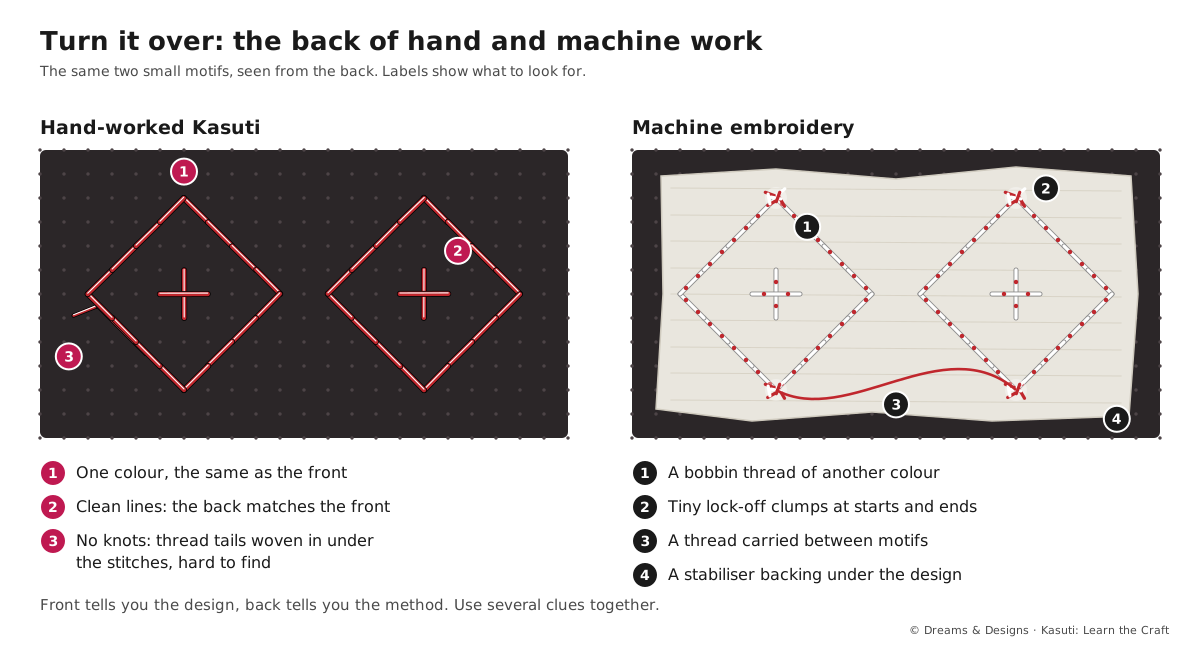
- Turn it over. This is the surest test. Real Gavanti and Murgi look almost the same on the back as on the front, with no knots. Thread tails are woven in under the stitches and are hard to find. Machine work usually shows a dense or messy back, a different-coloured thread down every line, threads carried between motifs, or a backing material. None of these belong in hand Kasuti.
- Look for small human differences. Hand-counted work, however skilled, shows tiny variations between repeats: one stitch sits a little higher, one thread is slightly tighter. That is a sign of the hand, not a fault. If every motif across a whole saree is identical down to the last stitch, suspect a machine.
- Count the stitches. Real hand stitches can be counted one by one, and each one starts and ends between the threads of the cloth. Stitches that look fused, overlapping or packed together suggest a machine.
- Look for Neyge. Neyge, the weaving stitch, is the slowest of the four. It is the first stitch to be dropped or replaced with something quicker when work is rushed or copied. A large piece with well-worked Neyge is a strong sign of real skill.
- Ask where it was made. Good sellers, cooperatives and emporia can usually tell you which town, which group and sometimes which maker. This is a useful extra check alongside the GI, especially for a costly piece such as a full Chandrakali saree. It never replaces turning the piece over.
A quick rule: front tells you the design, back tells you the method. Always judge the back.
Why the back is the test
Gavanti and Murgi are double running stitches. The needle goes out along a line leaving gaps, then comes back and fills them, using the same holes. So the thread lies on the front and the back in the same places, in the same colour. A machine cannot do that. Most embroidery machines work a lockstitch: a top thread meets a bobbin thread underneath, so the back shows the bobbin thread, which is often white or one colour for the whole design. Machines also tie off each colour with tiny locking stitches, jump between motifs, and need a stiff backing (a stabiliser) to stop the cloth puckering.
In more depth
The usual kinds of imitation
| What it is | What gives it away |
|---|---|
| Machine embroidery “in Kasuti style” | Bobbin thread on the back, lock-off clumps, jump threads, backing paper or fabric, identical repeats |
| Printed “Kasuti print” | No raised thread at all; the pattern is flat to the fingertip and faint or blank on the back |
| Woven (jacquard) Kasuti-inspired motifs | The pattern is part of the cloth; on the back it shows as loose floats or a reversed colour pattern, not stitches |
| Hand work, but not traditional | Knots on the back, a single running stitch with gaps on the back, or curves that were traced rather than counted |
The last two are not fakes in themselves. Woven Kasuti-inspired cloth is a real research direction for reviving Ilkal weaving, and hand embroidery with knots can be beautiful. The problem only starts when they are sold as hand-worked Kasuti.
The machine’s other clues
- Thread shine. Machine work often uses very shiny rayon or polyester thread. Kasuti uses twisted cotton or silk, with a softer shine. This is a hint, not proof: some hand workers use shiny thread too.
- Needle holes. A machine needle pierces the cloth wherever the design says, often through the threads. Hand Kasuti stitches enter between the threads, following the weave. Under a magnifier, stitches that wander slightly across the grain suggest a machine.
- Stitch length. Machine stitches are often exactly the same length even where the cloth threads are uneven. Hand stitches follow the threads, so on handloom they vary very slightly with the weave.
What the GI can and cannot tell you
Kasuti has a Geographical Indication (Module 1, The GI tag). It ties the name to its region and traditional method, and helps stop machine or printed copies being sold as Kasuti. But a GI protects a name and a region. On its own it does not prove that any one item is hand-made, or made by a particular artisan. Use it as a supporting signal, then check the back.
Tips for learners and teachers
- Make a test kit. Keep a small hand-worked sample and, if you can get one, a machine-made piece. Feeling and seeing both backs side by side teaches the difference in seconds.
- Use a phone torch. Shine it at a low angle across the front. Hand stitches cast tiny, slightly uneven shadows; prints cast none.
- Photograph the back of anything you are thinking of buying, and compare it at home with your own Gavanti.
- Check a hidden corner. Look inside a blouse or at the reverse of a pallu, where finishing is often left unlined.
- Ask kind questions. “Who stitched this?” and “How long does a pallu like this take?” are fair questions. A maker or honest seller is usually glad to answer.
- Judge your own work the same way. If your back would fail the test, fix it before you sell or gift the piece (Module 7, Common problems, and how to fix them).
- Teach it as a game. Hand learners three unlabelled samples and ask them to sort them using only the backs.
Common misunderstandings
“If the back has a clean line, it must be hand work.”
Not always. A simple machine line can also look like a line on the back. Look at the colour (a bobbin thread is often a different colour), at the starts and ends (machines leave tiny lock-off clumps), and at what happens between motifs (jump threads).
“Perfect work means expert hand work.”
Even experts show tiny differences. Total, machine-exact sameness over a large piece points to a machine.
“Every Kasuti stitch is reversible.”
Only Gavanti and Murgi are made to look the same on both sides. Neyge and Menthe have a working back. Do not reject a real piece because its Neyge back looks different.
“A GI tag on the label proves it is handmade.”
No. The GI protects the name and region. It does not certify each item. Always check the piece itself.
“Anything made on net or waste canvas is fake.”
No. The net method (Module 2) is a hand method. The stitches are still counted and hand-worked; the net simply gives you a grid on cloth you can’t count.
For earning and teaching
For earning: the back of your work is your best advertisement. Photograph and film both sides in every listing; a few seconds of turning a piece over convinces buyers more than any description. If a piece mixes Kasuti with other work, or uses knots, say so plainly. Honest labels build trust, and the course Kasuti as a Business covers labelling in Quality, labels and the GI.
For sourcing: when buying for a shop or a client, ask to see the back of every piece, ask which stitches are used by name (Gavanti, Murgi, Neyge, Menthe), and keep a photo record of what you accepted.
For teaching: this makes a good closing session for a beginner course. Learners who can judge a back become careful stitchers and careful buyers.
Sources and uncertain points
- The five checks follow the D&D ebook Kasuti – The Complete Encyclopedia, chapter 16, with chapter 4 (GI) and chapter 14 (Neyge as the first stitch to be dropped).
- The notes on lockstitch machines, bobbin thread, lock-off stitches and stabilisers come from general knowledge of machine embroidery. Machines and methods vary, so treat each clue as a hint and use several together.
- The notes on thread shine and needle holes are practical observations, not fixed rules.
- Woven, Kasuti-inspired jacquard cloth is described in applied textile research; it is an experiment in reviving Ilkal weaving, not a replacement for hand embroidery.
Check yourself
- Do you turn a piece over before you judge it?
- Can you name three things on a back that point to a machine?
- Do you know which two Kasuti stitches should look the same on both sides?
- Can you explain why a GI tag alone does not prove a piece is handmade?
- Would you know how to label a piece that is hand-worked but uses knots or mirrors?
Answers: back first; bobbin thread of another colour, lock-off clumps, jump threads, backing material, identical repeats; Gavanti and Murgi; it protects the name and region, not each item; describe exactly what it is, for example “hand embroidery in Kasuti style” or “Kasuti with mirror work”.