Kasuti has a very large family of named motifs: temple towers, lamps, chariots, peacocks, elephants and lotuses. This lesson shows you the four groups they fall into, what each motif is traditionally said to stand for, and how to read and stitch your first four from a chart.
What you’ll learn
- The four families of Kasuti motifs, with their Kannada names.
- What the best-known motifs are traditionally said to mean, and why those meanings are not a fixed code.
- Why every Kasuti motif looks stepped and geometric, even a peacock.
- How to stitch the four starter motifs above, and where each one belongs in a design.
Why every motif looks stepped
In Kasuti nothing is drawn freehand. Every line is made by counting squares or threads, so a curve can only be made as a little staircase of straight stitches. That is why a peacock, a lotus and a temple tower all share the same crisp, geometric look. Many writers link this look to rangoli, the patterns drawn on the floor at the doorway in the same region, which are also built on a grid of dots.
Craft surveys report that there are several hundred named traditional motifs (some say more than 700). Almost all of them fit into four families.
The four families
| Family | Motifs you will meet | Traditionally linked with |
|---|---|---|
| Temple and ritual | Gopura, deepa, tulsi katte, asana, Nandi, conch | Devotion, light, purity |
| Ceremony and home | Ratha, pallakki, cradle, flower pot, anklet bells | Festivals, weddings, births |
| Animals and birds | Navilu (peacock), aane (elephant), jinke (deer), parrot, swan | Beauty, strength, good fortune |
| Flowers and plants | Kamala (lotus), jasmine, marigold, cotton flower, cashew, almond | Purity, plenty |
Your four starter motifs
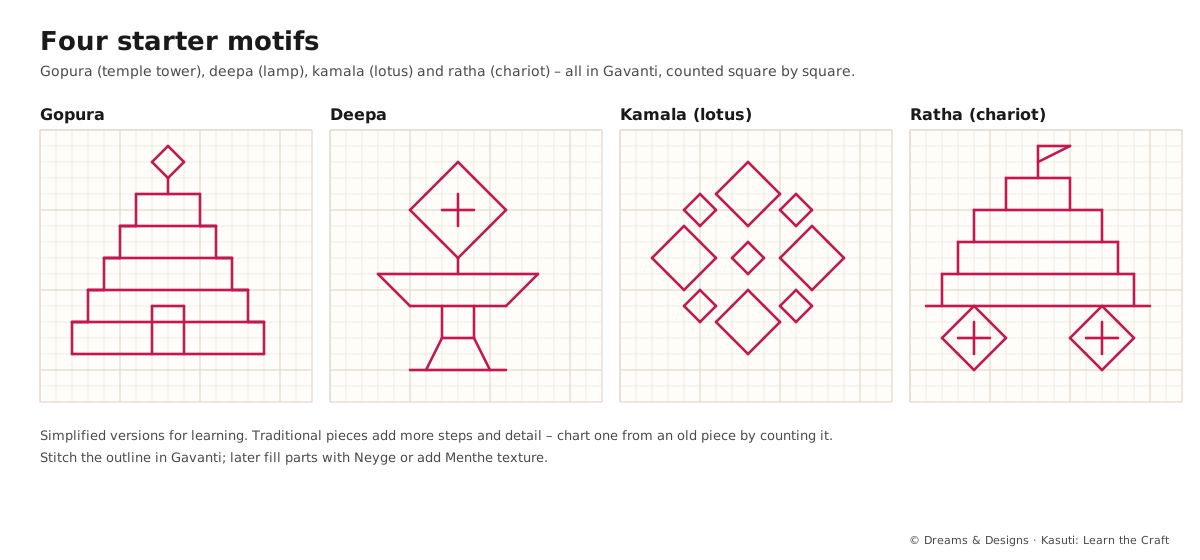
- Gopura – the stepped gateway tower of a South Indian temple. It is one of the most loved Kasuti motifs, and its steps suit the grid perfectly. Often read as devotion, or reaching upwards.
- Deepa – the oil lamp, linked with knowledge and with light driving away darkness. A small, quick motif, good as a filler.
- Kamala – the lotus, linked with purity. Several named forms are recorded.
- Ratha – the temple chariot that carries a deity in a festival procession. A large, important motif, usually placed where it will be seen.
All four are charted above in Gavanti outlines. Stitch each one on Aida, following the route-planning method from Module 3, Gavanti: the double running stitch. Later you can fill parts with Neyge or add Menthe texture.
About meanings: the peacock for beauty, the lotus for purity, the elephant for strength – these are shared, traditional associations. They are not a strict code that every embroiderer follows. Treat them as stories that go with the motifs, not rules.
In more depth: the motifs family by family
Temple and ritual
- Gopura – the temple gateway tower, stitched as a stack of steps getting narrower towards the top.
- Asana – a seat or platform prepared for a deity or an honoured guest. Often shown with a lotus.
- Tulsi katte (also tulsi vrundavan, tulasi katte) – the small raised stand built round a holy basil plant in the courtyard of many homes.
- Deepa – the oil lamp, stitched with a stepped base, a bowl and a flame.
- Shiva-linga, Nandi (Shiva’s bull) and shivana basinga (a crown-like ornament linked with Shiva) – these reflect the strong Shaiva and Lingayat roots of much traditional Kasuti.
- Conch, sun-face and the swastika – very old auspicious signs in India, used long before, and quite apart from, the twentieth-century misuse of the swastika in Europe.
Ceremony and home
- Ratha – the festival chariot.
- Pallakki – the palanquin, often paired with the ratha.
- The cradle (thottilu) – sometimes called “Rama’s cradle”, linked with births and naming ceremonies.
- Everyday things – flower pots, anklet bells (gejje) and similar small objects, usually used as fillers. They show that Kasuti grew from close looking at ordinary home life, not only from temples and courts.
Animals and birds
- Navilu – the peacock, usually with its tail spread.
- Aane – the elephant, often carrying an ambari (the ceremonial seat on its back).
- Jinke (deer), Nandi, tigers, horses, squirrels, and the naga (snake deity), which reflects snake worship across the region.
- Birds: parrots, swans, sparrows, ducks, pigeons and cocks.
Flowers and plants
- Kamala – the lotus. Craft surveys record named forms such as gandle kamala, gopi kamala and chittu kamala.
- Other flowers: jasmine, chrysanthemum, marigold, coconut flower, the cotton flower, and creepers.
- Seeds and fruit: stylised grain, cashew, almond (badami), grapes and rudraksha beads.
Where each kind goes
Large motifs (gopura, ratha, elephant, peacock) are the stars of a design and go where they will be seen most: on a saree, the pallu. Medium motifs (lotus, deepa, parrot) form rows and borders. Tiny motifs (dots, stars, small flowers) fill the spaces and fade a design out. The next lesson, From buti to border to corner, shows how to put them together.
Tips for learners and teachers
- Start with the deepa. It is small and has only straight lines, steps and one point: a good first motif after a plain border.
- Chart before you stitch. Copy each motif onto graph paper by counting, even from the chart above. Copying by counting teaches you how it is built.
- Chart from real pieces. If you have an old Kasuti piece at home, count its stitches onto graph paper instead of tracing its outline. You will learn far more.
- Keep a motif book. Stitch each new motif once on a labelled scrap and keep the scraps together. It becomes your own reference library.
- Find the centre line. Most motifs are mirror-images left to right. Mark the centre column, then stitch one side and copy it on the other.
- Simplify at first. The charts here are simplified for learning. Add steps and detail only once the simple version is clean.
- For teachers: put up a grid of real motifs and ask learners to sort them into the four families. It makes the vocabulary stick.
- For teachers: let each learner pick the motif they like most for Project 4. A motif they care about keeps them going through the long stitching.
Common misunderstandings
- Myth: every motif has one fixed meaning. Fact: meanings are traditional and widely shared, but they vary between families and regions. Sources present them as associations, not rules.
- Myth: curved, freely drawn motifs can still be Kasuti. Fact: a motif that leaves the counted grid may look pretty, but it is no longer built the Kasuti way.
- Myth: the swastika in Kasuti has a political meaning. Fact: it is an ancient Indian sign of good fortune, far older than its misuse in twentieth-century Europe.
- Myth: Kasuti motifs are only religious. Fact: many are everyday things: flower pots, cradles, squirrels, cashews.
- Myth: you must stitch a motif exactly as the old pieces show. Fact: embroiderers have always simplified and adapted motifs. What must stay is the counting and the clean back.
For earning and teaching
For earning: customers often ask for a motif because of what it means to them – a lotus for a wedding blouse, a cradle on a baby’s outfit, a deepa for a festival. Being able to explain a motif’s traditional meaning, simply and honestly, adds to a piece. Say “traditionally linked with”, never “guaranteed to bring”.
For teaching: motifs are where learners fall in love with Kasuti. A good first class on motifs is: sort photos into the four families, chart a deepa together on graph paper, then stitch it in Gavanti.
Sources and uncertain points
- The number of named motifs is reported differently; “over 700” is a figure from craft surveys, not a counted catalogue.
- The link with rangoli is often stated by writers; it is a likely influence, not a proven one.
- Meanings (peacock = beauty, lotus = purity, elephant = strength) are traditional associations; sources differ.
- Lotus variant names (gandle, gopi, chittu kamala), shivana basinga and “Rama’s cradle” are recorded in craft surveys; spellings vary and a Kasuti teacher should confirm them.
- Kannada words given here (thottilu, gejje, badami) are the common spellings; others exist.
- Source: D&D’s ebook Kasuti – The Complete Encyclopedia, chapters 7, 8, 21 and 23.
Check yourself
- Can you name the four families of Kasuti motifs?
- Can you give the Kannada names for peacock, elephant and lotus?
- Can you explain why a Kasuti peacock looks stepped?
- Do you know where a large motif like the ratha usually goes on a saree?
- Have you charted and stitched at least one of the four starter motifs?
Answers: temple and ritual, ceremony and home, animals and birds, flowers and plants · navilu, aane, kamala · because every line is counted on a grid · on the pallu, where it is seen.