Kasuti is beautiful and protected – so why isn’t it known everywhere? The reasons are practical, and most of them can be changed. This lesson names ten of them honestly, so that the next two lessons can look at what to do.
What you’ll learn
- Ten practical reasons Kasuti is not better known.
- Which of them are about the craft, and which about the market.
- Which ones a single learner, maker or buyer can help change.
- How the challenges connect to each other.
Ten things that hold it back
- Time. Thousands of stitches per piece make it slow, and so costly – and a buyer who doesn’t know that sees only the price.
- Few, ageing hands. Fewer young people learn it, and embroidery has often been poorly paid.
- A narrow product range. It is still seen mainly as a saree or blouse craft.
- An “old-fashioned” image. The traditional palette on black reads as heritage, not as something to wear every day.
- Low awareness. Outside north Karnataka, many people have never heard the word Kasuti.
- Cheap imitations. Machine-embroidered and printed copies look similar at a glance and undercut the price.
- Hard to verify. Most buyers don’t know to turn a piece over, so real and fake are sold side by side.
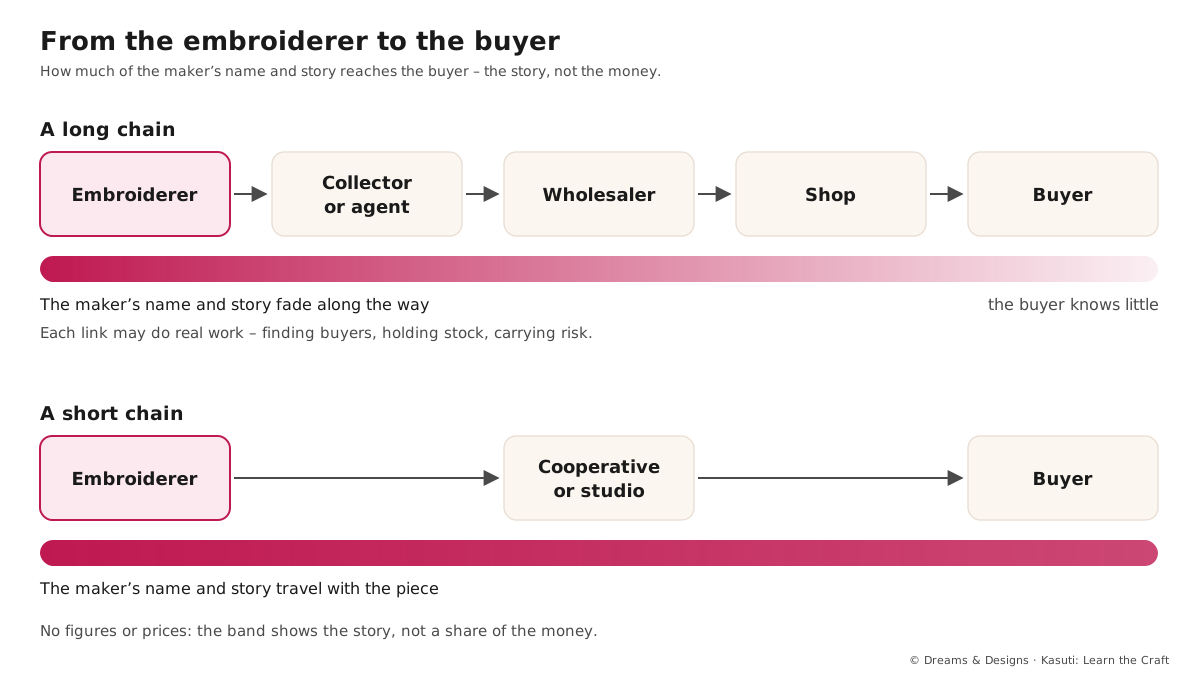
- Long chains of middlemen. Little of the price reaches the embroiderer.
- Little online presence. Few artisans have good photos, a story, or a way to sell beyond their town.
- No common standards for sizes, finishing, labels or care – which bulk and overseas buyers expect.
How they connect
These problems feed each other. Because the work is slow, it costs more. Because buyers can’t tell real from fake, they choose the cheaper copy. Because the real work sells less, embroiderers earn less, and young people choose other work. Because there are fewer makers, there are fewer good photos, fewer products and less awareness. The circle can be broken at almost any point – and every point where it is broken helps the others.
| Kind of problem | Which ones | Who can help most |
|---|---|---|
| About the craft | Time, few hands, narrow range, image | Makers, teachers, designers |
| About the buyer | Awareness, imitations, verifying | Sellers, teachers, every learner |
| About the market | Middlemen, online presence, standards | Cooperatives, studios, brands, state bodies |
In more depth
Time
A single elaborate motif or panel can need several thousand hand stitches; craft documentation describes pieces of around 5,000 stitches. Neyge, the slowest stitch, is the first to be dropped under time pressure. Time cannot be removed without changing the craft, but it can be explained, and products can be designed so that a buyer can afford a small piece of real work.
Few, ageing hands
Craft writing has long noted the difficulty of drawing young people to Kasuti. Low and uncertain pay, piece-rate work and the slow learning curve all play a part. Training centres, cooperatives and programmes such as Kaikrafts and Banjara Kasuti (Module 8, Kasuti now, and where to go next) show that steady work and fair rates bring learners back.
Image and range
The Chandrakali and the Ilkal saree are the craft’s pride, but they can also box it in. Many people think of Kasuti as something their grandmother wore. New colours, grounds and products, with the method unchanged, are the answer (next lesson).
Imitations and verifying
The GI protects the name, but it cannot check each item in a shop. Machine and printed copies are cheaper and quicker, and most buyers never look at the back. Every buyer who learns to turn a piece over weakens the copies.
Middlemen and standards
Long supply chains are common in Indian crafts. They often provide real services – finding buyers, holding stock, carrying risk – but they can also leave the maker with a very small share and no name on the product. Cooperatives and direct selling shorten the chain. Bulk and overseas buyers also want consistent sizes, finishes, labels and care instructions, which home-based work rarely has yet.
Tips for learners and teachers
- Pick one problem you can touch. A learner can raise awareness; a maker can improve photos; a buyer can check the back. Start there.
- Keep a time log of your own pieces (Module 11, Your stitch log: documenting your work). When someone asks why hand Kasuti costs more, you can show them.
- Turn it over in public. At a stall, a class or online, show the back. It teaches buyers in seconds.
- Say the name. Use the word “Kasuti” every time, with a one-line explanation, so people learn it.
- For teachers: ask learners which of the ten problems they have seen themselves. Real stories make this lesson stick.
Common misunderstandings
“Kasuti is expensive because sellers overcharge.”
Real hand Kasuti takes a great deal of time. Its cost mostly reflects hours of skilled work, though how much of the price reaches the maker varies a lot.
“Machine copies help by making Kasuti popular.”
They spread the look, but they also undercut makers and teach buyers to expect low prices. A copy sold honestly as “Kasuti-inspired machine embroidery” is a different matter from one sold as Kasuti.
“Middlemen are always the problem.”
Not always. Many do useful work. The problem is a chain so long and so hidden that the maker gets little and the buyer knows nothing.
“The GI should have solved this.”
A GI is a legal tool for the name. It helps, but it cannot by itself pay embroiderers, train new ones or teach buyers.
For earning and teaching
For earning: each problem in this lesson is also an opening for a small maker or studio – good photos, a clear story, honest labels, products a buyer can afford, and a fair share for the person who stitched it. The course Kasuti as a Business works through these, starting with What you are really selling and Pricing your time.
For teaching: every new learner you teach is one more person who knows what Kasuti is and how to check it. Teaching is part of the answer.
Sources and uncertain points
- The ten points follow the earlier version of this lesson, with background from the D&D ebook, chapters 1 (stitch counts), 14 and 16 (Neyge and imitations), 17 (decline and revival) and 19 (sourcing and costing).
- Stitch counts of around 5,000 per piece are as described in craft documentation; real counts vary greatly with the design.
- There is little reliable published data on Kasuti embroiderers’ numbers, ages or pay today; statements here are general and come from craft writing.
Check yourself
- Can you name five of the ten problems?
- Can you explain how slow work and cheap copies feed each other?
- Can you say why the GI alone cannot solve these problems?
- Can you name one problem that you, personally, can help with this month?
- Do you know which problems are about the craft, which about buyers, and which about the market?