Phulkari (“flower work”) is the embroidery of Punjab, once stitched by women for their families’ weddings – like Kasuti. The two crafts sit at opposite ends of India, yet both count the threads of a handwoven cloth and both belong to the bride. This lesson shows where they meet and where they part.
What you’ll learn
- What Phulkari is, and its main kinds.
- Four ways Phulkari and Kasuti are alike.
- Four ways they differ.
- How Phulkari’s darning compares with Neyge.
Phulkari in brief
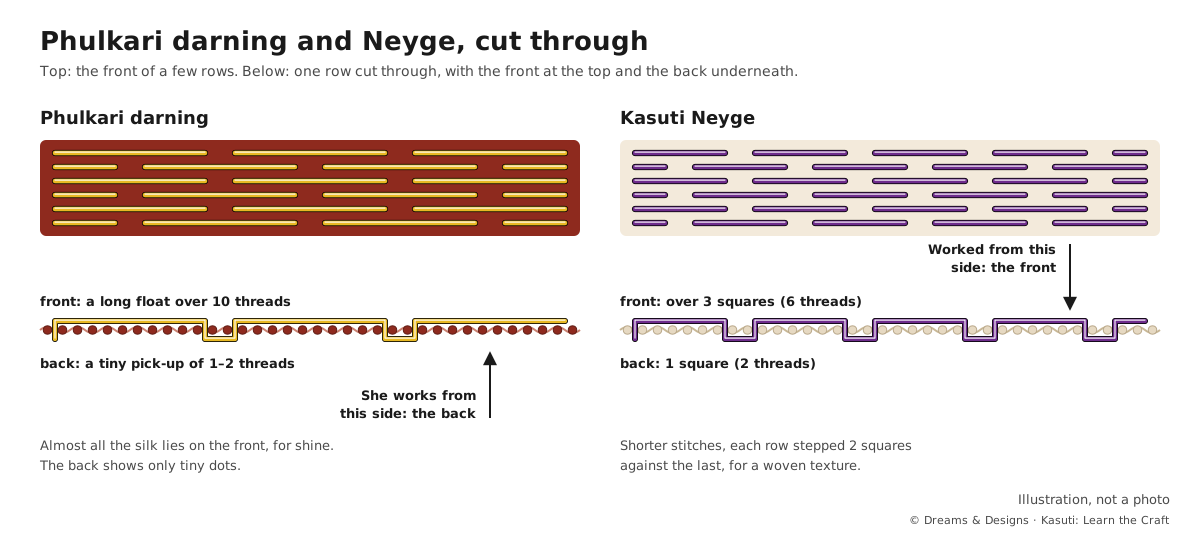
Phulkari comes from Punjab, a region now divided between India and Pakistan, and is also made in Haryana. It is worked in untwisted silk floss (called pat) on khaddar, a coarse handwoven cotton, often dyed a deep red or rust. The main stitch is a darning stitch worked from the back of the cloth: a long stitch lies on the front, and only a thread or two is picked up underneath. By changing the direction of the stitches – across, down or on the slant – the embroiderer makes the same golden silk catch the light in different ways.
There are several kinds. A bagh (“garden”) covers the whole cloth so the ground almost disappears. A phulkari in the narrow sense scatters motifs and leaves the ground showing. A chope, traditionally given by a grandmother to a bride, has stitching only along the edges. The sainchi shows people, animals and village life.
Alike
- Counted on handloom: both count the threads of a coarse handwoven cloth – khaddar for Phulkari, Ilkal and khun for Kasuti.
- Darning: Phulkari’s long darning stitch is a close cousin of Neyge’s woven fill.
- Women, weddings and trousseau: both were home crafts made for brides and passed down the family.
- Geometry: both build flowers and figures from straight, counted lines.
Different
- Coverage: a Phulkari bagh can cover the whole cloth so the ground disappears; Kasuti leaves the dark ground showing between motifs.
- Working side: Phulkari is worked from the back of the cloth; Kasuti’s Gavanti and Murgi are made to look right on both sides.
- Thread: Phulkari’s untwisted silk floss gives a glossy, satin-like shine; Kasuti uses twisted cotton or silk for crisp lines.
- Motifs: Phulkari favours flowers, geometric fields and village life; Kasuti is full of temple and procession motifs.
In more depth
Phulkari darning and Neyge side by side
Both are rows of running stitch placed by counting. In Phulkari, almost all the thread lies on the front as long, shiny floats, and the back shows only tiny dots; it is a way of covering cloth with silk while using as little as possible underneath. In Neyge, the stitches are shorter and the rows are stepped against each other, so the surface looks like a woven band. Phulkari aims for shine; Neyge aims for texture.
The chope, a two-sided exception
Craft writing describes the chope as worked in a double running stitch, so its border looks the same on both sides. If so, the chope uses exactly Gavanti’s logic, in another corner of India and for the same occasion: a wedding.
From home to market
Like Kasuti, Phulkari began as unpaid work for the family. Tradition says a grandmother would begin a bagh when a granddaughter was born, to finish by her wedding. The 1947 Partition split the craft’s homeland, and the old bagh became rare. Today much Phulkari is made for sale, some of it machine-made or printed, while cooperatives and designers work to keep the hand craft alive. Phulkari has a GI covering parts of Punjab, Haryana and Rajasthan. The story is very close to Kasuti’s (Module 8, Kasuti now, and where to go next).
Colour
Phulkari often uses one dominant colour – golden yellow or white silk on red – with touches of others. Kasuti uses several colours together on a dark ground, each with a job: one for outlines, one for bands, others for fills.
Tips for learners and teachers
- Try a Phulkari darn. Work a small diamond in Phulkari darning beside a Neyge band on the same Aida. The difference in how much thread lies on the front is easy to feel.
- Change the direction. Phulkari teaches a useful trick: the same thread, stitched in a different direction, looks like a different shade. Try it in a Neyge fill.
- Compare the backs. Turn both samples over: Phulkari’s back is mostly dots, Gavanti’s back is a line.
- Talk about weddings. Learners from Punjabi and Kannadiga families often have stories of a grandmother’s bagh or Chandrakali. Invite them.
- Use untwisted floss with care. It is beautiful but frays and tangles. Use shorter lengths if you try it.
Common misunderstandings
“Phulkari is just a kind of dupatta.”
Phulkari is the embroidery. Today it is mostly seen on dupattas, but the old pieces were large shawls and the work appears on many products.
“Phulkari is drawn, Kasuti is counted.”
Traditional Phulkari is counted too. Many modern pieces are printed and stitched freely, which is part of why the old counted work is so valued.
“Neyge and Phulkari are the same stitch.”
They are related darning stitches, but the length of the floats, the stepping of the rows and the look are different.
“Kasuti is reversible because it is counted.”
Counting gives precision. Reversibility comes from the double running logic of Gavanti and Murgi. Phulkari is counted but not reversible.
For earning and teaching
For earning: some buyers come looking for “something like Phulkari but different”. Kasuti’s dark ground and temple motifs make a good answer. Describe both honestly, and never call Kasuti a southern Phulkari.
For teaching: a “two brides” session – a Chandrakali pallu next to a Phulkari bagh, in pictures – makes the history of both crafts memorable and shows why counted embroidery belonged to weddings.
Sources and uncertain points
- The comparison points follow the earlier version of this lesson and the D&D ebook (chapters 3 and 6 for Kasuti).
- Phulkari details come from general craft knowledge. Names and kinds vary between regions and writers.
- The chope being worked in a two-sided double running stitch is reported in craft writing.
- The grandmother beginning a bagh at a granddaughter’s birth is traditionally said.
- The Phulkari GI and its regions are as reported; check the GI Registry for the exact entry.
Check yourself
- Can you say what “phulkari” and “bagh” mean?
- Do you know which side of the cloth Phulkari is worked from?
- Can you give two ways Phulkari and Kasuti are alike?
- Can you give two ways they differ?
- Can you explain how Phulkari darning differs from Neyge?