Every feature of Kasuti can be found somewhere else in the world. What no other tradition has is all of them together. This lesson pulls the whole module into one clear answer you can give anyone who asks, “What is special about Kasuti?”
What you’ll learn
- The six features that together make Kasuti unique.
- Which cousin shares each feature, and what Kasuti adds.
- How to explain Kasuti in one sentence, and in one minute.
- Why the combination, not any single feature, is the point.
The combination
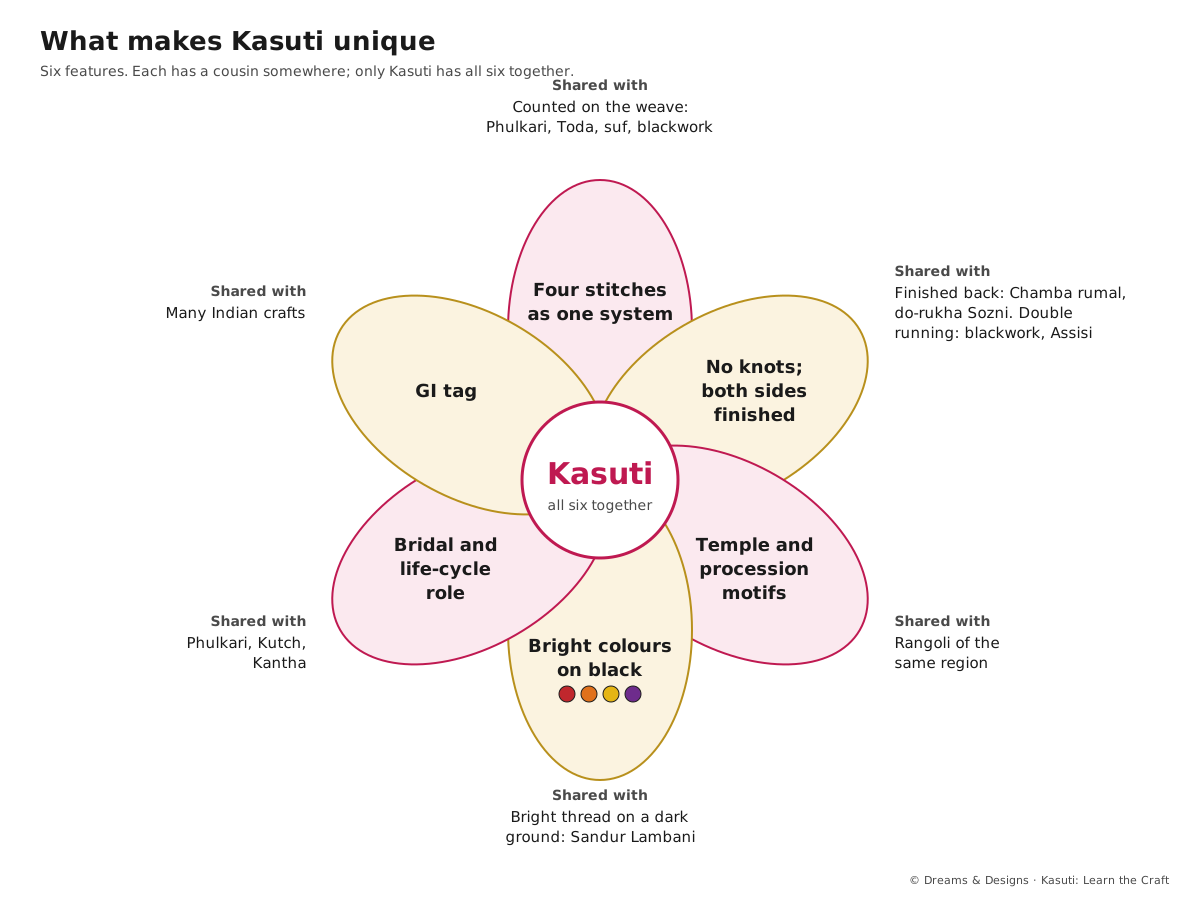
Put all of these side by side and Kasuti stands out for a combination no other tradition has in full:
- A four-stitch system – Gavanti, Murgi, Neyge and Menthe – that covers outline, band, fill and texture.
- No knots, ever, and near-perfect reversibility in its main stitches.
- Temple and procession motifs – gopura, ratha, pallakki, tulsi katte – close to the rangoli of the same region.
- A signature palette: red, orange, yellow and purple on black.
- A bridal and life-cycle role – the Chandrakali saree, gifts for new mothers.
- Legal recognition through its GI tag.
Each feature has a cousin somewhere. Blackwork shares the double running stitch. Phulkari and Toda share counted darning. Chamba rumal shares the finished back. Kutch and Phulkari share the bridal role. Many crafts have a GI. But only Kasuti brings all six together, built on one rule: count the threads, and let both sides show.
Shared, and Kasuti’s own
| Feature | Also found in | What Kasuti adds |
|---|---|---|
| Counted on the weave | Phulkari, Toda, suf, blackwork | Four stitches working as one system |
| Double running line | Blackwork, Assisi outlines | Murgi: the same logic on a zig-zag |
| Finished back | Chamba rumal, do-rukha Sozni | Achieved by counting, with no knots at all |
| Wedding and birth role | Phulkari, Kutch, Kantha | The black Chandrakali, the baby’s kunchi |
| Motifs from temple and festival | Rangoli of the same region | Gopura, ratha, pallakki, tulsi katte in thread |
| GI tag | Many Indian crafts | Protects the name and its north Karnataka home |
When you explain Kasuti to someone abroad, the comparison helps: “It’s Karnataka’s counted-thread embroidery – like blackwork, but with four stitches, no knots, and both sides finished.”
In more depth
Why the combination matters
A single feature can be copied. A machine can make a geometric pattern; a printer can copy the palette; anyone can stitch a gopura. What cannot be faked easily is the whole: counted placement, four stitches doing four jobs, both faces clean, no knots. That is why the back is the test of authenticity (Module 8, Is it real?), and why the rules in Module 10 say “change the surface, keep the structure”.
A system, not a stitch
Many crafts are known by one stitch: Kantha by its running stitch, Aari by its chain. Kasuti is a small, complete language. Gavanti draws, Murgi makes bands and steps, Neyge fills with texture, Menthe adds crosses and stars. Together they can render a temple tower, a chariot or a lamp with nothing but straight lines.
The one-minute version
“Kasuti is the hand embroidery of north Karnataka. It is counted, not drawn: the embroiderer counts the threads of the cloth and places every stitch by that count. It uses four stitches and never knots the thread, so the main lines look the same on the back as on the front. Its motifs come from temples and festivals – towers, chariots, lamps, palanquins – usually in bright colours on a black ground. It was stitched for brides and new babies, and it has a GI tag.”
Tips for learners and teachers
- Learn the one-sentence version by heart. You will use it every time someone admires your work.
- Show, then tell. Turn a sample over before you explain. The back makes the point.
- Use the table as a revision sheet at the end of Module 9.
- Ask learners to argue. “Is the GI what makes Kasuti unique?” makes a lively five-minute discussion – and the answer is no.
- Link back to the stitches. For each feature, ask which stitch carries it: Gavanti for the finished line, Murgi for the band, Neyge for texture, Menthe for crosses.
Common misunderstandings
“Kasuti is unique because it has a GI.”
Many crafts have a GI. The GI protects Kasuti’s name and home, but its uniqueness is in the method and the combination.
“Kasuti is unique because it is reversible.”
Chamba rumal and do-rukha Sozni are two-sided too. Kasuti reaches it by counted double running, without knots, in a four-stitch system.
“All four Kasuti stitches are reversible.”
Only Gavanti and Murgi are made to look the same on both sides. Neyge and Menthe have a working back.
“The palette defines Kasuti.”
The traditional palette is a strong signature, but modern Kasuti in white on white or indigo on indigo is still Kasuti if the method is kept.
For earning and teaching
For earning: the six features are your product story. A label, a listing or a stall sign can carry two or three of them in plain words: “hand-counted”, “no knots”, “finished on both sides”. Don’t claim more than is true of the piece – if it uses Neyge or Menthe, its back will not be fully reversible.
For teaching: end Module 9 by asking each learner to explain Kasuti in one minute, using at least four of the six features. It is a good check that the module has landed.
Sources and uncertain points
- The six features follow the earlier version of this lesson and the D&D ebook, chapters 1, 3, 4, 6 and 7.
- The earlier lesson listed the GI among Kasuti’s unique features; we have kept it, and added that many Indian crafts hold a GI too.
- Comparisons with other crafts come from the lessons in this module; see their own “Sources and uncertain points”.
- “No other tradition has all of these in full” is our summary of the comparison, not a claim from a single source.
Check yourself
- Can you name all six features?
- Can you name a cousin that shares each of three features?
- Can you explain why the GI alone doesn’t make Kasuti unique?
- Can you say which two stitches are reversible?
- Can you describe Kasuti in one sentence to someone who has never heard of it?