Tapering narrows a trouser leg from the knee or thigh down to the hem. It turns a straight or wide trouser into a slimmer one, and it is one of the most requested changes for men’s trousers and jeans. Widening is harder, because it needs cloth that may not be there. This lesson covers both, with the one measurement that must never be broken: the foot has to go through the hem.

What you’ll learn
- How to measure and mark a taper on the wearer.
- How to share the taper between side seam and inseam.
- The minimum hem width a foot needs.
- Three ways to widen a leg.
Measure first
- Hem width now: lay the leg flat and measure across the hem; double it for the circumference.
- Hem width wanted: measure a trouser the wearer likes, flat at the hem.
- The foot: with the foot pointed, measure around the heel and over the instep (the diagonal). The finished hem circumference must be at least this, plus about 1 in (2.5 cm) for a woven cloth, unless there is a zip, slit or stretch. Teacher to check.
- Where the taper starts: at the knee for a gentle taper; at mid-thigh or higher for a slim one.
Taper: main steps
- Turn the trouser inside out on the wearer and pin both seams of one leg evenly from the hem upwards, until it looks right in the mirror. Let the wearer walk and sit.
- Take off. Measure the pinned amount at the hem, knee and thigh.
- Unpick the hem for 3 in (7.5 cm) either side of each seam.
- Lay the leg flat with the crease in place. Mark the new line on both seams: equal amounts at the hem, curving smoothly to nothing at the start point. Use a long ruler and a hip curve.
- Copy the marks to the other leg by laying the legs together.
- Sew both seams, then try on. Check the leg hangs straight and the crease is central.
- Trim allowances to the usual width, finish the edges, press open or to the back.
- Re-hem. A taper changes the hem’s shape, so re-shape the hem allowance to mirror the new leg (see Part VI, Hems: blind, topstitched and faced).
Widening: main steps
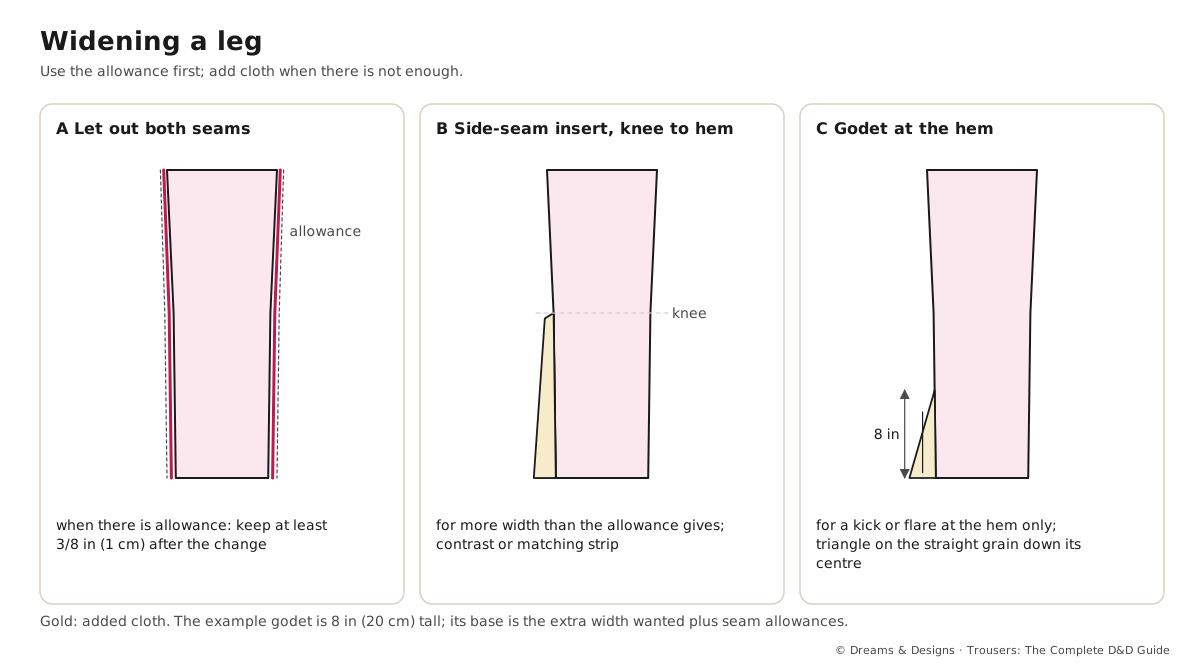
- Measure the allowance at both seams from knee to hem.
- If there is enough, let out both seams equally, keeping 3/8 in (1 cm) of allowance.
- If not, set in a long insert or a godet (see the folds below), or accept the leg as it is.
Teacher to check: a standard method; amounts in inches with cm.
Before you start
- Prerequisites: plain seams and hems (Part VI); Altering the seat, side seams and inseam.
- Time: 1–1 1/2 hours for a plain trouser; 2 hours or more for jeans.
- Difficulty: moderate.
- Tools: long ruler, hip curve, chalk, pins, seam ripper, overlocker or zigzag, iron.
- Check the style: a taper on a pleated trouser can make the pleats balloon; keep it gentle.
Step by step: a godet or kick-flare to widen the hem
- Open the side seam from the hem up to the height you want, for example 8 in (20 cm).
- Cut a triangle (godet) of matching cloth: height 8 in, base the extra width wanted plus seam allowances, on the straight grain down its centre.
- Sew one side of the godet to the front leg from the point to the hem, then the other side to the back leg. Stop exactly at the point; tie off by hand.
- Press the seams towards the trouser. Hem the leg and godet together.
A godet is a design change. Show the wearer a sketch first. See Part V, Adding flare: slash-and-spread, godets and flounces.
Variations, and left-handed notes
- Taper from the inseam only: keeps an outside stripe, piping or topstitched side seam untouched; limit to about 1/2 in (1.2 cm) each leg at the hem, or the leg will twist inwards.
- Taper from the side seam only: used on jeans with a felled inseam; same limit, or the side seam swings forward. See Altering stretch, knit and denim trousers.
- Tapering with an ankle zip or slit: lets the hem go narrower than the foot; for women’s cigarette trousers and children’s trousers.
- Converting to a jogger cuff: taper, then add a rib or elastic cuff at the ankle.
- Left-handed: mark with the trouser flat, working from the hem upwards on both seams so the curve matches.
Planning and control
- Proportion: a very narrow hem on a full thigh makes a “carrot” shape. Taper from higher up, or keep the hem wider.
- Knee room: keep at least 2 in (5 cm) of ease at the knee in a woven trouser, or the knee bags and strains when sitting. Teacher to check.
- Smooth line: the new seam should be one continuous curve; any step shows as a dent.
- Both legs equal unless the wearer’s legs differ.
Women’s, men’s and children’s legs
- Men: the common requests are a gentle taper from the knee on office trousers, and a slimmer leg on older jeans. Check the hem still covers the top of the shoe.
- Women: palazzos and wide-legs are often narrowed into straight trousers; a big change needs the hem fully reshaped and may lose the drape.
- Children: taper little; they need knee room, and the trouser must pass the foot quickly. An ankle elastic is often better.
- Adaptive wear: leave the leg wide enough for a brace, cast or prosthesis; consider a side zip. See Part III, Older bodies, seated and adaptive wear.
Tips, tricks and hacks
- Copy a trouser the wearer loves: lay it on top and trace its leg line.
- Measure the foot before you promise a narrow hem.
- Taper both seams for a straight leg.
- Start the taper higher for a bigger change; it looks smoother.
- Tack first and walk: a taper that looks fine standing can grab the calf on stairs.
- Re-shape the hem allowance after tapering, or the hem will pucker.
- Remove the old crease before tapering if it will no longer fall in the centre.
- Use a walking foot on slippery cloth so the layers do not shift.
- On a lined trouser, taper the lining a little less.
- Keep the trimmed strips for patches.
- What professionals do differently: they check the line from the side in a mirror, where a poor taper shows most.
Problems and how to fix them
The foot will not go through
- Let out the hem area by 1/4 in (6 mm) a seam.
- Add a short side slit or ankle zip.
- Prevention: measure the heel-to-instep diagonal first.
The leg twists
- Share the taper equally between both seams.
- Re-press the crease on the grain.
- Prevention: never take more than about 1/2 in (1.2 cm) from one seam only.
A dent or kink shows on the seam
- Resew with a smoother curve from higher up.
- Press over a seam roll.
- Prevention: draw the line with a hip curve.
The knee strains when sitting
- Let out at the knee by 1/4 in (6 mm) per seam.
- Move the start of the taper below the knee.
- Prevention: sit-test with the trouser tacked.
The hem puckers after tapering
- Unpick and reshape the allowance to mirror the leg.
- Make the hem allowance shallower.
- Prevention: always re-hem after a taper.
The trouser now looks out of proportion
- Let the hem out a little and taper from higher up.
- Change the length: a slightly cropped length often balances a slim hem.
- Prevention: pin on the wearer and view from the side.
Widening shows a pale line at the old seam
- Steam and brush; wash cotton once.
- Cover with a stripe or braid as a design.
- Prevention: warn the wearer before letting out faded or dark cloth.
Beginner mistakes and myths
- Myth: any trouser can become skinny. A woven trouser without stretch needs room for the knee and the foot.
- Mistake: tapering the side seam only.
- Mistake: starting the taper too low, making a sudden narrow ankle.
- Mistake: forgetting to re-hem.
Practice drills
- Beginner: taper an old pyjama from the knee by 1/2 in (1.2 cm) each seam.
- Improver: taper a men’s office trouser from the knee, re-hem, and check the crease.
- Confident: widen a cropped leg with a godet and hem it.
As a hobby, for earning, for teaching
As a hobby: tapering refreshes older trousers and jeans to a newer shape.
For earning: tapering is quick, steady work; a straight leg and an untouched crease bring people back.
For teaching: have learners measure each other’s foot diagonal and calculate the narrowest possible hem before cutting.
Care and finishing
- Finish edges and press seams before re-hemming.
- Re-set the crease with a damp press cloth.
Check yourself
- Do you measure the foot before tapering?
- Do you taper both seams equally?
- Do you re-shape the hem after tapering?
- Can you widen a leg with a godet?
Quiz
- What is the foot measurement for a hem? Answer: around the heel and over the instep, with the foot pointed.
- Why taper both seams? Answer: to keep the leg straight and the crease central.
- What can widen a hem with no allowance? Answer: an insert or a godet.
Key terms
- Taper: narrowing a leg gradually towards the hem.
- Heel diagonal: the foot measurement a hem must pass.
- Godet: a triangle of cloth set into a seam to add flare.
- Mohri: a common tailors’ word for the hem opening of a trouser or salwar; local use varies.
Sources and uncertain points
- Main source: D&D’s own trousers ebook, chapters 50–51 (taper the leg; distribute between side seam and inseam), widened with general tailoring practice.
- The foot-plus-1 in rule and knee ease are starting points. Teacher to check.