In Part V, Adding flare: slash-and-spread, godets and flounces, slash-and-spread added flare at the hem. Here the same method becomes a design tool. Slashes can run in any direction, stop at any hinge and open by any amount, so they can put volume exactly where you want it: pleats that fan from a curved seam, a peg that balloons at the hip, a cocoon, a paperbag waist, diagonal drape pleats. The rule that keeps the trouser wearable is simple: the waist, seat and crotch of the fitted block stay; only the volume moves.
Teacher to check: spread amounts are starting points, not yet checked by a D&D teacher.
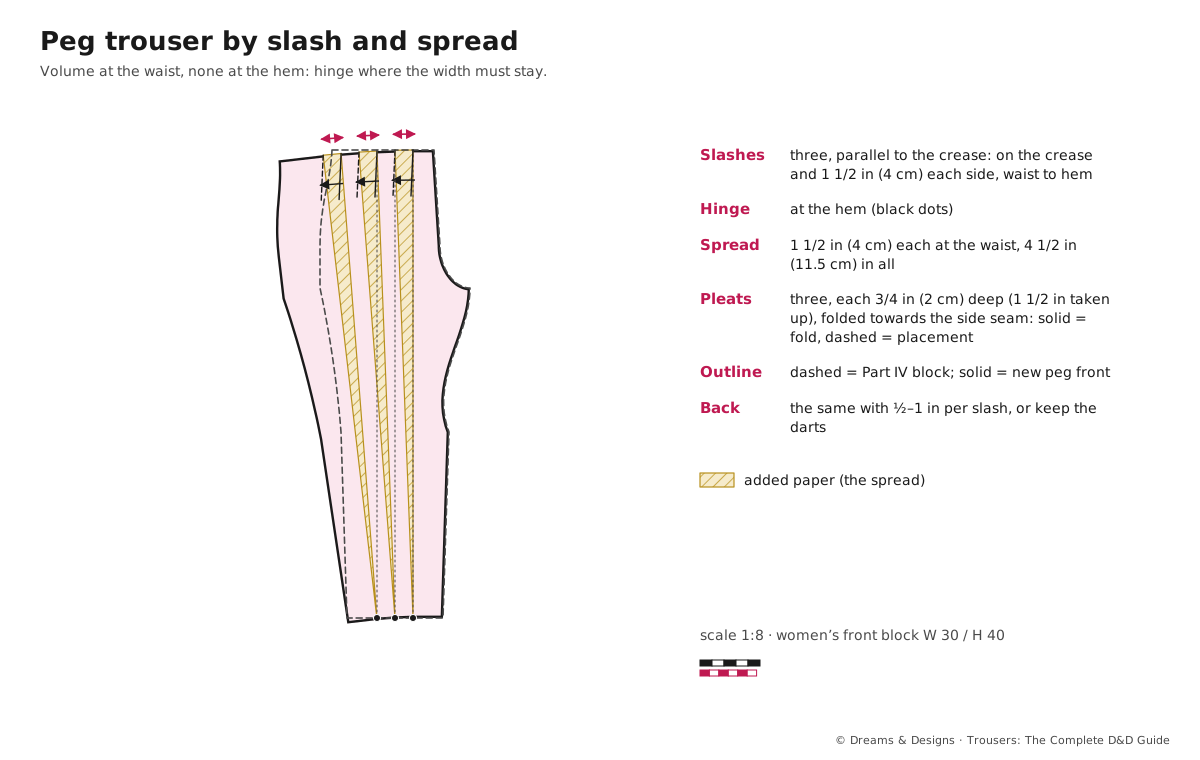
Photo: Curved style line, spread for three pleats.
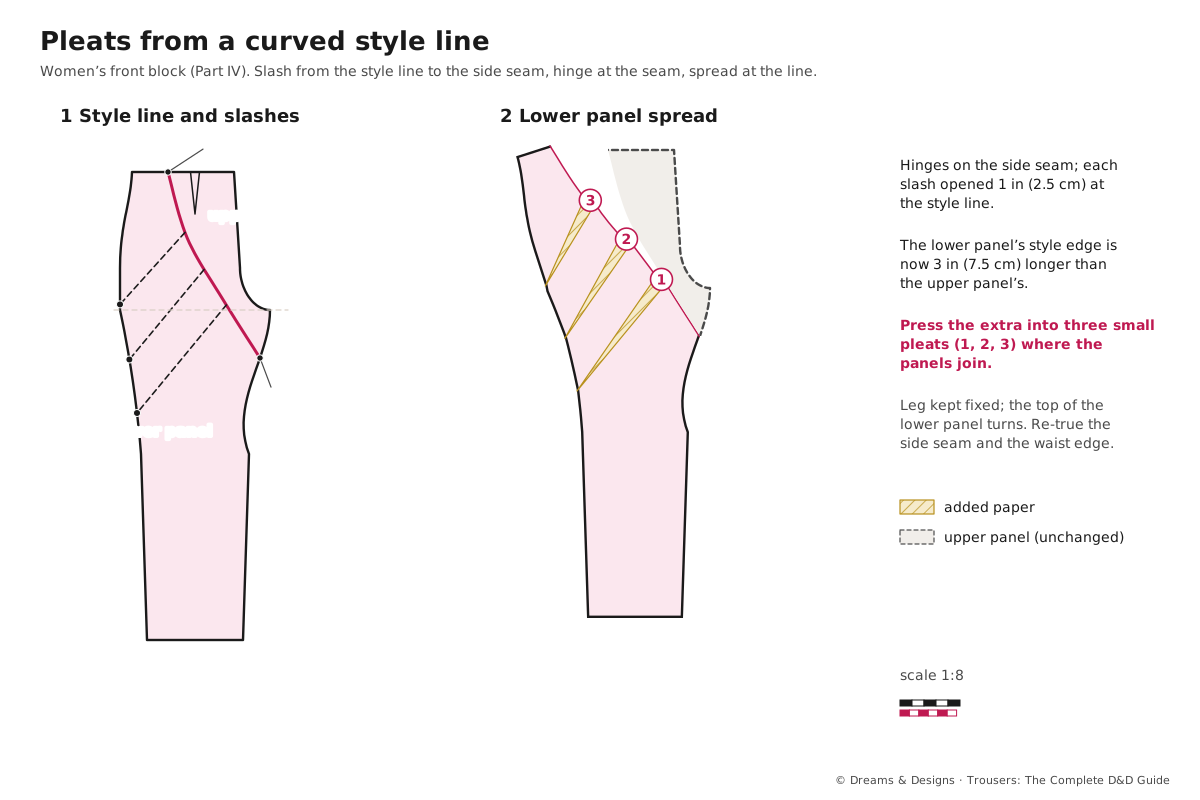
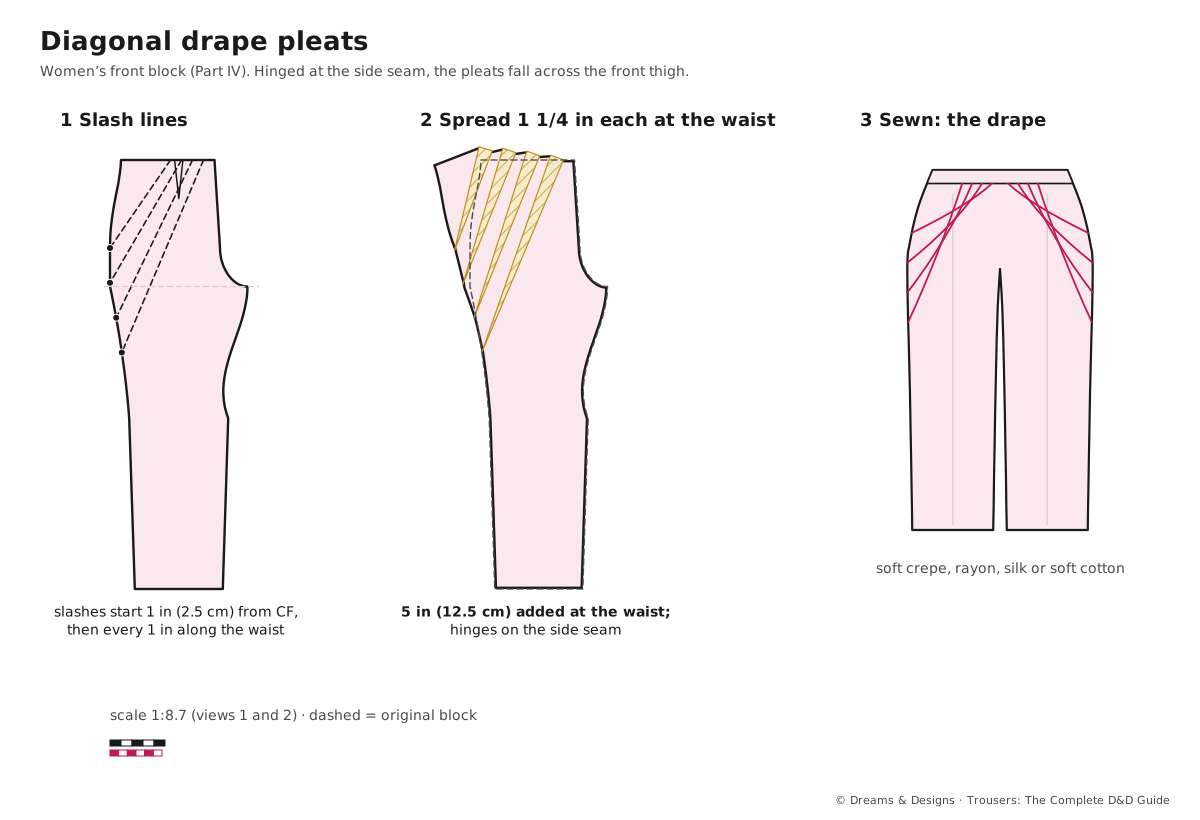
Photo: Diagonal drape pleats: four slashes hinged at the side seam.
What you’ll learn
- How the direction of a slash and the place of its hinge decide where volume appears.
- Five design moves: peg, balloon, cocoon, paperbag waist, and pleats from a style line.
- How to keep the fit while moving volume.
- How to check the result on a toile.
The two questions
- Where do I want the volume? At the waist, the hip, the thigh, the knee, along a seam?
- Where must it stay the same? Usually at the waistband seam (if fitted), the crotch curve, and the hem (if cuffed).
Slash from where you want volume to where you do not. Hinge at the place that must stay the same. Spread at the open end. That is the whole method.
Five design moves
| Move | Slashes | Hinge | Use the spread as |
|---|---|---|---|
| Peg | Vertical, waist to hem | Hem | Waist pleats or gathers |
| Balloon | Vertical, waist to hem | None (parallel) | Gathers into a band and a cuff |
| Cocoon | Horizontal, outseam to inseam | Inseam | Length on the outseam, so it curves out |
| Paperbag waist | Vertical, waist to hip | Hip (or parallel) | Gathers above and under the band |
| Style-line pleats | From a style line to a seam | The seam | Pleats or gathers along the style line |
Step by step: a peg trouser
- Trace the front block. Close the waist dart if you will replace it with pleats.
- Draw three slash lines parallel to the crease, from waist to hem.
- Cut each line to the hem, leaving a paper hinge.
- Spread each 1½ in (4 cm) at the waist. Look for: the hem width is unchanged.
- Redraw the waist as a smooth line; mark the spread as three pleats facing the side seam.
- Do the same on the back with less (½–1 in per slash), or keep darts there.
- Taper the hem a little more if you want a stronger peg.
- Toile: the pleats should open over the hip and fall closed at the ankle.
The other four moves, step by step
Balloon
- Slash front and back vertically waist to hem; spread each slash 2 in (5 cm) all the way down (parallel).
- Gather the waist into a band and the hem into a cuff the size of the ankle plus ease.
- Lengthen the leg 1–2 in (2.5–5 cm) so it blouses over the cuff.
Cocoon
- Draw three horizontal slashes from the outseam towards the inseam: at mid-thigh, above the knee and below the knee.
- Cut to the inseam, hinged there. Spread each 1 in (2.5 cm) at the outseam.
- The outseam now curves outward. Add the same total length to the back outseam, or the seams will not match.
- Redraw the outseam as one smooth curve; true the hem.
Paperbag waist
- Slash vertically from waist to hip; spread parallel 1 in (2.5 cm) each, three slashes per piece.
- Extend the top 1½–2 in (4–5 cm) above the waist for the ruffle.
- Sew a channel for elastic or a belt below the ruffle; or set the gathers under a separate band.
Pleats from a style line
- Draw a curved style line on the front, from the waist to the inseam or side seam.
- Cut along it. Draw slashes on the lower panel from the style line to the far seam; hinge at the far seam.
- Spread at the style line. Fold the extra as pleats or gathers when joining the panels.
Diagonal drape pleats
Slashes from the waist that run diagonally to the side seam, hinged there, give pleats that fall across the front of the thigh. They read as a soft drape. Spread 1–1¼ in (2.5–3 cm) per slash at the waist; more makes a cowl-like fall (draping a full cowl is in Draped styles: cowl-front and wrap trousers). Use a soft fabric: crepe, rayon, silk, soft cotton.
Before you start, and what you need
- Prerequisites: the basic slash-and-spread (Part V); a fitted block; pleats on paper (Part IV).
- Time: one hour per move on paper; two hours for a toile.
- Difficulty: intermediate.
- Tools: pattern paper, clear tape, paper scissors, a hip curve, a long ruler, a fabric marker.
- Budget: quarter-scale blocks on printer paper for trying ideas fast.
Variations
- Uneven spread: more at the side, less at the centre, for a sideways swing.
- Tulip front: spread the front for volume, then overlap two curved front panels.
- One-leg volume: spread only one leg, for asymmetry.
- Knee bloom: horizontal slashes at the knee, hinged at the inseam, with gathers into a seam.
- Left-handed: no change.
Planning and control
- Spread the same amount on mirrored pieces.
- Check that seams which join still match in length after spreading.
- Check that the pieces fit across your fabric.
- Choose fabric to match the move: crisp cloth for cocoons and pegs that stand out; soft cloth for drape pleats.
Where you see these in Indian fashion
- Peg and balloon: Afghani salwars, harem pants, children’s balloon pants.
- Cocoon: dhoti pants and some contemporary festive trousers.
- Style-line pleats and drape: common in contemporary Indian festive wear, especially draped dhoti-style pants with jackets.
- Paperbag waists: popular in Indian summer ready-to-wear and co-ord sets.
Women, men and children
- Women: every move is used; drape pleats and paperbag waists are frequent.
- Men: pegs (pleated trousers) and cocoons (dhoti pants) are the most common.
- Children: balloon and peg shapes with a cuffed ankle are practical for play; keep waist ruffles soft and short.
Tips, tricks and hacks
- Work at quarter scale first; it is ten times faster.
- Number the slashed pieces before you cut them apart.
- Draw a straight guideline on the new paper to keep pieces aligned.
- Close the dart into the first slash to save a step.
- Walk the joining seams after spreading.
- Use paper tape, not cellophane, if you will iron the pattern.
- Professionals record the spread on the pattern (“+3 in at waist, 3 slashes”).
- Pin paper pleats on the pattern to check how they fold.
- Volume needs weight to hang; very light cloth may need a lining.
- Photograph each version of the toile from the side.
Problems and how to fix them
1 · The waist grew
- Check the hinge was on the seam line, not the cutting line.
- Ease or pleat the extra into the band.
- Prevention: hinge exactly where size must stay.
2 · Seams no longer match
- Add the same length to the matching seam.
- Ease the longer seam.
- Prevention: walk seams after every spread.
3 · Pleats fall the wrong way
- Reverse the fold direction.
- Stitch pleats down 1–2 in (2.5–5 cm).
- Prevention: mark fold direction with arrows.
4 · The cocoon collapses
- Use a crisper fabric.
- Add a light underlining.
- Prevention: test fabric body first.
5 · The peg looks like a mistake
- Increase the volume to make it deliberate.
- Narrow the hem more.
- Prevention: sketch the shape before spreading.
6 · Drape pleats pull at the side seam
- Spread less per slash.
- Move the hinge lower.
- Prevention: toile in a fabric of the same weight.
7 · The piece will not fit across the fabric
- Add a seam in the leg.
- Reduce the spread.
- Prevention: measure the spread pattern against the fabric width.
Beginner mistakes and myths
- Mistake: spreading the crotch curve along with everything else.
- Mistake: forgetting to redraw a smooth outline.
- Myth: “Slash-and-spread is only for flare.” It moves volume anywhere.
Practice drills
- Beginner: make all five moves at quarter scale.
- Intermediate: make a toile of the peg and of the cocoon; compare from the side.
- Advanced: design your own move for a festive trouser and make it.
As a hobby, for earning, for teaching
As a hobby: one block and five moves make five trousers.
For earning: volume details give a small label a signature look without new blocks.
For teaching: students choose a move from a hat and present the result.
Care and finishing
- Steam pleats and gathers rather than pressing them flat.
- Hang voluminous trousers from the waistband with clips.
Sources and uncertain points
- General pattern-making practice; amounts are D&D teaching values.
- Names for these shapes differ between brands and schools.
Check yourself
- Can you decide the hinge from where size must stay?
- Can you make a peg without changing the hem?
- Can you make a cocoon and keep the seams matching?
- Can you add pleats along a curved style line?
Key terms
- Parallel spread: pieces opened evenly along their length.
- Style line: a seam placed for its look.
- Peg: full at the waist, narrow at the hem.
- Balloon: full throughout, gathered at both ends.
- Cocoon: curved outward through the leg.