A fabric treatment changes the colour or surface of cloth, or of a finished trouser. Washes soften and fade denim; dyeing and overdyeing change colour; resist techniques such as tie-dye, bandhani, leheriya and shibori make patterns by stopping dye from reaching parts of the cloth; indigo has a story of its own. Some of these are safe in a studio or at home, some need care, and some belong only in a factory. Each is labelled honestly here.
Teacher to check: dye amounts and times follow the dye maker’s instructions, which come first. Safety notes are general; read the label and safety sheet of every product.
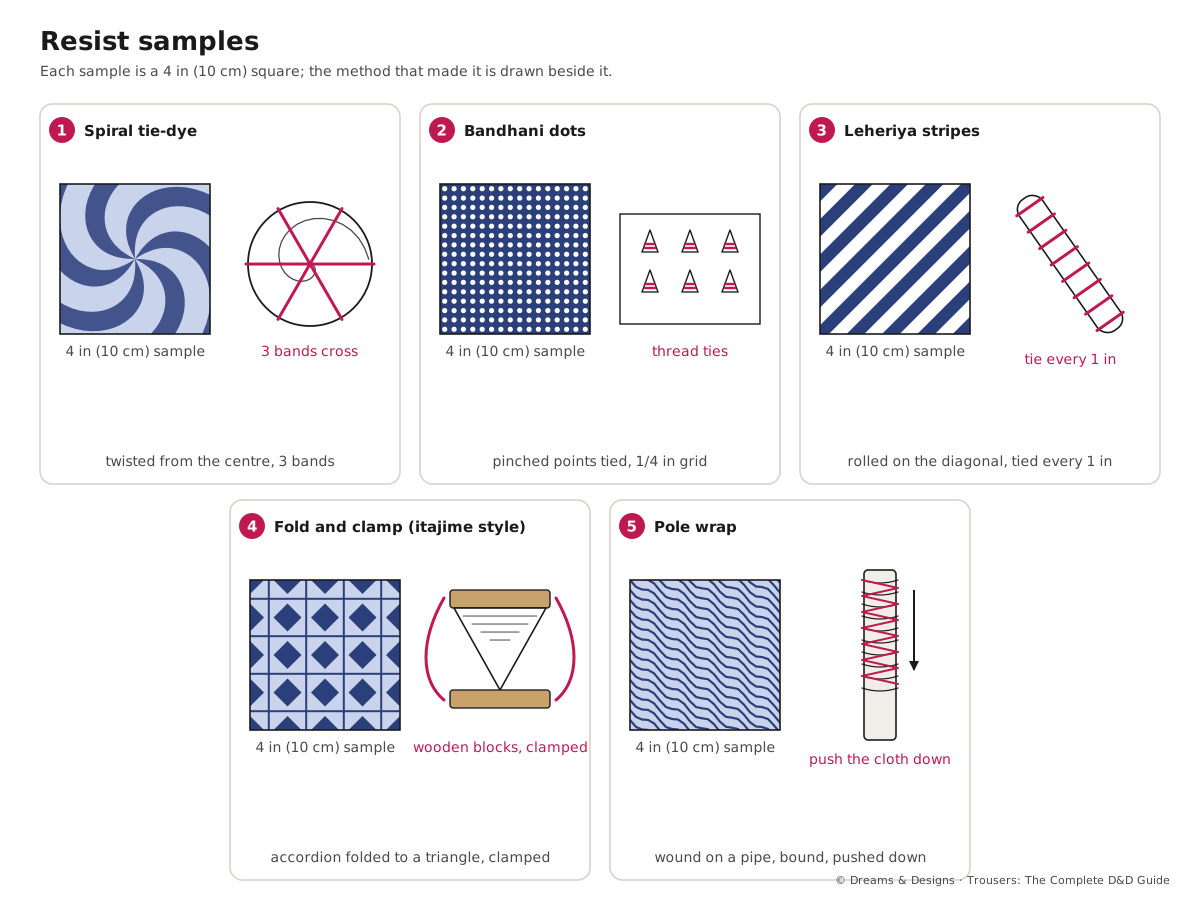
Photo: The four honesty labels used for every treatment.

What you’ll learn
- Four honesty labels for every treatment.
- What denim washes do, and which are safe.
- Garment dyeing, piece dyeing and overdyeing.
- Tie-dye, bandhani, leheriya, shibori and indigo, and how to place them on trousers.
The four honesty labels
- Studio-safe: can be done at home or in a studio with ordinary care.
- Studio with care: needs gloves, ventilation, a mask for powders, and separate tools never used for food.
- Factory only: needs industrial machines or chemicals; order it from a specialist unit.
- Short-lived: looks good new but fades or wears off in washing; tell the client.
Washes (mainly denim and cotton twill)
| Wash | What it does | Label |
|---|---|---|
| Rinse or soft wash | Removes stiffness, little fading | Studio-safe |
| Stone wash | Pumice stones rub the cloth; faded, worn look | Factory only |
| Enzyme wash | Enzymes soften and fade, with less damage than stones | Factory only |
| Acid wash | Stones soaked in a strong oxidising chemical give high-contrast marbling | Factory only |
| Bleach wash | Lightens the colour overall or in patches | Studio with care |
Sandblasting, once used for a worn look, caused serious lung disease (silicosis) among workers. Many brands and some countries have banned it. D&D does not recommend it. Laser finishing is the usual safer alternative (see the next lesson).
Dyeing and overdyeing
- Piece dyeing: the cloth is dyed before cutting. Even colour; the usual way.
- Garment dyeing: the finished trouser is dyed. Seams and edges take dye differently, giving a soft, lived-in look. Polyester thread does not take cotton dyes, so stitching stays its original colour: a design effect if planned.
- Overdyeing: dyeing over an existing colour. The result is a mix (yellow under blue gives green). Useful for refreshing faded trousers.
- Label: fibre-reactive and other cold-water dyes for cotton are studio with care; dyes for polyester need high heat and are mostly factory only.
Resist dyeing: tie-dye, bandhani, leheriya and shibori
- Tie-dye (general): cloth is twisted, folded or bunched and bound; the bound parts resist dye. Studio-safe to studio with care, by dye type.
- Bandhani (Gujarat and Rajasthan): thousands of tiny points of cloth are pinched and tied with thread before dyeing, giving dots in patterns. A highly skilled hand craft.
- Leheriya (Rajasthan): cloth is rolled on the diagonal and tied at intervals, giving wave-like diagonal stripes; mothra is a crossed version.
- Shibori (Japan): a family of shaped-resist methods: folding and clamping, stitching and pulling, binding, and wrapping on a pole.
Indigo
Indigo is a blue dye from plants (in India, mainly Indigofera tinctoria) and also made synthetically. It is not soluble in water, so it is used in a “vat” in which it is chemically reduced; the cloth comes out yellow-green and turns blue in the air. Each dip adds depth. Indigo is the dye of denim, and of many Indian textiles. Natural fermentation vats are studio with care; vats reduced with strong chemical reducers are studio with care at best and need training.
Step by step: a tie-dyed trouser hem (studio with care)
- Choose the trouser: 100% cotton, linen or viscose, washed to remove finishes.
- Plan placement: chalk where the pattern will go: hem band, one leg, side stripe.
- Tie: pleat the hem area into accordion folds and bind every 1 in (2.5 cm) with strong thread or rubber bands.
- Protect: wrap the rest of the trouser in a plastic bag tied off at the edge of the dye zone.
- Dye: follow the dye maker’s instructions; wear gloves and work in an airy place.
- Rinse in cold water until clear, then untie and wash warm.
- Dry and press. Check the colour in daylight.
Placing treatments on trousers
- Hem bands: tie-dye or bandhani along the hem draws the eye to the ankle; very common on palazzos and salwars.
- Ombré legs: dip-dyed, dark at the hem fading up; lengthens the visual line.
- Side stripes: leheriya or shibori strips set into the outseam.
- All-over: small bandhani dots or a soft shibori pattern read as texture.
- Before or after cutting: dye pieces before sewing if pattern must match across seams.
Where you see these in Indian fashion
- Bandhani on salwars, dupattas and festive palazzos, especially for weddings and festivals in Gujarat and Rajasthan.
- Leheriya for monsoon and Teej in Rajasthan.
- Indigo in handloom, block-printed and dabu (mud-resist) textiles; and in denim, much of it made in India.
- Garment-dyed and washed cottons in contemporary Indian casual wear.
Safety for each method
- Wear gloves for all dyes and bleach; a dust mask when mixing powders.
- Never mix bleach with other chemicals.
- Keep dye tools apart from kitchen tools.
- Work in a ventilated space; keep children and pets away.
- Dispose of dye baths as the product label says; ask your local authority about waste water.
- Children’s trousers: choose dyes that are washed out fully; wash twice before wearing.
Women, men and children
- Women: bandhani and leheriya palazzos and salwars; tie-dye co-ords.
- Men: washed and garment-dyed chinos and denim; indigo kurta pyjamas.
- Children: tie-dye is a favourite family activity; adults handle the dye, children do the tying.
Tips, tricks and hacks
- Test on a scrap of the same cloth first.
- Wash new cloth to remove finishes before dyeing.
- Dye the thread effect on purpose: sew with polyester thread before garment dyeing.
- Use a pipe from the hardware shop for pole-wrap patterns.
- Bind tighter for crisper resist lines.
- Dip lighter first; you can always go darker.
- Record recipes (dye, weight of cloth, time) in a notebook.
- Professionals dye a whole batch at once for matching colour.
- Buy genuine bandhani from craftspeople when you can; it supports the craft.
- Tell clients about colour run for the first few washes.
Problems and how to fix them
1 · Patchy colour
- Overdye a darker shade.
- Make it a deliberate mottled look.
- Prevention: wet cloth fully and stir often.
2 · Pattern too faint
- Re-tie and dye again.
- Use more dye.
- Prevention: bind tightly.
3 · Colour runs in washing
- Wash again in hot water as the dye label allows.
- Use a colour-catcher sheet.
- Prevention: rinse until clear.
4 · Polyester blend did not take dye
- Accept a heathered look.
- Use a dye made for blends.
- Prevention: check the fibre label.
5 · Bleach made holes
- Patch or darn as a design.
- Cut and remake the area.
- Prevention: dilute bleach and time it.
6 · Indigo rubs off
- Rinse and wash well.
- Add more thin dips.
- Prevention: many thin dips, not a few long ones.
7 · Seams are a different colour after garment dyeing
- Overdye darker.
- Call it a design detail.
- Prevention: test a sewn sample.
Beginner mistakes and myths
- Mistake: dyeing without gloves.
- Mistake: dyeing unwashed cloth.
- Myth: “Natural dyes are always safe.” Some mordants used with natural dyes are harmful.
- Myth: “Printed tie-dye is the same as bandhani.” Printed imitation is not tied; real bandhani has tiny raised points.
Practice drills
- Beginner: five resist samples on handkerchiefs.
- Intermediate: tie-dye a trouser hem band.
- Advanced: garment-dye a finished trouser with planned contrast stitching.
As a hobby, for earning, for teaching
As a hobby: tie-dye is joyful, quick and family-friendly.
For earning: overdyeing faded trousers is a useful service; working with bandhani and leheriya craftspeople adds value to a range.
For teaching: a resist-sample workshop is a popular one-day class; plan for safety and clean-up.
Care and finishing
- Wash dyed trousers separately, cold, inside out, for the first few washes.
- Dry in shade to slow fading.
Sources and uncertain points
- D&D ebook ch. 25 (jeans) and ch. 64 (environmental impact); general textile knowledge.
- Geographical Indication (GI) status exists for some bandhani from Gujarat; check the GI registry for the exact names before quoting.
- Bans on sandblasting differ by country and brand; described generally.
Check yourself
- Can you name the four honesty labels?
- Can you say which denim washes are factory only?
- Can you explain overdyeing?
- Can you tell bandhani, leheriya and shibori apart?
- Do you know the safety rules for dyeing?
Key terms
- Resist dyeing: blocking dye from parts of the cloth.
- Bandhani: Indian tie-resist dots.
- Leheriya: Rajasthani diagonal wave stripes.
- Vat: the dye bath for indigo.
- Garment dyeing: dyeing after sewing.