Every trouser worn today has ancestors. This family gathers sixteen of them, from the 3,000-year-old woollen trousers of the Yanghai riders to the Hammer pants of 1990. Each entry gives the historical cut and shows how to make a faithful version for theatre, film, re-enactment or a revival design.
What you’ll learn
- Sixteen historical trousers, in rough date order, and who wore them.
- The cut and closure of each, and what a modern maker changes.
- Which facts are firm and which are uncertain or traditionally told.
- How these styles return in today’s fashion.
What links these styles
These are the trousers of the past, kept alive in museums, paintings, re-enactment and costume. They follow the history told in Part I: the first riders’ trousers (History: the first trousers), Europe’s road from hose and breeches to long trousers (History: from hose and breeches to trousers), and the changes of the 20th century (History: the twentieth century). Read those lessons for the story; read this one for the garments.
How to tell them apart
Ask three questions. How long is the leg? (Knee: breeches, culottes, knickerbockers; ankle: pantaloons, bloomers.) How does it fasten? (Drawstring, laces to a belt, a fall front, a button fly, a zip.) And who wore it? (Riders, Roman soldiers, courtiers, cyclists, golfers, farm workers, entertainers.) The answers place most historical trousers within a century or two.
Where they show up in India
India has its own long trouser history, told in History: India’s trouser story: steppe dress brought by the Kushans, the Mughal pyjama and churidar, and jodhpurs. Several of the styles here reached India through British rule, uniforms and sport: breeches, plus-fours on golf courses, and later the Land Army look in war-time photographs. Theatre, film and period weddings in India often ask tailors for these cuts. Where we are not sure of a fact, the entry says so.
Tap any style to open its entry.
Yanghai riders’ trousers – wool, three woven pieces, straight legs, about 3,000 years old

Other names
Turfan trousers, the oldest trousers known so far.
Where it comes from
Found in graves at the Yanghai cemetery near Turfan in the Tarim Basin, Xinjiang, western China. A team led by Ulrike Beck and Mayke Wagner published radiocarbon dates of about the 13th to 10th century BCE in 2014. One man was buried with horse gear and weapons, which links the trousers to riding (see History: the first trousers). These are research reports, and dates may be refined.
The cut
Three pieces of woven wool: one for each leg and a stepped crotch piece joining them, shaped on the loom with almost no cutting. Straight legs, a high waist tied with a cord. Published research describes several weaving techniques in one garment and decorative bands at the knees.
Fabric
Best for a reconstruction: handwoven wool in twill and plain weaves, in natural browns. Worst: anything machine-smooth or synthetic.
From the block
Not from a block: draw two rectangles and a stepped crotch piece, then compare the result with The crotch curve: shaping and testing. The crotch piece solves the same problem as a modern crotch curve or a gusset (see Gussets and the crotch gusset).
Wear it
Museum displays, teaching and archaeology-inspired design. Worn originally by riders; such evidence as there is suggests steppe women rode and dressed practically too.
Fit notes and a tip
A reconstruction should say “illustration, after published descriptions”. Tip: build a paper model first; it is the best way to teach why a crotch piece is needed.
Scythian and Persian trousers – close, patterned riding trousers tucked into boots

Other names
Anaxyrides (the Greek word for these foreign trousers), Median dress.
Where it comes from
The Scythians were horse peoples of the steppe from about the 9th to the 3rd century BCE; the Medes and Persians ruled an empire in what is now Iran. Greek vase paintings show Scythian archers, and the mythical Amazons, in close, patterned trousers; Scythian gold work shows riders in trousers tucked into boots. Reliefs at Persepolis show Median dignitaries in trousers with tunics and coats. Herodotus, writing in the 5th century BCE, noted trousers as a foreign custom.
The cut
Close-fitting leg, high waist with a cord or belt, worn under a belted tunic or coat, the hem tucked into soft boots. Greek paintings show bold patterns: zigzags, checks and dots, though painters may have exaggerated them.
Fabric
Best for a reconstruction: wool or felt, leather for boots; patterned wool or appliqué for the Greek-painted look. Worst: shiny synthetics.
From the block
Start from a slim legging-like trouser (see From the block: taper, flare and wide legs) with ease for riding, and check seat room in The crotch curve: shaping and testing.
Wear it
Theatre, film, history displays and costume, with a belted tunic, a cap and soft boots. Steppe women wore trousers too, as burials show.
Fit notes and a tip
Reconstructions differ, because real cloth rarely survives; say which source you follow. Tip: leave extra length so the trouser does not pull out of the boot when the wearer bends.
Bracae (Rome) – Gaulish trousers, later worn by Roman soldiers on the frontiers
Other names
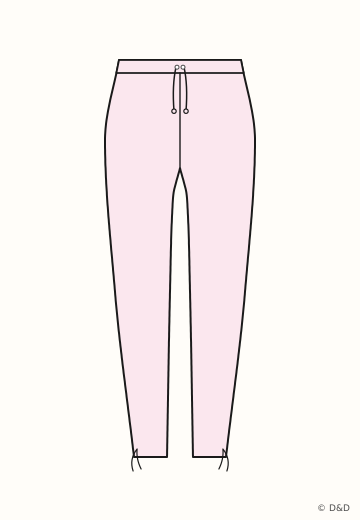
Braccae; feminalia for the knee-length Roman version.
Where it comes from
Bracae was the Latin word for the trousers of the Gauls, Germans and other northern peoples; Romans called part of Gaul Gallia Bracata, “trousered Gaul”. Roman soldiers on the cold northern frontiers adopted trousers and knee-length feminalia. Late Roman laws are reported to have banned trousers in the city of Rome around 400 CE, which suggests that people wore them (see History: the first trousers).
The cut
A loose or close trouser, ankle or knee length, gathered at the waist with a cord or belt and worn under a tunic. Some had ankle ties or were wrapped with leg bindings.
Fabric
Best for a reconstruction: wool twill or plain weave, checked wool for a Gaulish look. Worst: cotton jersey or anything with stretch.
From the block
A simple drawstring trouser like Indian drafts: churidar on the bias and kurta pyjama (the pyjama part), narrowed at the ankle.
Wear it
Re-enactment, school plays and costume, under a tunic with a cloak and boots or sandals.
Fit notes and a tip
Exact Roman cuts are uncertain; museum reconstructions vary. Tip: northern bog finds, such as the Thorsberg trousers, are the best evidence for a woven Iron Age trouser of this period.
Braies – loose medieval linen drawers tied at the waist

Other names
Brais, breeks (Scots), medieval drawers.
Where it comes from
Medieval European men wore loose linen braies as underwear, with separate hose on each leg tied to the braies belt (the braiel). Labourers sometimes worked in braies alone. Lengths shortened from the calf to the thigh over the Middle Ages (see History: from hose and breeches to trousers).
The cut
Very loose legs with a roomy, dropped seat, often made from rectangles and a gusset, gathered at the waist with a drawstring or a belt through a casing.
Fabric
Best for a reconstruction: linen. Worst: synthetics, which look wrong and are hot.
From the block
Rectangle-and-gusset construction, as in Gussets and the crotch gusset; or a wide pyjama from Indian drafts: churidar on the bias and kurta pyjama.
Wear it
Re-enactment and theatre, under a long tunic with hose.
Fit notes and a tip
Medieval clothing varied by place and century; follow one dated source. Tip: hand-sew with linen thread for the most convincing finish.
Hose and chausses – separate cloth leggings, later joined into one garment

Other names
Chausses (French), joined hose, “trunk” and hose. Chausses also means mail leggings worn with armour.
Where it comes from
In the Middle Ages, hose were separate cloth leggings for each leg, tied to the braies belt. In the 15th century the two legs were joined with a seat, the first close-fitting European trouser, closed at the front with a flap that grew into the codpiece (see History: from hose and breeches to trousers).
The cut
Cut on the bias of woven wool so they stretch over the leg, close-fitting, often with feet. Joined hose have a seat and a front flap, and are tied to the doublet with laces called points.
Fabric
Best for a reconstruction: wool cloth cut on the bias. Worst: modern knit tights, which look like tights.
From the block
The bias principle is the same as Indian drafts: churidar on the bias and kurta pyjama; the churidar is a close relative in cutting terms.
Wear it
Re-enactment, Shakespeare productions and fantasy costume, with a doublet or tunic.
Fit notes and a tip
Bias wool stretches lengthwise as well; let the cut pieces hang overnight before sewing. Tip: modern costume makers often use stretch fabric for comfort and say so; record it in the costume notes.
Breeches – trousers ending just below the knee, worn with stockings
Other names
Knee breeches, smallclothes. Riding breeches are a later relative (see Every trouser: active and sport (golf to dance)).
Where it comes from
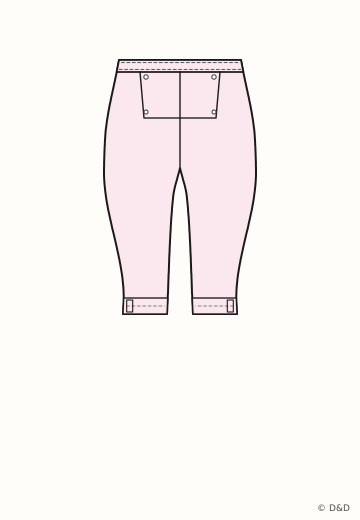
Fashionable European men wore breeches from the 16th to the early 19th century, in shapes from padded trunk hose to the fitted knee breeches of the 18th century, with stockings and buckled shoes. Long trousers replaced them for everyday wear in the early 19th century; breeches stayed for court, riding and some ceremonies.
The cut
A high waist, a fitted seat and thigh, a fall-front or button-fly closure, and a knee band fastened with buttons or a buckle just below the knee.
Fabric
Best: wool broadcloth, buckskin, silk and velvet for court, cotton for summer. Worst: thin cloth that wrinkles at the knee band.
From the block
Shorten The men’s block to below the knee and fit the knee band closely; the fall front is described in History: from hose and breeches to trousers.
Wear it
Period films, theatre and court costume, with stockings, waistcoat, coat and buckled shoes. Women wore breeches for riding and in some theatre roles.
Fit notes and a tip
The knee band must sit below the knee bone or it rides up when sitting. Tip: put a strap and buckle at the knee so it adjusts over different stockings.
Culottes (18th c.) – French knee breeches, the dress of the aristocracy

Other names
French knee breeches. Not the same as modern culottes, which are wide cropped trousers (see Every trouser: lengths).
Where it comes from
Culotte is French for knee breeches. In the French Revolution of the 1790s, working-class radicals were called sans-culottes, “without knee-breeches”, because they wore long trousers instead of the culottes of the aristocracy and middle class (see History: from hose and breeches to trousers).
The cut
Fitted knee breeches with a fall front, a high waist and a buttoned or buckled knee band, close through the thigh.
Fabric
Best: silk satin, silk velvet, fine wool, embroidered silks for court. Worst: cheap shiny satin, which shows every pull.
From the block
As breeches above: The men’s block shortened and fitted, with a fall front.
Wear it
18th-century costume, opera and theatre, with silk stockings, an embroidered waistcoat and coat.
Fit notes and a tip
Explain the name to customers: many expect modern culottes. Tip: back the fall-front button area with linen so the silk does not tear.
Pantaloons – close early-19th-century trousers, often with foot straps

Other names
Pantaloon trousers. The source of the word “pants”.
Where it comes from
The name comes from Pantalone, an old Venetian character in the Italian commedia dell’arte theatre who wore long hose. In the late 18th and early 19th centuries, close-fitting pantaloons replaced breeches for fashionable men, often in knit or stretchy cloth and with straps under the foot. American English shortened “pantaloons” to “pants”.
The cut
A high waist, a close-fitting leg from hip to ankle, a fall front, and a strap under the instep to keep the leg smooth. Held up by braces.
Fabric
Best: fine wool, knitted wool and doeskin; today, stretch wool for comfort. Worst: anything without give, which splits when sitting.
From the block
Narrow The men’s block as in From the block: taper, flare and wide legs; add foot straps as in Belt loops, tabs and adjusters.
Wear it
Regency and early-19th-century costume (period dramas set around 1800–1830), with a tailcoat, waistcoat and boots.
Fit notes and a tip
Foot straps pull the hem down when the wearer sits; fit seated. Tip: make the straps detachable with buttons so they can be removed between scenes.
Knickerbockers – loose breeches gathered into a band below the knee
Other names
Knickers (the origin of the British word for underwear), knee pants (US).
Where it comes from
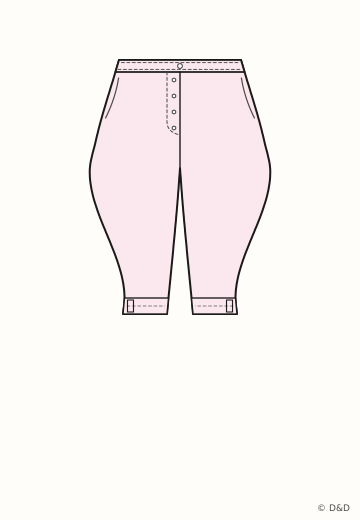
The name is usually traced to “Diedrich Knickerbocker”, the pen name Washington Irving used for his comic History of New York (1809). Illustrations of its Dutch settlers in loose knee breeches gave the garment its name. From the mid 19th century knickerbockers were worn by boys, sportsmen, cyclists and, in the 1890s, women cyclists.
The cut
Loose, full legs gathered or pleated into a band that buckles just below the knee, so the fabric blouses over the band. A button fly, a waistband and side pockets.
Fabric
Best: tweed, wool, corduroy and heavy cotton. Worst: lightweight fabrics that do not blouse over the band.
From the block
Shorten the block below the knee, add width as in From the block: palazzo, harem, culotte and jogger, and gather into a band.
Wear it
Period costume, country walks and heritage cycling events, with long socks and brogues. Women, men and children.
Fit notes and a tip
The blouson should fall about 2 inches (5 cm) over the band. Tip: cut the leg slightly longer at the back so it does not pull up when the wearer bends.
Plus-fours – knickerbockers with four extra inches, the 1920s golf trouser
Other names
Plus-twos, plus-sixes and plus-eights for the other overhangs.
Where it comes from
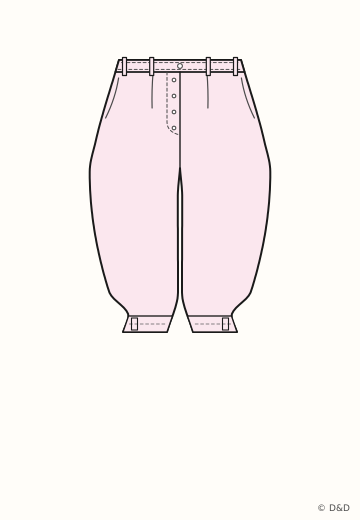
“Plus-fours” were cut 4 inches (about 10 cm) longer than ordinary knickerbockers, so they hung well over the knee band. They were popular for golf and country sport in the 1920s and 30s, helped by Edward, Prince of Wales, who wore them often. Golf’s later dress codes moved to long trousers (see Every trouser: men’s styles).
The cut
A pleated waist, very full legs and an extra 4 inches (10 cm) of length that falls over a buckled band just below the knee.
Fabric
Best: tweed, wool checks and heavy cotton. Worst: thin cloth, which sags rather than blouses.
From the block
As knickerbockers, adding 4 inches (10 cm) length and more width; pleats as in Darts, pleats and yokes on paper.
Wear it
Heritage golf days, 1920s parties and theatre, with argyle socks, brogues, a knitted pullover and a flat cap. Women wore them too.
Fit notes and a tip
Measure the overhang on the wearer, not on the table. Tip: a hook on the band is easier than a buckle for golfers who change often.
Bloomers / Turkish trousers – full trousers gathered at the ankle, under a short skirt

Other names
Turkish trousers, the Bloomer costume, the “American costume”. Later “bloomers” also meant girls’ gym knickers and women’s underwear.
Where it comes from
In 1851 the American reformer Elizabeth Smith Miller wore a short skirt over full trousers gathered at the ankle, inspired partly by the women’s trousers of the Ottoman world. Amelia Bloomer promoted the outfit in her paper The Lily, and the trousers took her name. Wearers were mocked and most gave the style up within a few years (see History: from hose and breeches to trousers).
The cut
Full trousers gathered at the waist and into a narrow band or casing at the ankle, worn under a knee-length dress. Close relatives of the şalvar and salwar.
Fabric
Best: cotton, light wool and silk. Worst: stiff fabrics, which stand out instead of falling softly.
From the block
A gathered salwar as in Indian drafts: salwar, kali and Patiala is very close; or widen a block with From the block: palazzo, harem, culotte and jogger.
Wear it
Victorian costume, suffrage-history events and theatre, with a knee-length dress and boots.
Fit notes and a tip
Tell the whole story: the style came from Ottoman women’s dress, and Elizabeth Smith Miller wore it first. Tip: an elastic ankle is easier to wear than ties.
Cycling divided skirt – 1890s full divided skirt for riding a bicycle

Other names
Rational dress, cycling skirt, divided cycling skirt.
Where it comes from
The 1890s bicycle boom made long skirts dangerous, as they caught in the chain. Members of the Rational Dress Society, founded in London in 1881, and other reformers promoted divided skirts and knickerbockers for the “New Woman” on her bicycle (see History: from hose and breeches to trousers and the divided skirt in Every trouser: shorts, skorts and divided skirts).
The cut
A fitted waist, very full divided legs with deep inverted pleats so the split hardly shows, and an ankle or mid-calf hem, often with a weighted facing.
Fabric
Best: wool serge, tweed and cotton drill. Worst: light silks that blow about.
From the block
As the divided skirt in this part, with a deeper crotch for pedalling.
Wear it
Heritage cycling events, 1890s costume and as a modern cycle-to-work skirt, with a blouse, jacket and boots.
Fit notes and a tip
Test on a real bicycle: sit, pedal, and check the hem clears the chain. Tip: a small loop and button inside the hem can shorten it for riding.
Beach pyjamas (1930s) – very wide, flowing trousers for seaside resorts
Other names
Lounging pyjamas, resort pyjamas.
Where it comes from
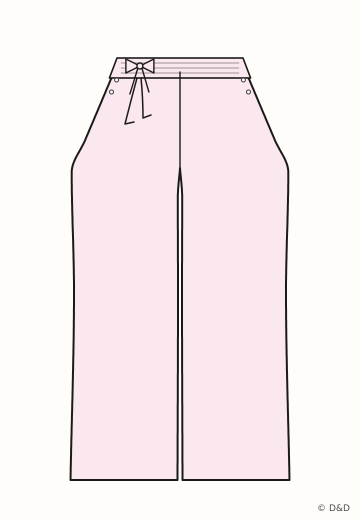
In the late 1920s and 1930s, fashionable women at resorts on the French Riviera and the Venice Lido wore very wide, floor-length “beach pyjamas”, often as a two-piece or with a halter top. Coco Chanel is associated with the trend; the name borrowed the Indian word that Britain had turned into sleepwear (see History: the twentieth century).
The cut
A high waist, a leg that widens from the hip to a very wide, floor-length hem, side buttons or a side zip, and often a matching top or halter bib.
Fabric
Best: silk crepe, rayon crepe, linen and printed cotton. Worst: stiff fabrics that lose the flow.
From the block
The palazzo method in From the block: palazzo, harem, culotte and jogger.
Wear it
Resort holidays, 1930s parties and summer events today, with a halter or knit top, a sun hat and flat sandals. Mostly women; anyone may.
Fit notes and a tip
A very wide leg must still fit closely at the waist and hip. Tip: for authenticity, use a side opening with buttons, not a front fly.
Siren suit – a one-piece zip-front suit made for air-raid shelters

Other names
Shelter suit, siren boilersuit. A close relative of the boiler suit (see Every trouser: one-piece).
Where it comes from
In Britain during the Second World War, a one-piece suit that zipped on quickly over night clothes when the air-raid siren sounded became popular. Winston Churchill famously wore his own versions, some in velvet; how far he designed them himself is told differently in different sources.
The cut
A one-piece jacket and trouser with a long front zip, a collar, a belt and patch pockets, roomy enough to pull over other clothes.
Fabric
Best: wool, wool flannel and cotton drill; velvet for a Churchill-style version. Worst: stiff fabrics that make sitting awkward.
From the block
A trouser block joined to a shirt block at the waist, with extra length in the body for bending (see Every trouser: one-piece).
Wear it
Second World War costume and theatre; modern one-piece versions for home and travel. All genders; children wore them too.
Fit notes and a tip
Check the torso length: bend and sit in the toile; a short body pulls at the crotch. Tip: a two-way zip makes it easier to use the toilet.
Land Army breeches – corduroy breeches worn by women farm workers in both world wars

Other names
Land Girl breeches, Women’s Land Army breeches.
Where it comes from
Britain’s Women’s Land Army recruited women to farm work in the First World War (from 1917) and again in the Second (from 1939). Its uniform included breeches, often corduroy, worn with long socks, boots, a shirt and a jersey. Australia and the United States had similar organisations.
The cut
Riding-style breeches: full through the thigh, narrowing sharply to a laced or buttoned fastening just below the knee, with a waistband and side pockets.
Fabric
Best: corduroy, cotton drill and wool twill. Worst: soft fabrics, which do not hold the jodhpur-like thigh.
From the block
Start from The women’s block: the framework and the front, add thigh width and narrow the knee, as for riding breeches and jodhpurs.
Wear it
War-history events, theatre and vintage country style, with knee socks, a shirt and boots.
Fit notes and a tip
Fit the knee fastening below the knee bone. Tip: original patterns vary between issues; follow one documented example and record it.
Hammer pants – very low drop-crotch trousers, tight at the ankle, from 1990
Other names
Harem pants (in the Western sense), drop-crotch pants, MC Hammer pants.
Where it comes from
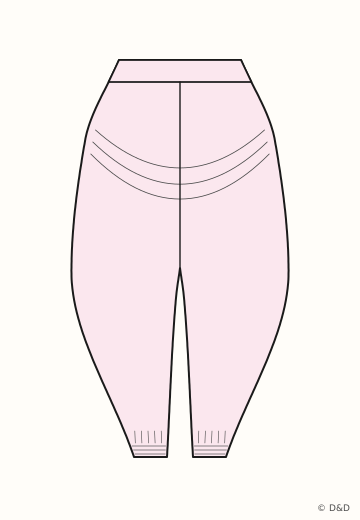
The American rapper MC Hammer made very low-crotched, ankle-cuffed trousers famous in his 1990 video for “U Can’t Touch This”. The cut echoes South Asian and Middle Eastern salwar and harem trousers, and dancers had worn similar trousers before; the name is the fashion world’s. Hammer pants returned in drop-crotch fashion from the late 2000s.
The cut
A very low crotch (often near the knees), huge balloon fullness through the thigh, a wide elastic waist and close ankle cuffs.
Fabric
Best: rayon, satin, cotton jersey and printed cotton with good drape. Worst: stiff fabrics, which stand out like tents.
From the block
Follow Draped styles: dhoti pants, harem and drop-crotch or the harem method in From the block: palazzo, harem, culotte and jogger.
Wear it
Dance, 90s parties and street style, with a fitted or cropped top and trainers. Any gender; children love them, with the crotch kept higher for safety (see Every trouser: children’s styles).
Fit notes and a tip
A very low crotch restricts the stride; test steps and stairs. Tip: make the back crotch a little longer than the front so the drop hangs evenly and does not swing forward.