A label tells you what a cloth is made of, not how well it is made. Two “100% cotton twills” can last two months or ten years. Professionals judge quality in the shop in a couple of minutes, using their hands, their eyes and the light. This lesson teaches the same checks, for cloth on the bolt and cloth bought online.
What you’ll learn
- Eight quick checks for fabric quality you can do at any counter.
- How to spot flaws, heavy finishes and weak weaves before you buy.
- Which quality marks exist in India and what they do and do not prove.
- How to buy trouser cloth online with fewer surprises.
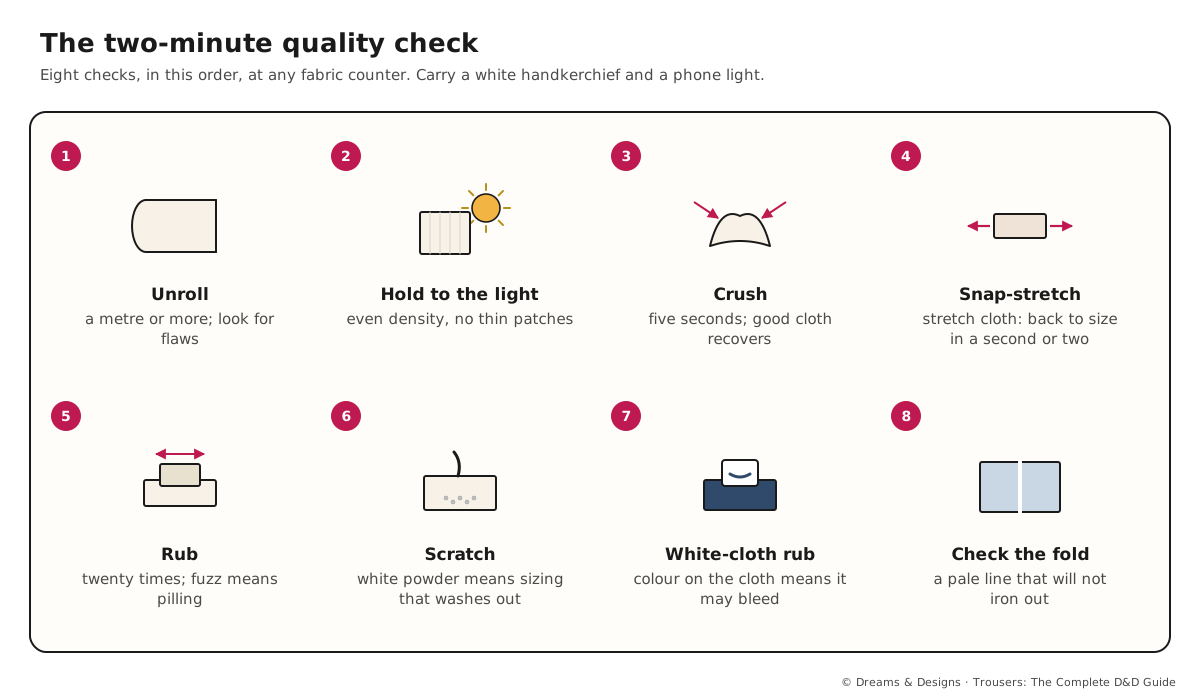
The two-minute check
- Unroll at least a metre. Look along the length for flaws: holes, slubs, dye streaks, uneven colour, crooked prints.
- Light test. Hold a single layer up to daylight. Even density is good; thin patches, gaps and lumps mean a loose or uneven weave that will sag and wear.
- Crush test. Squeeze a corner hard for five seconds and let go. Good cloth recovers at least partly, even linen. Sharp, deep creases that stay mean low-grade fibre or weak yarn.
- Snap-stretch test (stretch cloths). Stretch firmly for ten seconds and release. Good recovery: back to size within a second or two.
- Rub test. Rub the cloth hard against itself twenty times. Fuzz or little balls now means pilling at the inner thigh later.
- Scratch test for sizing. Scratch the surface with a fingernail or rub a fold between your fingers. White powder or a sudden softening means starch or “sizing” added to make thin cloth feel heavy. It washes out.
- Colour test. Rub a damp white handkerchief firmly on the cloth. Colour on the handkerchief means it may bleed or rub off (crocking).
- Fold-line check. Look at the fold where the bolt was folded. A pale line that does not iron out is permanent; cut around it or choose another piece.
Signs of good trouser cloth
- Even weave, firm to the touch, no gaps against the light.
- Straight selvedges, and a print or check that runs straight with the weave.
- Recovers from crushing and stretching.
- Colour does not rub off; smell is clean, not chemical.
- Seam threads hold: pinch two layers, pull firmly across the grain; the weave should not slide apart.
Remember the ebook’s warning: natural fibre is not automatically higher quality. A loose, cheap 100% cotton can wear worse than a well-made cotton-polyester-elastane twill. Fibre, weave, weight and finish all count.
Quality marks in India (and what they prove)
| Mark | Run by | What it says |
|---|---|---|
| Silk Mark | Silk Mark Organisation of India (Central Silk Board) | The product is pure natural silk |
| Handloom Mark, India Handloom brand | Ministry of Textiles schemes | Hand-woven; India Handloom also sets quality standards |
| Khadi Mark | KVIC | Genuine hand-spun, hand-woven khadi |
| Woolmark | The Woolmark Company | Wool content and quality as licensed |
| GI tags | Geographical Indications Registry | The product comes from the named place by the traditional method |
A mark proves origin or fibre, not that the cloth suits your trouser. A genuine handloom can still be too loose for a fitted pant. Check every scheme’s current rules with the body that runs it.
Buying online
- Read the GSM and the fibre percentages. If they are missing, ask; if no answer, be cautious.
- Compare the GSM with the photo. A cloth shown as structured suiting but listed at 110 GSM will not behave as pictured (the ebook’s red-flag tip).
- Check the width. Your quantity depends on it.
- Order a swatch where offered, or the smallest cut, before a big order.
- Read returns rules for cut fabric; many shops do not accept returns on cut lengths.
- Screen colour differs. Ask for a daylight photo if colour matching matters.
- On arrival: do the full two-minute check before pre-washing, so you can still return a faulty piece if the shop allows.
Buying in a market
- Take your swatch book, a tape and your quantity notes.
- Ask to see the cloth by daylight, at the shop door if needed; shop lighting changes colour.
- Ask for the end of a bolt to be checked for flaws before it is cut.
- Ask what the cloth is, its width, its care, and whether it has been pre-shrunk. Write it down.
- Buy all of one colour from the same bolt or lot; dye lots differ.
- Wholesale markets (Chickpet in Bengaluru is one well-known example) may have better choice but often sell larger cuts; ask about minimums.
Tips, tricks and hacks
- Carry a white handkerchief for the colour test and a small torch or phone light for the light test.
- Pull a thread from a cut edge: good yarn is even and strong; weak yarn breaks easily.
- Look at the back of printed cloth. Dye that has gone right through lasts longer than a pale surface print.
- Feel the hand after the scratch test; a heavily sized cloth goes limp at the first wash.
- Denim: heavier and firmer usually ages better, but takes longer to break in. Stiffness is not a fault.
- Synthetic smell: a strong chemical smell and waxy feel often means a heavy finish or low-grade fibre.
- Check both ends of a long piece; printing or dyeing faults often appear near the ends of a bolt.
- Pinch test seams in ready-made trousers too: the seat seam should not open when you pull across it.
- Keep a “good” and a “poor” example of each cloth in your swatch book to compare against.
- Ask other tailors which shops keep consistent quality; good suppliers are worth more than a small saving.
- What professionals do differently: they wash a small cut before buying a large amount for a big order, and only then commit.
Problems and how to fix them
The cloth went limp and thin after the first wash
- Use it for a softer style (pyjama, lining, palazzo) instead of a tailored trouser.
- Back the fronts with a light fusible if the trouser is already cut.
- Prevention: the scratch test for sizing in the shop.
A flaw appears in the middle of a cut piece
- Re-plan the layout to place the flaw in a hem, seam allowance or pocket bag.
- If it falls on a front leg, recut that piece from spare cloth.
- Prevention: check the full length before cutting, and mark flaws with a safety pin.
The print is off-grain
- Cut on the true grain and accept a slightly tilted print in a small all-over print.
- For stripes and checks, follow the print only if the cloth will not twist much; otherwise choose another cloth.
- Prevention: check that the print runs parallel to the selvedge in the shop.
The colour rubbed off on a white kurta
- Wash the trouser alone in cold water several times.
- Use a colour-catcher sheet when washing with other things.
- Prevention: the white handkerchief test.
Pilling between the legs after a month
- Shave the pills gently; wash inside out.
- Advise the customer that this cloth will keep pilling.
- Prevention: the rub test; choose a tighter weave or more filament yarn.
The online cloth is a different colour from the photo
- Return it if the shop allows and the cloth is uncut.
- Use it for a different project or as lining.
- Prevention: order swatches and ask for daylight photos.
The seat seam slides open under strain
- Restitch further in with a shorter stitch, and add stay tape.
- Line the seat to share the strain.
- Prevention: the pinch test on loose and slippery cloths.
Beginner mistakes and myths
- Myth: expensive means good. Price follows brand and fashion as well as quality. Do the tests.
- Myth: stiff denim is poor denim. It is often the opposite.
- Mistake: judging colour under shop lights.
- Mistake: pre-washing before checking for faults, then being unable to return the cloth.
Practice drills
- Beginner: do the eight checks on five cloths you own and score each out of eight.
- Improver: buy two cheap and two good cottons; test, wash, and compare after five washes.
- Confident: run the two-minute check for a friend in a market, explaining each step aloud.
As a hobby, for earning, for teaching
As a hobby: good cloth makes good trousers, and your time is worth good cloth.
For earning: when a customer brings their own cloth, check it in front of them and note any faults on the order slip before you cut. It protects you both.
For teaching: the printable check card makes a good handout; learners practise on a “mystery swatch” box.
Check yourself
- Can you do all eight checks from memory?
- Can you spot added sizing?
- Do you know what the Silk Mark does and does not prove?
- Could you buy trouser cloth online with confidence?
Quiz
- What does white powder from a scratched cloth mean? Answer: starch or sizing that will wash out.
- What is crocking? Answer: colour rubbing off onto other cloth.
- Is natural fibre always better quality? Answer: no; weave, weight and finish matter as much.
- What should you compare online with the photo? Answer: the GSM.
Key terms
- Sizing: starch or finish added to cloth to stiffen it.
- Slub: a thick spot in a yarn; a flaw in smooth cloth, a feature in raw silk and khadi.
- Crocking: dye rubbing off.
- Seam slippage: the weave sliding apart beside a seam.
- Dye lot: one batch of dyeing; lots can differ in colour.
- Bolt: a roll or folded length of cloth as sold.
Sources and uncertain points
- Main source: D&D’s own trousers ebook, chapter 18 and 76, with general textile and trade knowledge.
- Quality marks and their rules change; check with the Silk Mark Organisation of India, KVIC, the Ministry of Textiles and the Woolmark Company before relying on them.
- Chickpet is named only as an example of a Bengaluru wholesale textile area; D&D does not endorse particular shops.