This is the D&D book on trousers: every trouser there is, for women, men and children, in India and around the world. It starts with what a trouser is and where it came from, and ends with you drafting, sewing, styling, altering and earning from trousers of your own.
Free for now – still being compiled. Drafting and sewing lessons are marked “teacher to check” until a D&D teacher has checked them.
What you’ll learn
- What this book promises, and who it is for.
- How the twelve parts fit together.
- How to use the book as a learner, a teacher, a designer or a business owner.
- The few ground rules the whole book keeps.
The promise
By the end of this book you will be able to name and recognise trousers from every region of India and every continent, and know where each came from. You will measure women, men and children, draft a block for each, turn that block into any silhouette, and sew a trouser with a clean fly, pockets and waistband. You will choose fabric and colour with confidence, style one trouser from simple to special occasion, fix fit problems on any body, and, if you wish, teach trousers or earn from them.
Who it is for
- Hobby sewers who want trousers that fit, without guesswork.
- Students of fashion and tailoring who need the theory and the practice in one place.
- Working tailors and designers who want a reference for styles, fits and fixes.
- Teachers who want lesson-ready material, with checks and drills.
- Small businesses making, altering or selling trousers.
How the book is built
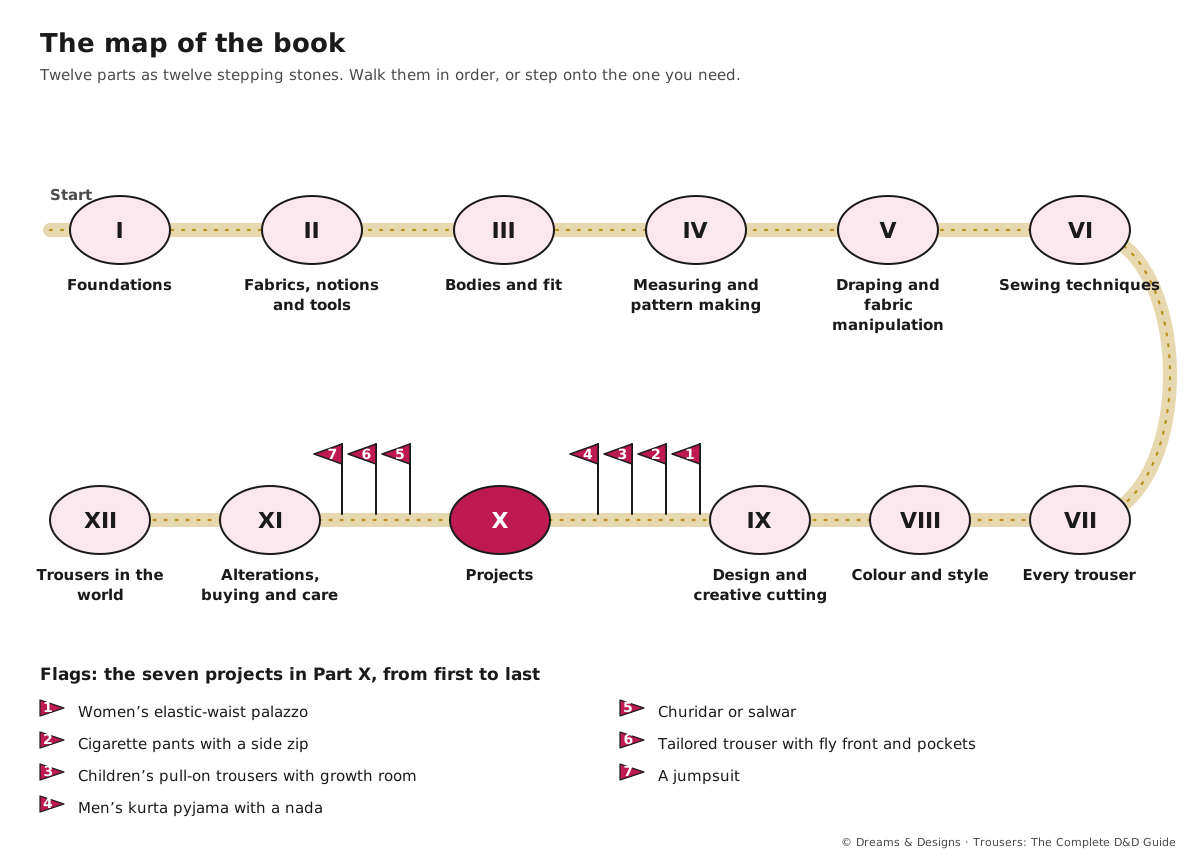
The book has twelve parts. You can read them in order, or jump to the part you need.
| Part | What it covers |
|---|---|
| I · Foundations | What a trouser is, history, India and the world, standards, the family |
| II · Fabrics, notions and tools | Fibres, what fabric for what trouser, zips to nada, tools, safety |
| III · Bodies and fit | Women, men, children and every other body; the fitting master list |
| IV · Measuring and pattern making | Measuring, blocks, the crotch curve, every silhouette, Indian drafts, grading |
| V · Draping and fabric manipulation | Draping on the form, pleats, gathers, tucks, godets, surface work |
| VI · Sewing techniques | Cutting, seams, pockets, fly fronts, waistbands, hems, pressing |
| VII · Every trouser | The style catalogue, family by family |
| VIII · Colour and style | Colour theory, skin tone, occasions, the look ladder, pairing |
| IX · Design and creative cutting | Silhouettes, cuts, details, Roopanthara Cutting, treatments, embellishment |
| X · Projects | Seven graded projects, from palazzo to jumpsuit |
| XI · Alterations, buying and care | Altering, buying ready-made, washing, repairs |
| XII · Trousers in the world | Hobby, teaching, earning, sourcing, sustainability, the future |
Each lesson opens short: what you’ll learn, the key picture and the main idea. Everything else, the depth, the tips, the problems and the checks, sits in tap-to-open sections below. Nothing has been cut to keep a page short; it has been folded.
How to use this book: four ways
As a learner
Work through Parts I to VI in order, then make the projects in Part X as you go. Do the drills in each lesson before the project that needs them. Read the style catalogue (Part VII) when you are choosing what to make next.
As a teacher
Each lesson can be one class. The open part is the talk; the folded parts give you tips to share, the mistakes students make, drills to set and a self-check to end the class. The “For earning and teaching” sections suggest how to frame the topic for different groups: children, adults, career students.
As a designer
Start with Part I for the history and the world styles (they are a deep well of ideas), then go to Part IX, design and creative cutting, and Part VIII, colour and style. Use the catalogue as a reference shelf.
As a business owner
Read Part III (fit) and Part XI (alterations and buying) first: they are what customers ask about most. Part XII covers earning, costing as a method, sourcing and sustainability. The book never gives prices, and never gives tax or legal answers: it tells you what to ask, and whom.
The ground rules this book keeps
- India first, then the world. Indian styles, climates, fabrics and occasions come first, with notes for readers abroad.
- Women, men and children, always. Every part covers all three. Unisex styles are noted, and anyone may wear any style.
- Every body. No body is a problem to be hidden. We say a style “suits”, “balances” or “draws the eye”, never that it makes someone look slimmer.
- Every skin tone is beautiful. Colour advice is about harmony, never about looking fairer.
- Measurements in inches, with centimetres. Indian tailors mostly work in inches; the rest of the world mostly in centimetres. You get both.
- A standard method. The drafting and sewing lessons use a standard, widely taught method, not a secret system. They are marked “teacher to check” until a D&D teacher has checked them.
- Facts checked, doubts marked. Where historians disagree, or a story is only “traditionally said”, the lesson says so, and lists it again under “Sources and uncertain points”.
- No prices. Costing is taught as a method. Kit contents are listed in the book; ask the studio about the kit.
- Real pictures only. Diagrams are drawn exactly. Photos are of real D&D work, with consent. Drawings that look like real work are labelled “illustration”.
Where this book comes from
The starting point is D&D’s own ebook, Encyclopedia of Trousers for Women. That book was written for women and leaned towards the Western story. This book widens it: India first, then every continent, and men and children alongside women. It also adds the full making side, from measuring to finishing, and the design side, including D&D’s own Roopanthara Cutting (ರೂಪಾಂತರ, “transformation”), a way of turning a fitted trouser into new three-dimensional shapes while the fit stays.
Facts from other books, museums and research papers are used for checking only. Nothing is copied from them, in words or pictures. Pioneers of other methods are credited in the references at the back of the book.
What you need to start
- For Part I: nothing but curiosity. A notebook helps: jot down the trousers you see around you this week.
- For the making parts: a measuring tape, pattern paper, a long ruler, chalk, sharp shears and a sewing machine. Part II lists the full kit.
- The D&D starter kit is matched to the first two projects (an elastic-waist palazzo and side-zip cigarette pants). Its contents are listed in Part X.
Tips for learners and teachers
- Keep a “trouser diary”: a photo or sketch of one interesting trouser a day, with where you saw it.
- Read Part I even if you only want to sew. Knowing why a churidar is cut on the bias makes the draft easier to remember.
- Teachers: start a new group with What a trouser is. The shared words save time in every later class.
- Use the self-checks honestly. If you answer “no”, re-read the lesson before moving on.
- Share your work: the studio loves to see what you make.
Check yourself
- Can you name three of the twelve parts and say what each covers?
- Do you know which way of using the book suits you best?
- Do you know why the drafting lessons are marked “teacher to check”?
- Do you know where to find the list of uncertain facts in each lesson?
Key terms
- Block: a basic, well-fitting pattern from which other styles are made.
- Silhouette: the outline shape of a garment.
- Roopanthara Cutting: D&D’s own name for sculptural reconstruction cutting (Part IX).
- Look ladder: how one garment moves from simple to special occasion (Part VIII).