This lesson covers four more ways to change how cloth looks and behaves: using the bias for drape and stretch, folding cloth into sculpted shapes, bonding layers and seams with heat instead of thread, and cutting patterns with a laser. Two are studio skills; two are mainly factory processes. Each is labelled honestly, with its safety rules.
Teacher to check: folding methods and bonding settings; laser cutting is described for understanding only, not as a home method.

What you’ll learn
- How bias cutting changes drape, stretch and fit, and how the churidar uses it.
- How to fold cloth into sculpted surfaces for trouser panels and hems.
- What bonding and welded seams are, and what can be done in a studio.
- What laser cutting is, what it does to different fibres, and why it is a factory process.
Bias effects
Cloth cut at 45° to the grain, the true bias, stretches and drapes much more than on the straight. A trouser leg on the bias clings and moves; it also grows longer as it hangs. The churidar is India’s best-known bias trouser: cut long and narrow on the bias, it hugs the leg and falls into soft folds at the ankle, often called “bangles” (see Part IV, Indian drafts).
- Cut each leg singly, on the true bias, mirror-imaged.
- Hang the cut pieces or the made trouser overnight before hemming.
- Stay-stitch the waist, and use a nada or elastic rather than a zip where possible.
- Use bias for single panels (a side panel, a cowl, a flounce) when a whole bias leg is too unstable.
Fabric folding
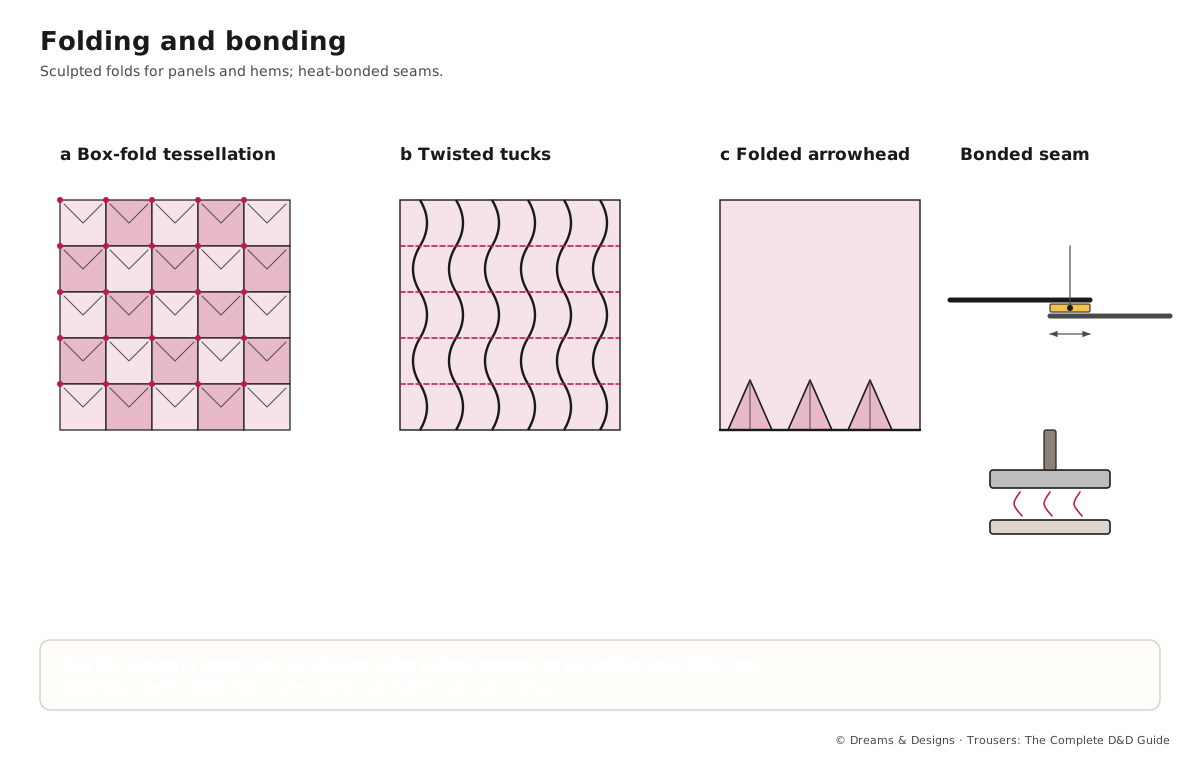
Folding uses tacks or tiny stitches to hold folds in a pattern: box folds, tessellations, twisted tucks, arrowheads. Paper folding ideas from many cultures inspire it. It makes sculptural panels for a trouser hem, a waist yoke or a side stripe.
- Fold the design in paper first, at full size.
- Mark a grid on the cloth: crisp cotton, organza or silk taffeta hold folds best.
- Fold on the grid lines, pressing as you go, and tack each fold with a few hidden stitches.
- Back the panel with a light lining to protect the stitches, then cut it to the pattern.
Bonding
- Fusible web (a thin glue sheet) bonds two layers with an iron: for appliqué, hems on light trousers, and a quick fix. Studio-safe with a press cloth.
- Bonded seams: seams joined with heat-activated tape instead of stitching, used in sportswear for flat, smooth seams. They need a heat press with set temperature and pressure; mainly a factory process.
- Ultrasonic welding joins synthetic layers by vibration and heat: a factory process only.
Laser-cut work
A laser cutter follows a digital design and burns through cloth with a focused beam. On polyester and nylon it melts and seals the edge, so cut-outs do not fray. On cotton, linen, silk and wool it scorches the edge brown and leaves a burnt smell. Laser cutting is done by trained operators in workshops with fume extraction. It is not a home method. Some materials, such as PVC and vinyl, give off dangerous gases when lasered and must never be cut this way.
Where you see these in Indian fashion
- Bias: churidars for women, men and children; bias-cut evening trousers; bias side panels in fusion wear.
- Folding: sculpted and origami-inspired panels in Indian designer and fusion wear; folded and tucked borders on festive palazzos.
- Bonding: bonded-hem leggings and sports trousers sold in India; fusible appliqué in children’s wear.
- Laser-cut: laser-cut lace-effect hems and panels on polyester palazzos and kurtas, and laser-cut suede and faux-leather trims in occasion wear.
Safety for each method
- Bias: no special hazard; watch for long bias legs catching on shoes, especially for children.
- Folding: pins and the iron; keep fingers clear of steam.
- Bonding: irons and presses burn; use a press cloth, test the web on a scrap, and ventilate when fusing large areas.
- Laser: only trained operators, enclosed machines, fume extraction and fire watch. Never laser PVC, vinyl or unknown coated cloth. If you order laser work, ask the workshop which materials they cut and how they handle fumes.
Ordering laser and bonded work from a workshop
- Prepare a clean digital file of the design at full size, with the cutting lines in one colour.
- Send a fibre sample and ask for a test cut.
- Check edges: sealed on synthetics, scorched on naturals. Decide whether scorch is acceptable as a look.
- Ask how many pieces fit on one sheet; plan the layout to reduce waste.
- Agree the finish: whether the workshop also bonds, presses or packs.
Before you start, and what you need
- Prerequisites: grain and bias (see Draping basics: the form, padding and grain); pressing.
- Time: a bias trouser takes longer than a straight one because each leg is cut singly and hung; a folded panel sample, an evening.
- Difficulty: intermediate for bias and folding; bonding with fusible web, beginner; laser and bonded seams, ordered from a workshop.
- Tools: a long table, weights, sharp shears, fine pins, fusible web, a press cloth and a non-stick sheet, an iron with a reliable heat setting.
- Cloth: soft cotton, viscose or silk for bias; organza, taffeta and crisp cotton for folding; polyester or nylon for clean laser edges.
Women, men and children
- Women: bias-cut evening trousers and churidars move beautifully and follow the body’s curves; they show everything the body does, so offer a lining if wanted.
- Men: men’s churidars for weddings are cut on the bias like women’s; folded and laser-cut details appear on designer sherwani sets.
- Children: churidars for children need extra length for the bangles and a soft elastic or nada waist; avoid stiff folded panels that rub, and fusible patches that make the cloth stiff and hot.
Tips, tricks and hacks
- Hang bias pieces 24 hours before marking the hem.
- Cut bias single-layer; folded bias shifts.
- Stay-tape bias waists with a straight-grain tape.
- Fold in paper first; it is free and fast.
- Use organza for folding samples: it holds a crease and shows the structure.
- Test fusible web on the real cloth; some glue shows through light fabrics.
- Use a Teflon or baking sheet under fusible to protect the iron.
- Professionals sample every manipulated panel and keep them in a labelled book.
- Ask for laser test cuts before paying for a full run.
- Label laser-cut natural fibres “edge treated by laser; may have a slight scorch”.
Problems and how to fix them
1 · The bias leg twists
- Recut each leg mirror-imaged on the true bias.
- Balance both seams equally.
- Prevention: cut single-layer and mark the grain on each piece.
2 · The bias hem drops unevenly
- Hang overnight and re-level.
- Use a narrow hem that moves with the cloth.
- Prevention: never hem bias the day it is cut.
3 · Folds lose their shape
- Add more tacking stitches.
- Back with a light interfacing.
- Prevention: choose crisp cloth for folding.
4 · Fusible web shows as a stiff patch
- Use a lighter web.
- Stitch instead of bonding.
- Prevention: test on a scrap.
5 · Bonded hem lifts after washing
- Re-fuse with a press cloth.
- Stitch the hem.
- Prevention: follow the web’s heat and time; cool before moving.
6 · Laser edges are scorched
- Use the scorch as a design feature, if the client agrees.
- Ask the workshop for a lower power test.
- Prevention: choose synthetic cloth for clean laser edges.
7 · Laser-cut holes fray
- Seal with a fray-stop liquid on the back (test first).
- Back with a lining.
- Prevention: natural fibres fray; plan a backing.
8 · The churidar has no bangles at the ankle
- Leave more length: the bias leg needs to be much longer than the leg to fold.
- Narrow the ankle so the folds cannot slip down.
- Prevention: cut churidar legs on the true bias and long; check against Part IV, Indian drafts.
Beginner mistakes and myths
- Mistake: cutting bias on folded cloth.
- Mistake: thinking any cloth can be laser cut.
- Myth: “Bonded seams are cheaper than sewn.” They need specialist machines; cost depends on the factory.
- Myth: “Laser-cut lace is hand-made lace.” It is a cut pattern; describe it honestly.
Practice drills
- Beginner: cut two strips of the same cloth, straight and bias, and hang them for a day; measure both.
- Intermediate: fold a 6 inch (15 cm) box-fold tessellation in organza.
- Advanced: make a churidar on the bias with a folded, tacked panel at the ankle.
As a hobby, for earning, for teaching
As a hobby: folding is a quiet, creative craft with only cloth, needle and iron.
For earning: folded panels and honest laser-cut trims, sourced from a good workshop, add a signature to a studio range.
For teaching: show bias stretch with two hanging strips; it explains the churidar instantly.
Care and finishing
- Store bias trousers folded, not hung, after the first hang, so they do not keep growing.
- Hand wash folded panels; reshape while damp.
- Wash laser-cut and bonded pieces cool; no high heat.
Sources and uncertain points
- D&D ebook ch. 11 (bias in the design vocabulary) and ch. 16 (performance fabrics); general textile knowledge.
- Laser settings and fume hazards depend on the machine and material; ask the workshop.
Check yourself
- Do you know why a bias leg must hang before hemming?
- Can you fold and tack a simple tessellation?
- Do you know which bonding is studio-safe and which is factory only?
- Can you explain what a laser does to synthetic and natural fibres?
- Do you know which materials must never be laser cut?
Key terms
- True bias: 45° to the grain, the line of most stretch.
- Tessellation: a repeating folded pattern.
- Fusible web: a heat-activated glue sheet.
- Bonded seam: a seam joined with heat-activated tape.
- Laser cutting: cutting cloth with a focused beam of light.