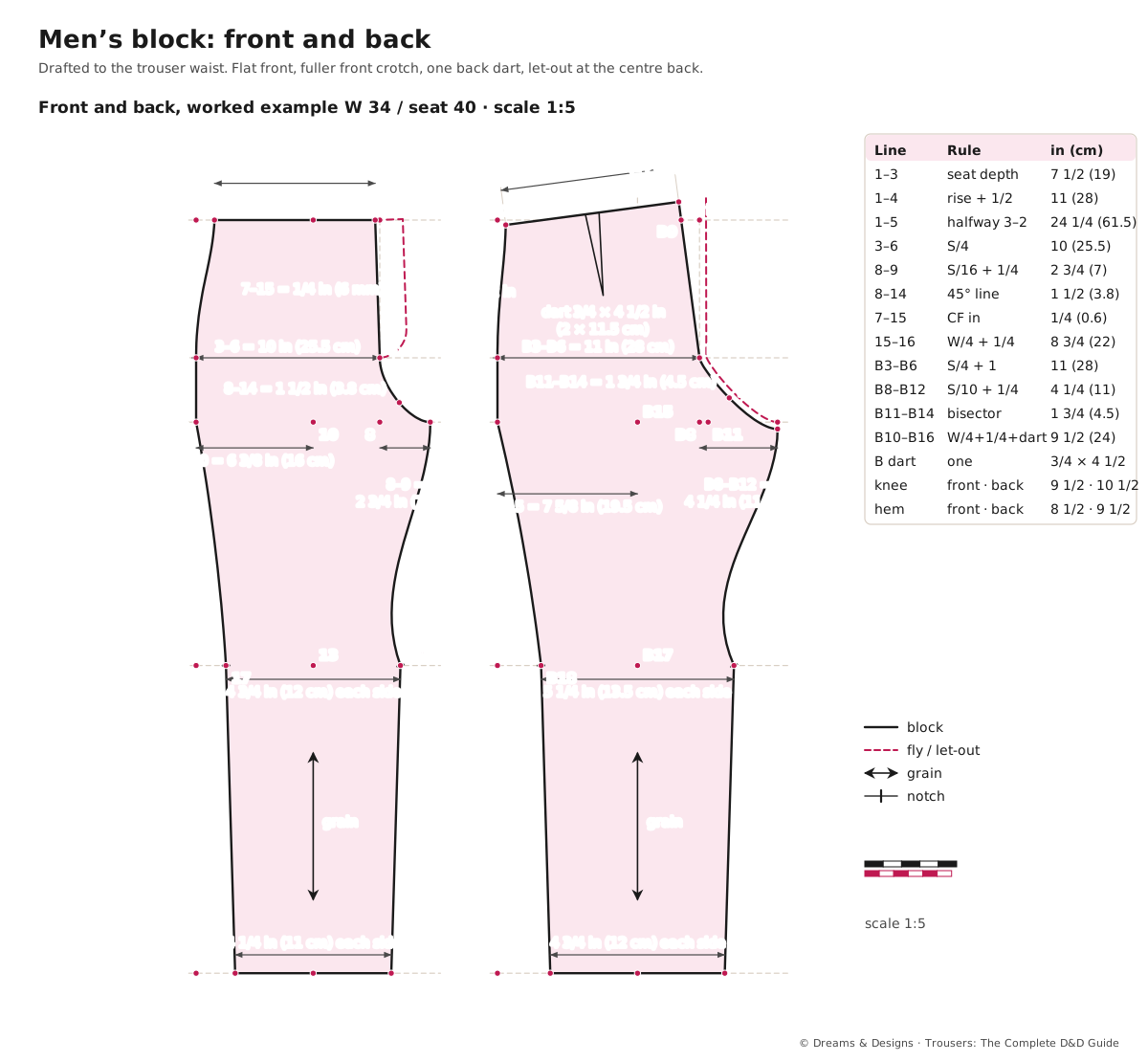
The men’s block uses the same framework as the women’s, with four differences: it is drafted to the trouser waist, it has more room at the front crotch, it has less waist shaping and no front dart, and its back is finished for a split waistband that can be let out. This lesson drafts it point by point for our worked-example man.
What you’ll learn
- What changes between a women’s and a men’s trouser block, and why.
- How to draft the men’s front with extra crotch room and a flat front.
- How to draft the men’s back, with its seat room and single dart.
- How to check the block against the body.
Measurements
Worked example: trouser waist (W) 34 in (86.5 cm), seat (S) 40 in (101.5 cm), seat depth 7 1/2 in (19 cm), seated rise from the trouser waist 10 1/2 in (26.5 cm), finished length 41 in (104 cm). All are measured from the trouser waist, where he wears the waistband (see Measuring women, men and children).
Framework
- Side line from point 1. 1 to 2 = 41 in (104 cm), hem.
- 1 to 3 = seat depth, 7 1/2 in (19 cm): seat line.
- 1 to 4 = seated rise + 1/2 in = 11 in (28 cm): crotch line.
- 5 halfway between 3 and 2: 1 to 5 = 24 1/4 in (61.5 cm), knee line (check: waist to knee 24 in).
- Square across from 1, 3, 4, 5 and 2.
Front
- 3 to 6 = S/4 = 10 in (25.5 cm). Square up to 7 and down to 8.
- 8 to 9 = S/16 + 1/4 in = 2 3/4 in (7 cm). The extra 1/4 in is the men’s front crotch room.
- 10 halfway between 4 and 9: 6 3/8 in (16 cm) from 4. Crease and grain line.
- 45° line from 8; 14 at 1 1/2 in (3.8 cm). Curve from 6 through 14 to 9. (Women’s: 1 1/4 in. The men’s curve is fuller.)
- 7 to 15 = 1/4 in (6 mm). Join 15 to 6.
- 15 to 16 = W/4 + 1/4 in = 8 3/4 in (22 cm). No dart: the flat front. Point 16 lands about 1 in (2.5 cm) from the side line.
- Side seam: 16 to 3 with the hip curve, then straight to 4.
- Knee: 4 3/4 in (12 cm) each side of the crease (front knee 9 1/2 in, 24 cm). Hem: 4 1/4 in (11 cm) each side (front hem 8 1/2 in, 21.5 cm). Shape inseam and side seam as for the women’s block.
Back
- B3 to B6 = S/4 + 1 in = 11 in (28 cm). Square up to B7, down to B8.
- B9 1 in (2.5 cm) in from B7. CB line through B6 and B9, extended 1 in (2.5 cm) above the waistline to B10 and down to the crotch line at B11.
- B8 to B12 = S/10 + 1/4 in = 4 1/4 in (11 cm). B13 3/8 in (1 cm) below B12.
- Bisect the corner at B11; B14 at 1 3/4 in (4.5 cm). Curve from B6 through B14 to B13.
- B15 halfway between B4 and B12: 7 5/8 in (19.5 cm) from B4. Back crease.
- Square the waist off the CB at B10; B10 to B16 = W/4 + 1/4 in + 3/4 in dart = 9 1/2 in (24 cm). B16 lands about 1/2 in (1.3 cm) from the side line.
- Dart: one, halfway along the waist, 3/4 in (2 cm) wide, 4 1/2 in (11.5 cm) long.
- Knee: 5 1/4 in (13.5 cm) each side of the crease (back knee 10 1/2 in, 26.5 cm). Hem: 4 3/4 in (12 cm) each side (back hem 9 1/2 in, 24 cm).
Then run the checks on paper (below): waist 35 in, seat 42 in, crotch seam about 26 7/8 in.
A standard method: a D&D teacher checks the figures before you rely on them.
Checks on paper
- Waist (8 3/4 + 8 3/4) × 2 = 35 in (89 cm): 1 in ease.
- Seat (10 + 11) × 2 = 42 in (106.5 cm): 2 in ease.
- Crotch seam about 12 1/4 in (31 cm) front + 14 5/8 in (37 cm) back = about 26 7/8 in (68 cm), about 1 1/8 in over the body’s 25 3/4 in.
- Knee 20 in (51 cm); hem 18 in (45.5 cm). Back inseam up to 1/4 in (6 mm) shorter than the front.
Women’s and men’s blocks compared
| Point | Women’s block | Men’s block | Why |
|---|---|---|---|
| Waist | Natural waist | Trouser waist | Where it is worn |
| Front extension | H/16 | S/16 + 1/4 in | Front crotch room |
| Front curve at 45° | 1 1/4 in (3 cm) | 1 1/2 in (3.8 cm) | Fuller front curve |
| CF shaping | 1/2 in | 1/4 in | Straighter front |
| Front dart | 3/4 in | None (flat front) | Less waist-to-seat difference |
| Back extension | H/10 | S/10 + 1/4 in | Stride and seat room |
| Back dart | 1 in × 5 in | 3/4 in × 4 1/2 in | Flatter seat on average |
These are averages, not rules about who someone is. Many women suit the men’s block, and many men the women’s: choose by measurements and toile, never by label.
Variations
- Fuller stomach: draft to the trouser waist below the stomach, then add the tummy change (Fit changes on paper). A lower trouser waist with longer braces or side adjusters often suits better than a high one.
- Athletic thighs: add 1/2 in (1.3 cm) to the back extension and widen both knees by 1/4 in (6 mm) each side.
- Flat seat: reduce B3 to B6 to S/4 + 1/2 in and the back dart to 1/2 in.
- High-waisted (natural waist) trousers: draft from the natural waist and add the front pleats in Darts, pleats and yokes on paper.
- Boys from about 13: use the men’s block with their own measurements (see Children’s blocks: baby, toddler and teen, and growth tucks).
Tips, tricks and hacks
- Ask where he wears his trousers and draft there; it changes the rise more than anything else.
- Keep the crease on the grain exactly: men’s trousers are pressed with a crease that shows every error.
- The back extension controls the stride. Test with a long step and a squat.
- Do not over-shape the waist; men’s trousers look best with a near-straight side seam above the seat.
- Use the split back in every formal trouser; it pays for itself at the first alteration.
- Professionals keep the seat seam allowance generous and tapering, never a fixed 3/8 in.
- Measure his favourite trouser, particularly the rise and the knee; men are often loyal to a knee width.
- Check the hem against the shoe: a formal trouser hem usually covers about half the shoe’s heel counter at the back.
- Use a slight forward slope on the hem (back 1/2 in, 1.3 cm, longer) for formal trousers that touch the shoe.
- Write the dress side (if he has a preference) on the block for bespoke work.
Problems and how to fix them
Front crotch feels tight
Cause: front extension or front curve too short for him.
- Add 1/4 in (6 mm) to the front extension.
- Deepen the front curve slightly at 14.
- Prevention: check front crotch length against the body plus about 3/4 in (2 cm).
Smile lines from the fly
Cause: tight across the seat or front hip.
- Add 1/4 in (6 mm) at each side seam over the seat.
- Add front crotch room as above.
- Prevention: size by seat, not waist.
Trouser slips down at the back
Cause: back rise too short, or flat seat with too little waist grip.
- Raise B10 by 1/2 in (1.3 cm).
- Take in the CB at the waist using the let-out allowance.
- Prevention: fit the waist on the body, seated.
Diagonal folds from inner thigh to seat
Cause: back extension too short.
- Lengthen the back extension by 1/4–1/2 in (6–13 mm).
- Drop B13 another 1/8 in (3 mm) and re-check the inseams.
- Prevention: squat test in the toile.
Legs look wide at the hem
Cause: the straight block is wider than current taste.
- Taper as in From the block: taper, flare and wide legs.
- Keep the knee, narrow the hem by 1/2 in (1.3 cm) each piece.
- Prevention: agree the hem width before cutting.
Front crease does not hang straight
Cause: crease off the grain, or bow or knock knees.
- Re-cut with the crease on the grain.
- Use the knee changes in Fit changes on paper: thighs, knees, petite and tall.
- Prevention: check knees from the front at measuring.
Waistband gapes at the CB
Cause: swayback, or too much back waist.
- Take in the CB seam at the top, tapering to nothing at the seat.
- Reduce the back dart.
- Prevention: check side view for posture.
Beginner mistakes and myths
- Drafting to the natural waist for a man who wears trousers low: the rise is then far too long.
- Adding a front dart by habit. Most men’s trousers are flat-front or pleated, not darted.
- Myth: “Men’s and women’s blocks are completely different.” The framework is the same; a handful of numbers change.
- Myth: “More seat ease fixes every men’s fit problem.” Often it is the crotch extension.
Practice drills
- Easy: draft the men’s block at quarter scale.
- Medium: draft it over the women’s block at quarter scale in another colour; list every difference.
- Medium: draft a full-size men’s block for a family member and make a toile.
- Hard: draft the same man’s block from the natural waist and from the trouser waist; compare the rise.
For hobby, earning and teaching
As a hobby: men’s pyjamas and trousers for family are good practice; men are often easier to fit at the waist, harder at the seat.
For earning: men’s formal trousers and kurta-pyjama sets are steady work, and a reliable men’s block per customer brings repeat orders.
For teaching: teach the men’s block as “the women’s block with five changes”; learners then see the logic, not two separate recipes.
Care and finishing
- Mark the block “MEN’S, trouser waist”, with the measurements and date.
- Store the fly and waistband pieces (next lesson) with the block.
Sources and uncertain points
- A standard, widely taught method, written for this book; D&D has no drafting method of its own. Men’s blocks differ more between schools than women’s, especially in front crotch room.
- Crotch-seam lengths are measured on our draft and rounded.
- All figures for a D&D teacher to check on a toile.
Check yourself
- Can you name five differences between the women’s and men’s blocks?
- Do you draft a men’s block from the trouser waist?
- Can you explain where the extra front crotch room comes from?
- Can you run the four checks on the men’s block?
Key terms
- Flat front: a trouser front without darts or pleats.
- Front crotch room: extra length and fullness at the front crotch for men.
- Seat: the fullest part of the buttocks.
- Dress side: the leg a man’s trousers are cut with a little more room, in some bespoke tailoring.