This project makes one of the two great Indian trousers worn under a kurta: the Punjabi salwar, full at the top and gathered on a nada, narrowing to the ankle; or the churidar, cut on the bias so it hugs the leg and gathers into rings above the ankle. Both are drafted in inches from a few measurements. Choose one path; the second makes a fine follow-up.

What you’ll learn
- How a salwar is built from panels and kalis, and how a churidar is cut on the true bias.
- How to lay out a near zero-waste salwar on 44 in cloth.
- How to gather a wide top evenly onto a nada.
- How to fit a churidar on the body and finish its ankle opening.
At a glance
| Path | Skills practised | Time |
|---|---|---|
| A · Punjabi salwar (Intermediate) | Indian draft, kali, single-layer layout, French seams, nada casing, mohri finish | Draft 1 hour; cut 45 minutes; sew 4–5 hours |
| B · Churidar (Intermediate, harder) | True-bias cutting, stay-stitching, fitting on the body, stretch seams, ankle opening with hooks | Draft 1 hour; cut 1 hour; sew and fit 5–7 hours |
Lessons this project uses: Module 4, Indian drafts: salwar, kali and Patiala and Indian drafts: churidar on the bias and kurta pyjama; Module 6, Seams: plain, French and flat-felled, Waistbands: elastic, half-elastic, nada and adjustable, Hems: turn-ups, churidar ankles, raw edges and growth hems and Order of construction: jeans, salwar and churidar. Module 9, Designing with grain, cross grain and bias, explains the bias.
Materials and quantities
For our worked-example woman: hip 40 in (101.5 cm), seated rise 11 in (28 cm); salwar length 38 in (96.5 cm) and mohri 14 in (35.5 cm); for the churidar, waist to knee 23 in, knee to ankle 15 in, knee 15 in, calf 14 in, ankle 9 in.
| Item | Salwar | Churidar |
|---|---|---|
| Fabric, 44–45 in (112–115 cm) wide | 2.25–2.5 m | About 2.5 m |
| Best cloths | Cotton cambric, mulmul, rayon, crepe, silk | Soft cotton, rayon, cotton-silk, knits with care; must have bias give |
| Nada | 1.5 m, or a self nada | 1.5 m, or elastic at the back and a nada at the front |
| Closures | None | 8 small hooks and thread loops, or 2 zips 4 in (10 cm) |
| Thread and interfacing | 1 spool; a scrap behind the nada holes | 1 spool; a scrap behind the nada holes; 1 m of 3/8 in stay tape |
| Pattern paper | 2 sheets, about 50 × 36 in | 1 long sheet, about 55 × 36 in |
To scale: use your own hip, rise and length in the same formulas. The salwar needs two rows of panel length on 44 in cloth; very large hips may need a third. The churidar needs about two bias lengths; lay your pattern out on paper first (Module 2, How much fabric to buy).
Path A · The Punjabi salwar draft
From Indian drafts: salwar, kali and Patiala, unchanged. The panel length includes the nefa and hem; add 1/2 in (1.3 cm) seam allowance to the long edges and the asan curve.
- Panel length = 38 + 2 in nefa + 1 1/2 in hem = 41 1/2 in (105.5 cm).
- Panel top = H/4 + 2 in = 12 in (30.5 cm); outer edge straight.
- Asan depth = seated rise + 2 in = 13 in (33 cm).
- Extensions: front 2 in (5 cm), back 3 in (7.5 cm); raise the back panel top 1 in (2.5 cm) at the centre, sloping to nothing at the side.
- Crotch curve: inner edge straight down 11 in, then curve out to the crotch point, 1 1/2 in (4 cm) from the corner.
- Panel hem 5 1/2 in (14 cm); straight inseam from the crotch point.
- Kali (cut 2): 41 1/2 in long, 10 in (25.5 cm) at the top, 3 in (7.5 cm) at the hem.
- Check: mohri 5 1/2 + 5 1/2 + 3 = 14 in; each leg’s top 12 + 12 + 10 = 34 in; about 68 in (173 cm) gathers onto the nada.
Salwar cuts vary from tailor to tailor and region to region; this is one common layout. A D&D teacher checks the figures before you rely on them.
Path A · Cutting layout

- Pre-wash and press. Lay the cloth single layer, right side up.
- Row 1: two front panels side by side, turned over for a left and a right, with the two kalis top-to-tail beside them. About 39 in (99 cm) of the width is used.
- Row 2: the two back panels, again a left and a right. Cut the nada strips from the space beside them.
- Mark the asan notches (one front, two back), the nefa and hem folds, and an “F” or “B” on each panel’s wrong side.
Path A · Step by step
The order is from Order of construction: jeans, salwar and churidar.
- Kalis to panels. On each leg, sew the kali’s long edges to the outer edges of a front panel and a back panel, narrow end at the hem. French seams on fine cloth; on firmer cloth, plain seams overlocked. Check: top and hem edges level.
- Inseams. Front panel to back panel, crotch point to hem. Finish.
- Crotch seam. One leg inside the other, inseams matched; sew from the back top to the front top; double-stitch the lower curve; finish.
- Nada holes at the centre front of the outer nefa layer, interfaced (as in Project 4).
- Nefa. Press 1/4 in under, fold 1 3/4 in inside, and stitch all round close to the lower fold.
- Try on with the nada threaded. Check: the gathers sit evenly, the asan is comfortable sitting on the floor, the mohri passes over the foot and sits at the ankle.
- Mohri. Press 1/4 in then 1 1/4 in and stitch; or edge it with lace or piping; or gather it into an ankle band (Hems: turn-ups, churidar ankles, raw edges and growth hems).
- Finish: spread the gathers, add latkans if wanted, press.
Path B · The churidar: draft, layout and steps
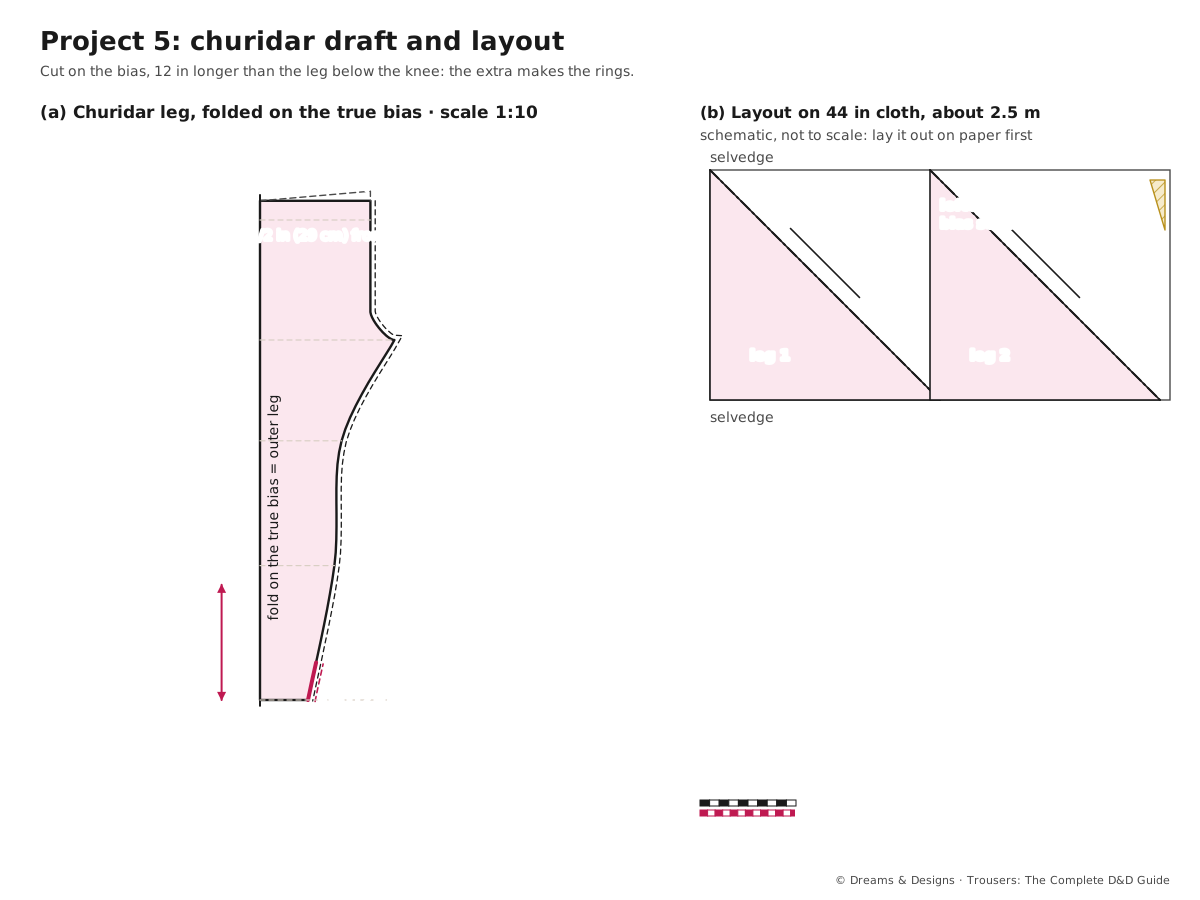
The draft
From Indian drafts: churidar on the bias and kurta pyjama, unchanged. Extra length for the gathers: 12 in (30.5 cm), for about six to eight rings.
- Fold on the true bias: bring the cut edge down to lie along the selvedge. The 45° fold is the outer leg.
- Top: 2 in (5 cm) for the nefa above the waistline.
- Waist width from the fold = H/4 + 1 1/2 in = 11 1/2 in (29 cm); raise the back half 1 in (2.5 cm) at the centre back.
- Asan depth = seated rise + 1 1/2 in = 12 1/2 in (32 cm); extension 2 1/2 in (6.5 cm); width at the crotch line 14 in (35.5 cm) folded; curve through 1 1/2 in (4 cm) from the corner.
- Knee 23 in (58.5 cm) below the waistline: (knee + 2 in) ÷ 2 = 8 1/2 in (21.5 cm) folded.
- Below the knee: 15 + 12 = 27 in (68.5 cm). Calf point 13 in below the knee: (calf + 1 1/2) ÷ 2 = 7 3/4 in (19.5 cm). Ankle: (ankle + 1) ÷ 2 = 5 in (12.5 cm): mohri 10 in (25.5 cm).
- Total cut length = 2 + 23 + 27 = 52 in (132 cm).
- Ankle opening: the 10 in mohri is less than the 12 1/2 in heel-to-instep, so mark a 4 in (10 cm) opening at the lower end of the inseam, with 3/4 in (2 cm) allowance for the hooks and facing.
- Seam allowance 1/2 in (1.3 cm) on the inseam and crotch; generous on the inseam (3/4 in, 2 cm) if you want room to adjust at the fitting.
Layout
- Fold the cloth on the true bias and lay the pattern’s fold line on the cloth fold. Cut.
- Cut the second leg the same way from the next section, with the fold running in the same direction, so both legs stretch alike.
- Keep the leftover triangles for bias piping or a dupatta edging.
Step by step
From Order of construction: jeans, salwar and churidar.
- Stay-stitch the waist and crotch edges lightly, 3/8 in (1 cm) from the edge; the bias stretches. Fuse stay tape along the ankle-opening allowances.
- Machine-baste the inseams (above the ankle opening) and the crotch seam.
- Fitting: she tries it on with the nada tied. Pin the leg close along the calf and ankle, leaving the extra length to bunch into rings above the ankle. Check: she can sit and bend the knee; the rings fall evenly, not all on one side.
- Stitch the fitted seams with a very narrow zigzag (width 0.5–1 mm, length 2.5 mm) so they stretch with the bias and do not snap. Double-stitch the crotch.
- Finish the seams: overlock or zigzag; French seams are too stiff on bias legs.
- Nada holes and nefa, as for the salwar.
- Hang the churidar for a day; the bias drops and narrows.
- Ankle: face or turn the opening allowances, sew 8 small hooks on one side and thread loops on the other, about 1/2 in (1.3 cm) apart; or set a small zip. Hem the ankle 1/2 in (1.3 cm), or bind it with a bias strip.
- Press lightly; do not flatten the rings.
Teacher to check: churidar fitting is a hands-on skill, and studios vary the extra length and the ankle finish.
Fitting points
- Asan: both styles sit lower and looser than a trouser; she should sit cross-legged without strain.
- Gathers (salwar): spread evenly round the body, with no bunch at the front.
- Churis (churidar): even rings above the ankle; the leg close but not tight at the knee when sitting.
- Length: the salwar at the ankle bone; the churidar’s rings sit between ankle and mid-calf.
Success check
- The crotch seam is double-stitched and the inseams meet.
- Salwar: the kalis are set straight, and both mohris measure the same.
- Churidar: both legs were cut with the bias the same way, and the rings fall evenly on both.
- The nefa is level and the nada runs freely.
- Inside, every edge is finished.
Finished preview
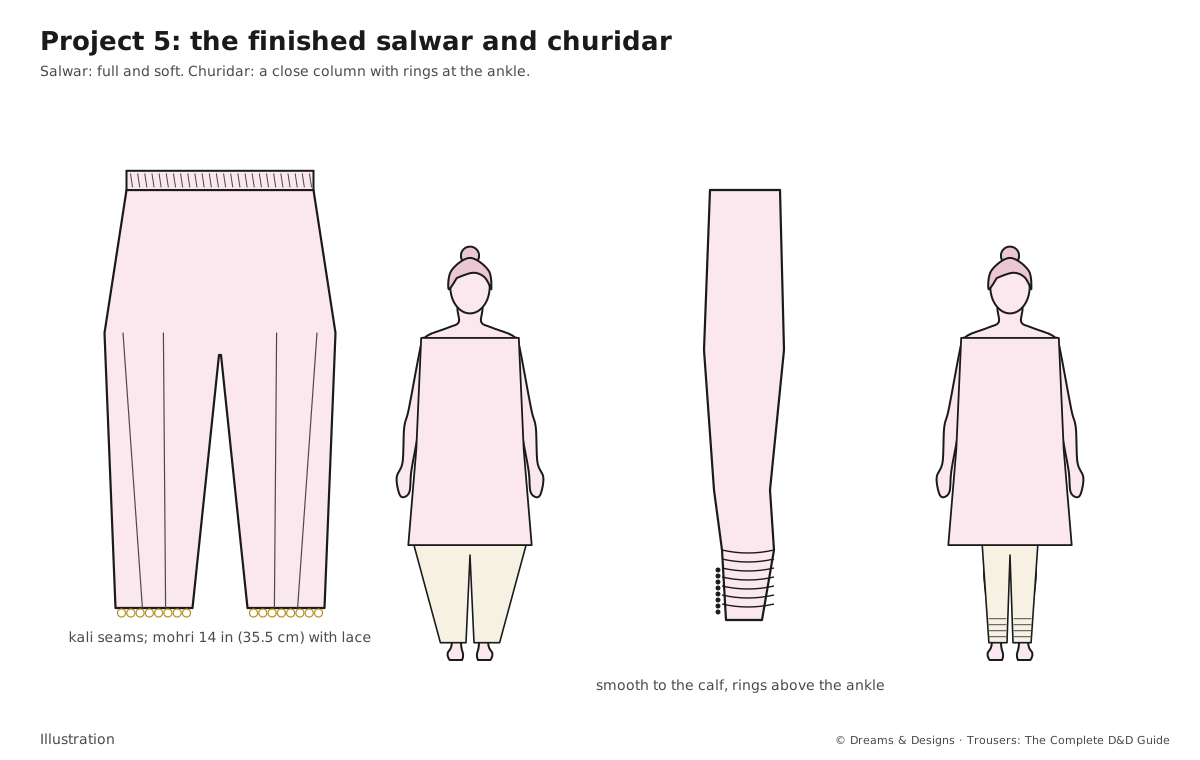
Salwar: soft gathers from a nada at the waist fall into a full seat and thigh, then narrow along the kalis to a 14 in (35.5 cm) mohri at the ankle; under a knee-length kurta, the fullness shows below the hem. Churidar: a smooth, close leg that gathers into six to eight soft rings above the ankle, closed with a neat row of hooks; under a long kurta or an anarkali it looks like a column.
Tips, tricks and hacks
- Join the kali to the front panel first, on both legs, before the back; it is easier to keep left and right straight.
- Gather a salwar with the nada, not with gathering stitches: the gathers can then move to suit the body.
- Find the true bias by folding a square corner of the cloth so the cut edge lies on the selvedge; check with a set square.
- Cut both churidar legs with the same bias direction; opposite biases twist in opposite ways.
- Use a fine needle (70/10) on rayon and mulmul.
- Thread loops are softer than metal eyes against the ankle.
- Hang the churidar from the nefa with weights (clothes pegs) at the ankles overnight before the final finish.
- Professionals fit churidars on the customer at the baste stage; a dress form cannot show the rings.
- The kali saves cloth: laid top-to-tail, two kalis fill the space beside two panels. Keep the rule in mind when you design.
- Piping at the mohri from the churidar’s leftover bias triangles makes a matched set.
Problems and how to fix them
The salwar gathers bunch at the front
- Pull the gathers towards the back and sides along the nada.
- Stitch through the nefa at the side seams to hold the spread.
- Prevention: spread the gathers at the try-on and mark the side positions.
The kali seams twist down the leg
- Unpick and re-sew from the top down, matching the edges every 6 in.
- Press each seam flat before the next.
- Prevention: cut the kali with its grain down its centre.
The mohri is too small to pass the foot
- Add a short slit at the inseam and finish it with a button and loop.
- Unpick the hem and re-cut the inseams wider at the ankle.
- Prevention: check the mohri against the heel-to-instep on paper.
The churidar seam snaps
- Re-sew with a narrow zigzag or a stretch stitch.
- Use polyester thread, which stretches more than cotton.
- Prevention: never sew bias legs with a straight stitch only.
The churidar rings fall to one side
- Check both legs were cut with the bias the same way; if not, re-cut one leg.
- Re-fit the inseam so the leg centre lines up with the knee.
- Prevention: mark the bias direction on the pattern.
The churidar is tight at the knee when sitting
- Let out the inseam over the knee by 1/4 in (6 mm).
- Add 1 in (2.5 cm) to the knee width on the next pair.
- Prevention: fit sitting as well as standing.
The churidar grows longer after a day
- Re-mark the ankle on the body and trim.
- Re-set the hooks if the opening moved.
- Prevention: always hang it for a day before the ankle finish.
Variations: sizes, fabrics, Indian and occasion versions
- Patiala salwar: a much fuller leg with six deep pleats, a kali on the inner leg and a 4 in (10 cm) patti at the ankle; about 3–4 m of 44 in cloth (Indian drafts: salwar, kali and Patiala; Pleats: accordion, sunray and Patiala).
- Afghani, Pathani and dhoti salwars: from the same pieces (Module 7, Every trouser: India and South Asia (salwars, churidar and pyjamas)).
- Men’s churidar: the same draft on his seat, rise and leg; worn with sherwanis and bandhgalas.
- Children’s salwar: on the child’s measurements, with elastic rather than a nada for young children, and no latkans (Module 3, Children’s trousers: safety).
- Elastic plus nada: elastic in the back of the nefa for comfort, the nada at the front.
- Festive: silk or brocade salwars lined with cotton; churidars in cotton-silk with a contrast piped ankle; gota or lace at the mohri (Module 8, What to wear where: weddings and festivals).
- Everyday: mulmul and cambric salwars for Bengaluru summers; rayon churidars for office kurtas.
- Knit churidar: cotton jersey cut on the straight grain, which gives a ready-made, leggings-like churidar; reduce the widths for the stretch.
Beginner mistakes
- Cutting the churidar on the straight grain: it will not gather into rings.
- Cutting the two churidar legs on opposite biases.
- Sewing the kali upside down, narrow end at the top.
- Forgetting that the salwar panel length already includes the nefa and hem.
- Hemming a churidar the day it is sewn.
As a hobby, for earning, for teaching
As a hobby: a salwar is a satisfying first Indian garment; once you have made one, a matching dupatta edging from the leftovers finishes the set.
For earning: salwars and churidars are steady orders with every kurta; churidars need a fitting, so plan for two visits. Cost your time by the method in Part XII.
For teaching: teach the salwar first (it is forgiving), then the churidar as a lesson in grain. A bias demonstration with a square of cloth makes the idea click.
Care and finishing
- Wash churidars gently and dry them flat or folded over a bar, not hung by the ankles; the bias stretches.
- Iron salwars with the nada out; spread the gathers as you press.
- Check hooks and loops after each wash.
Sources and uncertain points
- Both drafts are the book’s Module 4 figures, from common Indian tailoring practice; regions and tailors vary them, especially the Patiala.
- The extra churidar length (12 in here) is a choice; some tailors use 6–12 in. Teacher to check.
- Seam allowances of 1/2 in for these drafts are a common Indian tailoring choice, given here because Module 4 does not state them.
Check yourself
- Can you name the panels, kali, asan, nefa and mohri?
- Can you find the true bias on a piece of cloth?
- Do you know why the churidar is cut 12 in longer than the leg?
- Did you fit the churidar on the body before the final stitching?
- Can the wearer sit cross-legged in it?
Share your work
We’d love to see it. Photograph the front, the back and the inside in daylight, then either:
- Send it to the studio on WhatsApp – the subject is filled in for you, and a teacher replies; or
- post it in #show-and-tell on the Bangalore Sewing Club Discord with the tag #trousers-p5.