Indian dress has been changing form for centuries. Uncut lengths of cloth, draped on the body, have again and again become stitched garments that keep the look of the drape and lose the time it takes to tie it. The dhoti became dhoti pants; the saree became the pre-stitched saree, the pant-saree and the saree-gown; the lungi became wrap trousers; the salwar travelled, changed and settled across the subcontinent. This lesson tells those stories as design lessons: what was kept, what was changed, and why.

What you’ll learn
- How draped garments became stitched trousers, and what each change kept.
- The salwar’s journey, and the family it grew.
- Design lessons from these transformations that you can use today.
Dhoti to dhoti pants
The dhoti is an uncut length of cloth, usually 4–5 m, wrapped and tucked so that it divides between the legs (see The family: dhoti, mundu, lungi and other wraps). Dhoti pants keep the dhoti’s look, the deep folds at the front and the cloth falling between the legs, but fix them with a stitched pattern: a dropped crotch, a draped or pleated front, an elastic or nada waist and narrow cuffs. They are worn by women, men and children, at weddings, festivals and dance, and in everyday fusion wear. What was kept: the low, soft drape and the cool airflow. What changed: no tying, a fixed size, and pockets.
Saree to pant-saree and saree-gown
- Pre-stitched saree: the pleats and pallu are stitched in place on a petticoat or a waistband, so the saree can be put on in minutes. Many regional drapes are sold pre-stitched, including the Maharashtrian nauvari.
- The nauvari and other kaccha drapes: the nine-yard saree, tucked between the legs at the back, is itself a draped trouser. Its stitched version is a natural step.
- Pant-saree: a trouser (often a cigarette pant or dhoti pant) worn with a draped or attached pallu; the look of a saree with the movement of trousers.
- Saree-gown: a gown with stitched pleats and a draped pallu, popular for receptions and evening events. Not a trouser, but the same design move.
Lungi to wrap trousers
The lungi is a tube or length of cloth wrapped around the waist. Wrap trousers keep its overlap and its cool, loose leg but divide the cloth into two legs, with an overlapping front panel and ties. Fisherman-style wrap trousers, found across South and South-East Asia, follow a similar idea.
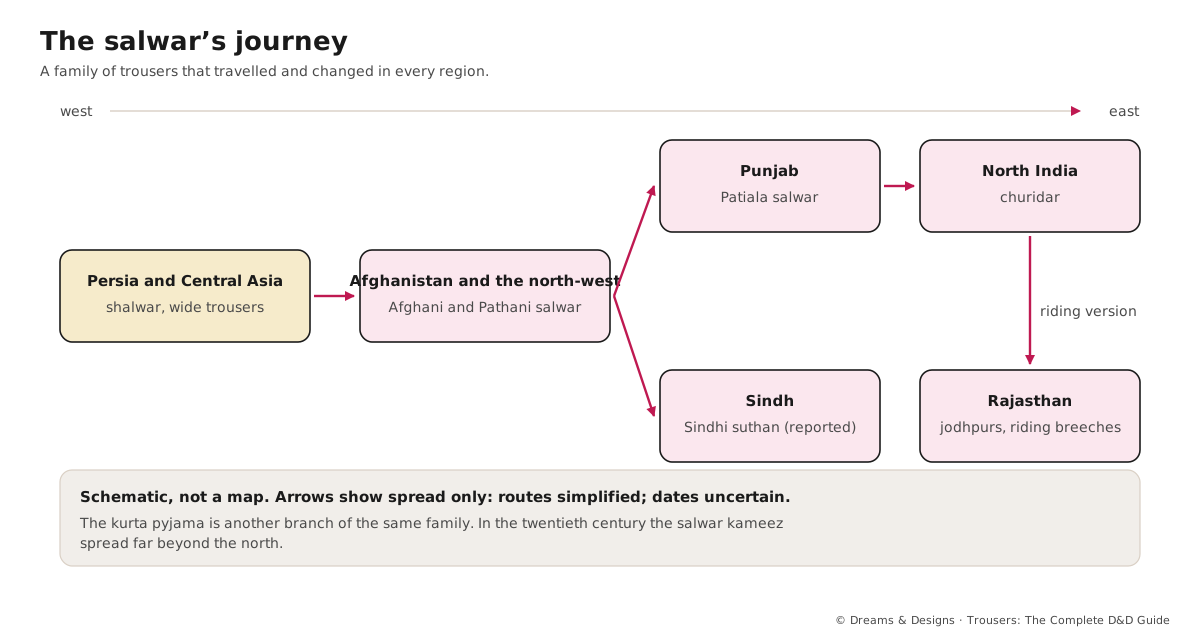
The salwar’s journey
The word salwar (shalwar) is generally traced to Persian. Wide trousers of this family came to the north of the subcontinent from Central Asia and Persia over many centuries, and changed in every region. The Patiala salwar of Punjab, with its deep pleats; the Afghani and Pathani salwars; the churidar, cut long and on the bias so it ruches at the ankle; and the kurta pyjama are all branches of the same family. In the twentieth century the salwar kameez spread far beyond the north to become everyday wear for women and girls across India. The word pyjama itself, from Persian “leg garment”, travelled with the British to the rest of the world as night wear.
In more depth: the jodhpur and other transformations
- Jodhpurs: riding breeches, full at the thigh and close at the calf, are named after Jodhpur. They are widely said to have been adapted from the churidar for riding in the late nineteenth century and taken to Britain by Rajput polo players; details and names differ between sources.
- Dhoti salwar: a salwar with a dhoti-style draped front, a fusion of two families.
- Sharara and gharara: wide, flared trousers of North Indian court dress, often described as a stitched answer to the look of a skirt; the gharara’s knee joint is a design line with a band (see Part IV).
- Kerala mundu and veshti: worn draped; stitched “ready” versions with a fixed waist are now common.
- Lehenga to divided skirt: festive divided skirts and palazzo-lehengas move between skirt and trouser (see The family: skirts, lehengas and divided skirts).
Design lessons from these transformations
- Keep the look, fix the labour. Every one of these keeps the visual signature (folds, drape, pallu) and removes the tying.
- Keep the comfort. Airflow, a loose seat and a soft waist were kept in every case; they suit the climate.
- Fix size, add adjustment. A drape fits anyone; a stitched version needs an elastic, a nada or a wrap to keep that flexibility.
- Add function. Pockets, closures, a hem that stays put.
- Respect the original. The drape’s name and meaning go with it; the stitched version is presented as a modern option, not a replacement.
Women, men and children
- Women: pant-sarees, dhoti pants, pre-stitched sarees and dhoti salwars are all widely worn.
- Men: dhoti pants with a kurta or bandhgala; ready-tied dhotis and mundus with a stitched waist for weddings and temple visits.
- Children: stitched dhoti pants and ready-made pavadai or langa for festivals and dance; easy to put on, safer than a long drape for running.
Respect and religious wear
- Some drapes carry religious or community meaning (for example, the dhoti or veshti worn for temple rituals, or wedding drapes). Some temples and ceremonies ask for the draped, unstitched form; ask the family or the place of worship.
- Present stitched versions as one more choice, with the original named and described respectfully.
Tips for learners and teachers
- Drape the original first. Tie a real dhoti or nauvari on a form before designing its stitched version.
- Photograph the drape from four sides; the folds you love are the ones to keep.
- Measure the drape: fold depths, crotch drop, hem width.
- Use the drape lessons in Part V (Draped styles: dhoti pants, harem and drop-crotch) to turn the drape into a pattern.
- Ask older family members how they tied it; regional differences are rich.
Common misunderstandings
- Myth: “Stitched versions are not traditional.” Stitched forms such as the salwar and the churidar have centuries of history of their own.
- Myth: “Draped dress is only for women.” The dhoti, mundu and lungi are mainly men’s wear; the nauvari and other kaccha drapes are women’s.
- Myth: “The pyjama is British.” The word and the garment came from Persian and Indian use.
For earning and teaching
For earning: pre-stitching a client’s own saree or dhoti is a valued studio service before weddings.
For teaching: a session where students drape a dhoti, then design its stitched version, links Part V and Part IX.
Sources and uncertain points
- D&D ebook ch. 4 (trousers in global dress traditions); general dress history.
- The word origins of salwar and pyjama are generally given as Persian; routes and dates of spread are simplified here and uncertain.
- The jodhpur origin story is widely told; names and dates differ between sources.
- The spread of the salwar kameez across India in the twentieth century is described generally; dates differ by region.
Check yourself
- Can you say what dhoti pants kept from the dhoti, and what they changed?
- Can you name three stitched forms of the saree?
- Can you name four members of the salwar family?
- Can you name the five design lessons from these transformations?
Key terms
- Kaccha (kachha, kashta) drape: a drape tucked between the legs at the back.
- Nauvari: the Maharashtrian nine-yard saree.
- Pallu: the decorated end of a saree.
- Pant-saree: a trouser worn with a saree drape or pallu.
- Pavadai, langa: a long skirt worn by girls in South India.