Children’s trousers are not small adult trousers. They hold nappies, survive crawling and cricket, come down fast at the potty and still fit after a growth spurt. This family gathers the styles made mainly for babies, toddlers and children, from poppered baby leggings to school trousers, festive kurta pyjamas and dance tights.
What you’ll learn
- The seventeen children’s styles and the age each one suits.
- Where growth room goes in each style.
- The safety points for each: cords, small parts, loose threads and fire.
- Which children’s block and which sewing lessons each style uses.
What links these styles
Every style here starts from a children’s block, not a shrunken adult one (see Children’s blocks: the child block and Children’s blocks: baby, toddler and teen, and growth tucks). Babies and toddlers have a round tummy, no waist and a nappy, so their trousers need a long back rise and a soft waist. Older children have little waist-to-hip shape, so most styles use elastic or adjustable button-elastic. All of them build in growth room, and all of them follow the safety habits in Children’s trousers: safety.
How to tell them apart
Sort them by age and use. Baby styles (leggings with poppers, nappy-friendly pants, sleepsuits) are about changing and comfort. Toddler and play styles (joggers, pull-ons, adjustable jeans, knee-patch trousers, dungarees) are about movement and potty independence. School styles are about hard wear. Indian festive styles (kurta pyjama, dhoti pants, salwar, harem pants) are about looking special while staying soft inside. Special-use styles (snow, swim, dance) are about the activity.
Where they show up in India
Naming ceremonies, first birthdays, Diwali, Eid, Christmas and weddings bring the festive children’s styles to every tailor. School reopening in June brings uniform trousers, shorts and let-downs in waves. Sizes, growth rates and measuring are in Babies and toddlers, Children, pre-teens and teens and Children’s sizes by age and height, and ease for every style. Safety standards are named in Children’s clothing safety standards; this lesson gives no legal answers, so if you sell children’s wear, ask a testing laboratory or the right office what applies.
Tap any style to open its entry.
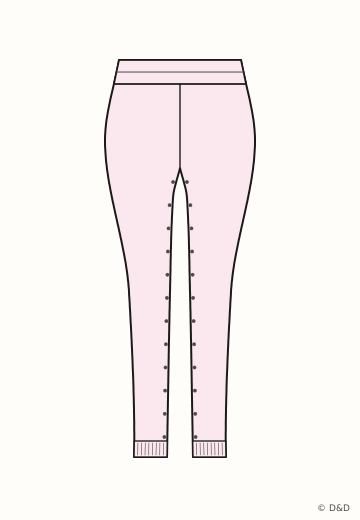
Baby leggings with poppers – soft knit leggings that open along the inside leg
Other names
Snap leggings, popper pants, baby bottoms.
Where it comes from
Stretch knit baby clothes with press studs became common from the mid 20th century, as cotton knits and reliable metal and plastic poppers made quick nappy changes possible without undressing the baby.
The cut
A deep, round seat for the nappy, a soft fold-over rib waist that does not press on the tummy, a slim leg and a row of poppers along the inside leg from ankle to ankle. Foot cuffs fold over to cover the feet, and fold back as the baby grows.
Fabric
Best: pre-washed cotton jersey, cotton interlock and cotton rib. Worst: stiff or scratchy fabrics, and anything with metallic print on the inside.
From the block
Start from the baby block in Children’s blocks: baby, toddler and teen, and growth tucks, add a popper placket to the inside leg, and add nappy room as in Babies and toddlers.
Wear it
Everyday wear from birth to about 12 months, with a vest or jhabla top. For all babies, girls and boys alike.
Fit notes and a tip
Safety: use nickel-free poppers, set into an interfaced strip with the right tool, and pull-test every one (see Children’s trousers: safety). Growth: the rib waist folds down and the foot cuffs roll back. Tip: sew the popper strip so the inside leg opens fully; half-openings make changing slower, not faster.
Nappy-friendly baby pants – roomy seat cut over a cloth or disposable nappy

Other names
Fluff-friendly pants (cloth-nappy users’ term), harem-style baby pants, nappy pants.
Where it comes from
Parents using cloth nappies found that ordinary baby trousers pulled down at the back. Makers developed cuts with a rounder, deeper seat; the style is widely shared among cloth-nappy families online, and the name “fluff-friendly” is informal.
The cut
A much deeper and wider back seat than standard, a slightly dropped crotch, a wide rib waist and rib ankle cuffs. The leg is relaxed so it does not press the nappy against the thighs.
Fabric
Best: cotton jersey, French terry and soft muslin for Bengaluru’s heat. Worst: tight wovens with no give.
From the block
Baby block from Children’s blocks: baby, toddler and teen, and growth tucks, with the back rise and seat width increased as described in Babies and toddlers; the harem method in From the block: palazzo, harem, culotte and jogger, kept gentle.
Wear it
Everyday for babies and young toddlers, with a T-shirt or jhabla. All babies.
Fit notes and a tip
Ask which nappy the baby wears, and fit over it. Growth: rib cuffs cover extra length, and the wide waist suits a growing tummy. Safety: no drawstring; elastic only, with two fingers sliding in flat. Tip: mark the back with a coloured stitch so carers put the pants on the right way round.
Sleepsuit with feet – all-in-one with legs and feet, poppers from neck to ankle

Other names
Babygro (a UK brand name, often used for any sleepsuit), footed sleeper, footie pyjamas, onesie.
Where it comes from
The stretch all-in-one baby suit is usually credited to the American inventor Walter Artzt in the 1950s, marketed as the Babygro; details of the patent and the date are reported differently in different sources.
The cut
A one-piece with long sleeves, legs and closed feet, opening with poppers or a zip from the neck down the inside of the legs, so the nappy can be changed without undressing the arms.
Fabric
Best: cotton jersey or interlock for warm nights; brushed cotton or cotton velour for cool ones. Worst: loose, fluffy fabrics for sleepwear, which catch fire easily.
From the block
The baby block extended up into a bodice, as in Children’s blocks: baby, toddler and teen, and growth tucks. The one-piece family is in Every trouser: one-piece.
Wear it
Sleep and lounging, from birth to about two years. All babies.
Fit notes and a tip
Safety, three points: trim and secure every thread inside the feet, because a loose thread can wrap round a toe (a thread tourniquet); use close-fitting cotton for nightwear; and if a zip is used, add a fabric guard at the chin. See Children’s trousers: safety and, for nightwear standards, Children’s clothing safety standards. Growth: feet that are too short curl the toes; make the foot a little long, or make footless versions with cuffs. Tip: turn the finished sleepsuit inside out and run your hand inside each foot before delivery.
Toddler joggers – soft knit joggers with rib waist and cuffs, pull-on

Other names
Trackies, joggers, “lower” (north Indian English).
Where it comes from
A small version of the adult jogger and track pant (see Every trouser: active and sport (joggers to cycling shorts)). Knit joggers became a staple of toddler wear because they pull on and off in seconds.
The cut
A high back rise over the nappy or pants, an elastic or rib waist, a relaxed leg tapering into rib cuffs at the ankle. No fly and no buttons.
Fabric
Best: cotton French terry, cotton fleece in winter, cotton jersey with a little elastane. Worst: heavy fleece in summer, and fabric that pills fast at the knee.
From the block
Toddler block from Children’s blocks: baby, toddler and teen, and growth tucks, using the jogger method in From the block: palazzo, harem, culotte and jogger.
Wear it
Play, nursery, travel and potty training, with a T-shirt or sweatshirt and soft shoes. All toddlers.
Fit notes and a tip
Safety: for this age, elastic only; leave the drawstring out, or use a short mock bow sewn flat. Growth: cut the legs long and let the rib cuffs gather the extra. Tip: make the waist wide enough to pass over the nappy easily, so the child can pull them down alone.
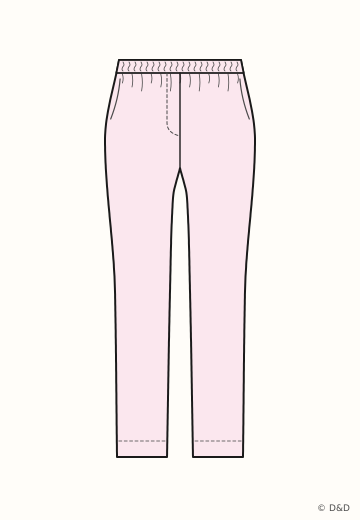
Pull-on trousers – woven trousers with an elastic waist and no fly
Other names
Elastic-waist trousers, pull-ups, “pull-on pant”.
Where it comes from
Elastic waists became practical for everyday clothes in the mid 20th century and have been the standard for young children ever since, because most children cannot keep a fixed waist up or open a fly quickly.
The cut
A woven trouser with a fully elasticated waist, straight leg and deep hem. A mock fly (topstitching only) gives a smarter look without the opening.
Fabric
Best: cotton twill, cotton poplin, linen–cotton and soft corduroy. Worst: stiff canvas that makes elastic gathers bulky.
From the block
Children’s blocks: the child block, with the waist cut straight and wide enough to pass over the hips; sew the casing as in Waistbands: elastic, half-elastic, nada and adjustable; order of work as in Order of construction: basic and pull-on trousers.
Wear it
Everyday from about 18 months to 8 years, for nursery, school days out and family visits. All children.
Fit notes and a tip
Growth: leave a 2–3 inch (5–7.5 cm) hem and wide side seam allowances. Safety: hems must clear the floor in the child’s shoes. Tip: a pull-on trouser is the first pattern a child can learn to sew; see Children, pre-teens and teens.
Adjustable-waist jeans – children’s jeans with buttonhole elastic inside the band

Other names
Kids’ adjustable jeans, growth-waist jeans.
Where it comes from
Buttonhole elastic fixed inside the back waistband, tightened by moving a button, became a common feature of ready-made children’s jeans and school trousers from about the 1990s, so a pair could fit a slim child and still last after growth.
The cut
A children’s five-pocket jean with a back yoke and a waistband that has a channel inside each back half, holding buttonhole elastic and a button near the side seam.
Fabric
Best: 8–11 oz (270–375 g/m²) cotton denim with a little stretch. Worst: heavy rigid denim, which is hard for small hands to button and stiff to play in.
From the block
Children’s blocks: the child block, with the jeans details from Jeans front pockets and back patch pockets, the children’s fly from Fly variations: jeans, button and children’s flies, and the elastic as in Waistbands: elastic, half-elastic, nada and adjustable.
Wear it
Play, outings and weekends, from about 2 years to the early teens, with T-shirts and trainers. All children.
Fit notes and a tip
Safety: for under-threes, use bar tacks instead of metal rivets, and a mock fly instead of a working zip. Pull-test the waist button. Growth: the elastic, a deep hem and wide inside-leg allowances. Tip: put the adjuster buttons at the side, not the centre back, so they do not press when the child sits.
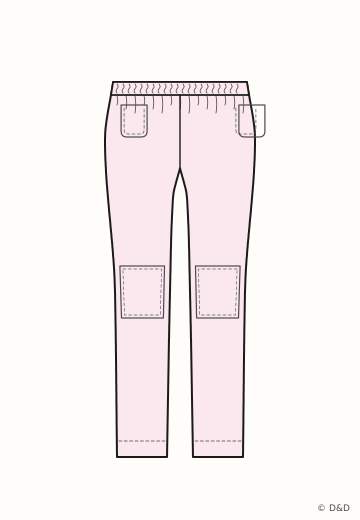
Knee-patch play trousers – sturdy trousers with double or patched knees
Other names
Play pants, double-knee trousers, reinforced trousers.
Where it comes from
Patching worn knees is as old as trousers; building the second layer in from the start comes from workwear (see the carpenter style in Every trouser: work and uniform) and became a standard detail in children’s playwear.
The cut
A straight trouser with a second layer of cloth, or a decorative patch, over the knee area, sewn before the leg seams are closed. Often with a crotch gusset for climbing.
Fabric
Best: cotton twill, denim, canvas and corduroy, with the patch in the same or a tougher fabric. Worst: soft jersey on its own for crawlers, which wears through in weeks.
From the block
Children’s blocks: the child block; mark the knee line on the toile with the child kneeling; add a gusset as in Gussets and the crotch gusset.
Wear it
Playgrounds, gardens, cricket in the lane, from crawlers to about 10 years. All children.
Fit notes and a tip
Place the patch from the kneeling position; standing knee lines sit too low. Growth: as the leg lengthens the knee moves down, so make the patch tall enough to allow for it, and add a deep hem. Tip: use iron-on patches only as a temporary repair; stitched patches outlast the trouser.
Children’s dungarees – trousers with a bib and straps, buttoned or buckled

Other names
Overalls (US), bib trousers, salopettes (French, often for ski versions).
Where it comes from
Bib-and-brace work trousers were worn by farmers, railwaymen and factory workers from the 19th century (see Every trouser: one-piece). Children’s dungarees became popular in the 20th century because the straps hold the trouser up without a waist.
The cut
A high trouser with a front bib, a lower back panel, shoulder straps crossing at the back, and openings at the sides. Baby and toddler versions add poppers along the inside leg for changes.
Fabric
Best: denim, cotton twill, corduroy and needlecord. Worst: thin fabrics that sag under the bib.
From the block
Children’s blocks: the child block extended upwards into a bib and back panel; poppers as in Babies and toddlers.
Wear it
Play and outings, from about 6 months to 8 years, over a T-shirt or jumper. All children.
Fit notes and a tip
Safety: the buckles and buttons are small parts; for under-threes use sewn-on buttons with a shank, or well-set poppers, and pull-test each. Avoid long loose straps. Growth: two or three buttonholes on each strap, and a deep hem. Tip: dungarees slow down a toddler’s potty dash; choose a pull-on trouser for toilet training.
School trousers – hard-wearing uniform trousers with an adjustable waist

Other names
Uniform trousers, school pant.
Where it comes from
School uniforms in India follow British models brought in during the colonial period, with grey, navy, khaki and white trousers. Many schools now allow trousers for girls as well as boys; rules differ by school, so always check.
The cut
A straight, mid-rise trouser with a fly, waistband with buttonhole elastic inside, side pockets and belt loops. Strong seams: the crotch is double-stitched and the pocket corners bar-tacked.
Fabric
Best: polyester–viscose or polyester–cotton suiting, as many schools specify; it washes daily and holds its colour. Worst: pure linen or pure viscose, which crease and wear fast.
From the block
Children’s blocks: the child block for younger children; for teens, measure and use the adult blocks with care, as in Children’s blocks: baby, toddler and teen, and growth tucks. Grade a set as in Grading children’s sizes and checking a graded set.
Wear it
Daily school wear, from about 5 to 18 years, with the school shirt, belt and black shoes. Girls and boys where the school allows.
Fit notes and a tip
Growth: a 2–3 inch (5–7.5 cm) hem and 1 inch (2.5 cm) side and centre-back allowances; plan for the let-down line as in Children, pre-teens and teens. Tip: June brings a rush of alterations; ask parents to bring last year’s trousers in April for let-downs.
School shorts – uniform shorts above the knee, elastic or adjustable waist

Other names
Half pant, chaḍḍi (Kannada, informal), nikkar (Hindi, informal).
Where it comes from
Short trousers were the standard for European boys well into the 20th century, with long trousers as a rite of passage (see History: the twentieth century). The custom came to Indian schools, where shorts are still common for younger boys and for sports kit, and many schools now offer shorts or skorts to girls for sport.
The cut
A school trouser cut to about 2–4 inches (5–10 cm) above the knee, with an elastic back or adjustable waist and side pockets. Younger children’s versions have no fly.
Fabric
Best: the same polyester–viscose or polyester–cotton as the school trousers. Worst: thin cotton that shows sweat and wears at the seat.
From the block
Children’s blocks: the child block, shortened, with a little extra hem width so the shorts sit away from the thigh.
Wear it
Daily school wear for younger children, and sports days, with the school shirt, socks and shoes. Girls and boys where the school allows.
Fit notes and a tip
Growth: a deep hem and adjustable waist. Shorts that are too short after a growth spurt can usually be let down once. Tip: curve the inside leg hem slightly downwards so the shorts do not ride up between the thighs when the child runs.
Children’s kurta pyjama – small festive kurta pyjama, elastic waist, soft inside

Other names
Kids’ kurta pajama. Pyjama in Kannada is pyjāma.
Where it comes from
A child’s version of the adult kurta pyjama (see Every trouser: men’s styles), worn for festivals, poojas, naming ceremonies and weddings across India.
The cut
A straight, roomy pyjama with an elastic waist and a deep hem, under a kurta that reaches the knee or mid-thigh. Baby versions add poppers along the inside leg or under the kurta.
Fabric
Best: soft cotton, mulmul, cotton silk, and silk lined with cotton where embroidery or zari touches the skin. Worst: scratchy art silk and metallic brocade against bare skin.
From the block
The child pyjama in Indian drafts: churidar on the bias and kurta pyjama, scaled on Children’s blocks: the child block.
Wear it
Diwali, Eid, Ugadi, Ganesh Chaturthi, weddings and family functions, with juttis or sandals and a matching kurta or waistcoat. Boys mostly; girls wear it too, and any child may.
Fit notes and a tip
Safety: elastic instead of a nada for young children; if a nada is used, keep the ends short, with no latkans or beads, and bar-tack it at centre back. Festive wear near diyas and fireworks should be close-fitting cotton or silk, with “keep away from fire” on the label. Growth: deep hem and elastic. Tip: make two pyjamas for one kurta; children spill.
Children’s dhoti pants – stitched dhoti look for small children, elastic waist

Other names
Kids’ dhoti, readymade dhoti pant. For the draped garment: panche (Kannada), dhotar (Marathi), veshti (Tamil).
Where it comes from
Boys in many Indian communities wear a draped dhoti or panche for ceremonies such as the upanayana or a naming ceremony, or for temple visits. Stitched dhoti pants give the look without tying, and became popular for festive children’s wear from the 2000s.
The cut
Soft folds at the front stitched in place, a gathered back, a low (but not very low) crotch and a narrow ankle. Elastic waist under a kurta.
Fabric
Best: soft cotton, silk–cotton and silk lined with cotton. Worst: stiff silk that makes the folds stand out and scratch.
From the block
Indian drafts: dhoti pants, sharara and gharara, scaled on Children’s blocks: the child block.
Wear it
Festivals, weddings and ceremonies, with a short kurta or jubba, and a small angavastram if wanted. Boys mostly; girls wear dhoti pants with short kurtis.
Fit notes and a tip
Safety: keep the crotch only moderately low, so a running child cannot trip on it; stitch every fold down so no loose fabric hangs; no free ties. Where a family wants a real draped dhoti for a ceremony, that is their tradition to follow, and the elder who ties it will know how. Tip: add a narrow elastic at the ankle so the hem stays clear of the floor.
Children’s salwar – small salwar with elastic waist and gathered ankle

Other names
Kids’ salwar, Patiala (for the pleated version). Salwar is from Persian.
Where it comes from
A child’s version of the Punjabi salwar or Patiala (see Every trouser: India and South Asia (salwars, churidar and pyjamas)), worn with a kameez and dupatta for festivals and everyday wear, especially in north India.
The cut
A gathered salwar with a slightly dropped crotch, an elastic waist and a cuffed ankle, under a kameez or kurti.
Fabric
Best: cotton, cotton silk and soft rayon. Worst: very stiff fabric, which makes the cuff hard to pull over the heel.
From the block
Indian drafts: salwar, kali and Patiala, scaled on Children’s blocks: the child block; Patiala pleats as in Pleats: accordion, sunray and Patiala.
Wear it
Festivals, school cultural days, weddings and everyday wear. Mostly girls; boys wear the Pathani style.
Fit notes and a tip
Safety: elastic, not a nada, for under-sevens; no long latkans at all for small children (a latkan sewn flat to the waistband gives the look). Growth: a deep ankle cuff that can be let down, or an elastic ankle. Tip: check that the cuff passes over the heel before you sew the second leg.
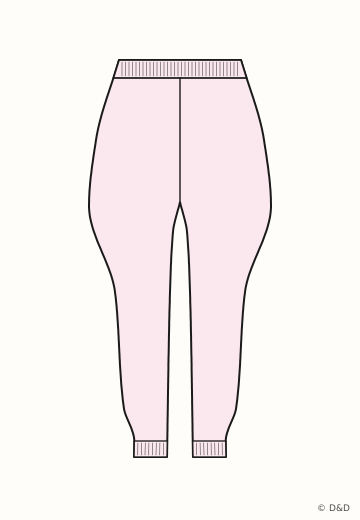
Children’s harem pants – soft, dropped-crotch pull-ons with cuffed ankles
Other names
Baby harems, drop-crotch pants, Aladdin pants.
Where it comes from
The name borrows the Western term “harem pants” for loose Middle Eastern and South Asian trousers (see the history and India families in this part). For children, the style grew popular from the 2000s because the roomy seat fits a nappy and the rib cuffs absorb growth.
The cut
A wide, low seat, a balloon leg and a narrow rib cuff at the ankle, with a wide rib waist. Very easy to sew from one or two pieces.
Fabric
Best: cotton jersey and French terry; printed cotton knits. Worst: slippery fabric that drags on the floor.
From the block
From the block: palazzo, harem, culotte and jogger, on the toddler or child block; or the one-piece method in Draped styles: dhoti pants, harem and drop-crotch.
Wear it
Play, nursery, travel and home, from babies to about 6 years, with T-shirts. All children.
Fit notes and a tip
Safety: keep the crotch only moderately dropped, about knee height at most when standing, so a toddler does not trip. Growth: long legs gathered by the cuffs. Tip: for a nappy-wearing baby, this is often the easiest pant to sew and to change.
Snow pants – padded, waterproof trousers with braces for snow play

Other names
Ski pants, salopettes, snow trousers.
Where it comes from
Insulated, waterproof children’s trousers developed with modern synthetic fabrics in the second half of the 20th century. In India they are needed for trips to Kashmir, Himachal, Sikkim and abroad.
The cut
A high rise or bib with braces, a padded or lined relaxed leg, reinforced knees and seat, and an inner gaiter at the ankle that fits over the boot to keep snow out.
Fabric
Best: waterproof, breathable nylon or polyester shells with polyester wadding or fleece lining. Worst: cotton, which soaks up snow and stays cold.
From the block
Children’s blocks: the child block with extra ease for layers (see Children’s sizes by age and height, and ease for every style). Seal seams with tape if the fabric needs it.
Wear it
Snow trips and cold holidays, over thermal leggings, with snow boots. Every child.
Fit notes and a tip
Safety: no long cords at the ankle or waist; use hook-and-loop tabs or short elastic instead; reflective trim helps on grey days. Growth: adjustable braces and a little extra length; many families buy one size up, but too long trips, so use a growth tuck in the lining. Tip: for a one-off trip, a lined, water-repellent pull-on over warm leggings may be enough; ask how long the trip is.
Swim leggings – sun-protective swim tights in chlorine-resistant knit

Other names
Swim tights, rash leggings, burkini leggings (part of a modest swimsuit).
Where it comes from
Full-length swimwear for children spread with sun-protection advice in Australia and elsewhere from the 1990s, and with modest swimwear for girls and women in the 2000s.
The cut
A close-fitting legging with covered elastic at the waist, a lined front, flat seams and a plain coverstitched hem. Worn alone or under a swim dress or tunic.
Fabric
Best: chlorine-resistant polyester or nylon–elastane swim knit. Fabrics may carry a UPF (ultraviolet protection factor) rating; read the supplier’s test details rather than assuming. Worst: cotton, which sags and drags in water.
From the block
A negative-ease legging drafted on Children’s blocks: the child block; stretch adjustments as in Troubleshooting a first draft: toiles, stretch and asymmetry.
Wear it
Swimming lessons, beaches and pools, with a rash guard or swim top. All children; pools may have their own rules on swimwear, so check.
Fit notes and a tip
Safety: no ties, beads or loose trims in the water. Growth: swim knit stretches, but too-tight leggings are hard to pull on wet; size by height. Tip: rinse in fresh water after each swim; chlorine shortens the life of elastane.
Dance and ballet tights-pants – footless or convertible tights for dance class

Other names
Ballet tights, footless tights, convertible tights, dance leggings.
Where it comes from
Tights for dance grew from the knitted stockings and leggings of 19th-century European ballet. Convertible tights, with a small opening under the foot so the dancer can roll them back, became common in the later 20th century.
The cut
A close legging with a gusset, covered waist elastic, and a foot that is either closed, open (footless), a stirrup or convertible.
Fabric
Best: nylon–elastane or cotton–elastane knit with good recovery. Worst: knits that go baggy at the knee after one class.
From the block
A negative-ease legging on Children’s blocks: the child block; gusset as in Gussets and the crotch gusset.
Wear it
Ballet, contemporary and jazz class, under a leotard or dance top. For Bharatanatyam and other Indian classical forms, practice wear is usually a practice saree or a salwar-style costume, which is a different garment; follow the school’s code. All children.
Fit notes and a tip
Many dance schools set a colour and type; ask the teacher first. Safety: no loose strings at the foot. Growth: knits allow some; size by height and leg length. Tip: sew the gusset with a stretch stitch, as split crotches are the first failure in dance tights.