Most trousers sold in India today are not one fibre but a blend: terry-wool office trousers, polyviscose school uniforms, cotton-stretch jeans, viscose palazzos. Man-made fibres are not second best. Chosen well, they add strength, shape and easy care that natural fibres cannot give on their own.
What you’ll learn
- The two kinds of man-made fibre, regenerated and synthetic, and how they behave differently.
- What terry-wool, polyviscose, poly-cotton and cotton-stretch actually are, and which trousers they suit.
- How to read a fibre label and predict a blend from its percentages.
- When a blend is the best of both fibres, and when it is the worst.
Two kinds of man-made fibre
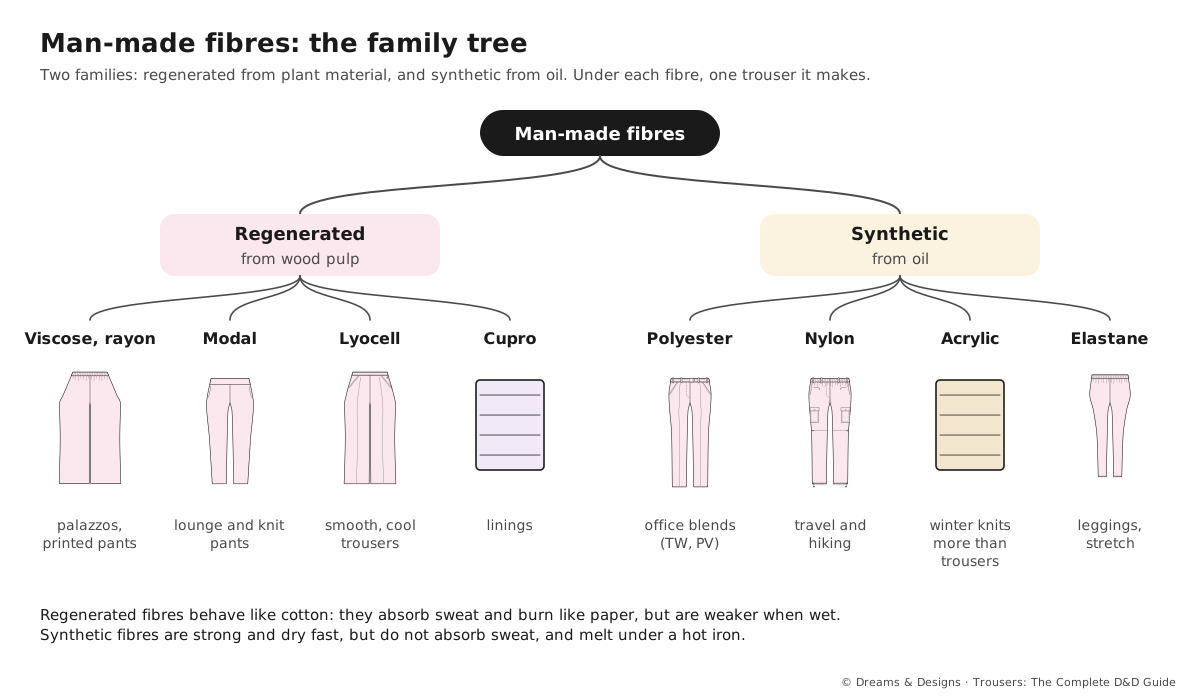
Regenerated fibres (also called semi-synthetic or man-made cellulosic) start as plant material, usually wood pulp, which a factory dissolves and spins into new fibre. They behave much like cotton: they absorb sweat, feel cool and burn like paper. They are softer and drape more than cotton, but they are weaker when wet and can shrink.
- Viscose (rayon): soft, fluid, takes dye beautifully. The palazzo and printed-pant fabric of India. Shrinks and can go stiff if washed hot.
- Modal: a refined viscose, softer and stronger when wet. Common in loungewear and knit pants.
- Lyocell (often sold under the brand Tencel): strong, smooth, cool; made in a closed-loop process that recovers most of the solvent.
- Cupro (Bemberg is a well-known brand): a silky regenerated fibre, used mainly for linings.
Synthetic fibres are made from oil-based chemicals. They are strong, keep their shape and dry fast, but they do not absorb sweat, so they feel warmer in heat and humidity. They melt under a hot iron.
- Polyester: strong, crease-resistant, cheap, does not shrink. Can pill and feel sticky in heat. Often sold in India as terylene (originally a brand name), or simply “poly”.
- Nylon (polyamide): very strong and abrasion-resistant. Used in travel, hiking and sports trousers.
- Acrylic: wool-like and warm; seen in winter knits more than in trousers.
- Elastane (spandex; Lycra is a brand): the stretch fibre. Used in small amounts inside other fibres (see Weight, drape, hand and stretch).
India’s trouser blends
| Blend | Usual mix | Why it works | Best trouser |
|---|---|---|---|
| Terry-wool (TW) | Polyester with 15–45% wool | Crease and drape of wool, strength and easy care of polyester | Men’s and women’s office and suit trousers |
| Polyviscose (PV) | About 65% polyester, 35% viscose | Smooth, does not shrink, cheaper than wool, softer than pure polyester | Office trousers, school uniforms, formal pants |
| Poly-cotton (PC) | Polyester and cotton in many ratios | Creases less and lasts longer than cotton | Uniforms, workwear, budget chinos |
| Cotton-stretch | Cotton with 1–3% elastane | Comfort and recovery in a fitted trouser | Chinos, jeans, cigarette pants, children’s jeans |
| Viscose-stretch, ponte | Viscose or polyester, with elastane, often knitted | Soft stretch, tailored look without stiffness | Women’s straight pants, travel trousers, leggings |
| Linen-cotton, linen-viscose | Varies | Linen’s coolness with fewer creases | Summer trousers |
The mixes above are the usual ones in Indian markets, not fixed rules. The label, or the shopkeeper, should tell you the exact percentages. If they cannot, test a snippet (see Natural fibres for trousers, the burn test).
Reading a label
The fibre that comes first is the main one. Read the numbers, not the marketing name. “97% cotton, 3% elastane” is a firm cotton with a little give. “65% polyester, 32% viscose, 3% elastane” is a smooth, warm-feeling suiting with stretch. Both may be called “stretch trousers” on the hanger. Module 1, Care and fibre labels, explains labels and care symbols in full.
In more depth: why blends exist
Each fibre has a weakness. Cotton creases and shrinks; wool is costly and needs care; viscose is weak when wet; polyester is hot. Blending puts two or three fibres in one yarn so each covers another’s weakness. A terry-wool trouser keeps its crease through a Bengaluru monsoon day, survives the washing machine and costs less than pure wool.
The trade-off is that a blend also inherits a little of each weakness. Polyester-rich blends pill at the inner thigh. Viscose-rich blends can shrink. A blend is only as good as its ratio, its yarn and its weave, which is why two “PV suitings” can feel completely different.
Blends and recycling
Blends are harder to recycle than single fibres, because the fibres cannot easily be separated. If sustainability matters to you or your customer, a single-fibre cloth (pure cotton, pure linen, pure wool) is simpler to recycle at the end of its life. Recycled polyester exists and is increasingly common; ask what the claim is based on.
Step by step: choosing a blend in the shop
- Decide the job first. Office trouser that must hold a crease? Child’s school trouser that must survive daily washing? Palazzo that must flow?
- Ask for the fibre content in percentages and the width. Write them on your swatch.
- Crush test. A good terry-wool or polyviscose springs back almost at once.
- Rub test. Rub the cloth firmly against itself twenty times. If it fuzzes already, it will pill at the thigh.
- Breath test. Hold it over your mouth and breathe through it. Dense polyester barely lets air through; that trouser will feel warm.
- Stretch test for any elastane cloth: pull for ten seconds, release, and see whether it springs back fully (see Judging fabric quality).
- Ask about care. Can it be machine washed? Does the shop advise dry cleaning? Note it for the customer.
Tips, tricks and hacks
- For office trousers in Bengaluru, a light terry-wool is the most forgiving all-year choice: it breathes better than polyviscose and holds a crease better than cotton.
- Viscose palazzos: pre-wash in cold water and dry in shade. Viscose can shrink noticeably on the first wash; buy extra length.
- Use a cooler iron for anything with polyester, nylon or elastane, and a pressing cloth always.
- Polyviscose creases set with steam and a clapper rather than heat alone (see Cutting, sewing and pressing tools).
- Use polyester thread on synthetic blends. Cotton thread on a polyester trouser can break first at stress points.
- Choose a sharp (Microtex) needle for densely woven polyester and a stretch needle for elastane blends, to avoid skipped stitches.
- School uniforms: polyviscose or poly-cotton survives daily washing far better than pure cotton. Add a reinforced knee for younger children.
- Static cling in polyester trousers in dry winter air is eased with a cotton or viscose lining rather than a polyester one.
- Feel the inside face of a stretch cloth. A soft, cotton-rich inside face is cooler against the skin, even if the outside is shiny.
- Pilling test hack: rub the swatch against the rough side of a denim scrap. A cloth that survives this survives a day of walking.
- What professionals do differently: they ask for the fibre content of the lining and pocketing too, and match care. A dry-clean-only lining in a washable trouser ruins the trouser.
Problems and how to fix them
The office trousers pill between the thighs
- Remove pills with a fabric shaver or a fine razor drawn gently over the surface.
- Wash inside out, on a gentle cycle, with similar garments only.
- Prevention: choose a cloth with less polyester, a tighter weave or filament yarns, and test by rubbing before buying.
The viscose palazzo shrank and went stiff
- Soak in cool water with a little hair conditioner or fabric softener, then gently ease it back to length while damp.
- Let down the hem if there is allowance.
- Prevention: pre-wash viscose cold, never wring it, and dry it flat or on a line in shade.
The polyester trousers feel sticky and hot
- Add a cotton or cupro lining to the seat and legs.
- Offer the customer a lighter or more open-weave cloth for the next pair.
- Prevention: do the breath test in the shop and choose terry-wool, linen blends or cotton for hot, humid climates.
Shiny marks appeared where it was ironed
- Steam lightly through a damp cloth and brush; mild shine may lift.
- If the fibre has melted, the shine is permanent; patch or recut the panel.
- Prevention: lower the iron, use a press cloth, and test on a scrap.
Skipped stitches on a stretch blend
- Change to a new stretch needle (75/11 or 90/14 depending on weight).
- Rethread the machine and check the tension; use polyester thread.
- Prevention: start every stretch project with a new stretch needle and a test seam on a scrap.
The crease will not hold in a cotton-rich blend
- Press with a damp cloth, then hold the clapper on the crease until the fabric cools.
- Stitch a very fine crease line from the inside (edge-stitching the crease) on casual styles.
- Prevention: for permanent creases, choose wool or terry-wool.
The label says “wool blend” but it smells of burning plastic
- Tell the customer honestly what the fabric is likely to be before cutting.
- Offer a different cloth, or adjust the care advice (low iron, machine wash).
- Prevention: ask for percentages at purchase, and burn-test unlabelled suiting.
Beginner mistakes and myths
- Myth: polyester is always cheap and nasty. Well-made polyester and its blends are strong, smart and easy to care for. Quality depends on the yarn and weave.
- Myth: viscose is a synthetic. It is made from plant cellulose and behaves more like cotton than polyester.
- Myth: more elastane means more comfort. Too much elastane in a woven trouser can bag and wear out faster. 1–3% is usual for wovens.
- Mistake: ironing a blend at the setting for its first-named fibre. Iron for the most heat-sensitive fibre in the mix.
- Mistake: calling terry-wool “wool” to a customer. Name the blend; customers value honesty.
Practice drills
- Beginner: collect five labels from your own wardrobe’s trousers. Write down each blend and note how each trouser wears.
- Improver: buy small cut pieces of terry-wool, polyviscose and poly-cotton. Do the crush, rub, breath and burn tests on each, and record the results.
- Confident: sew a test seam on each with three different needles and two threads. Note which combination gives no puckering and no skipped stitches.
As a hobby, for earning, for teaching
As a hobby: blends let you make trousers you can wash at home and wear to work. Learning to read labels also makes ready-made shopping easier.
For earning: men’s and women’s office trousers in terry-wool and polyviscose are steady, year-round work for tailors in India. Knowing the blends lets you advise confidently and quote time and care honestly.
For teaching: ask learners to bring a trouser label from home. Sort the labels into natural, regenerated, synthetic and blend on the board. It makes the theory personal at once.
Care and finishing
- Terry-wool: dry clean for best results; many can be gently hand or machine washed cool; check the shop’s advice.
- Polyviscose and poly-cotton: machine wash cool or warm, hang to dry, iron low to medium with a cloth.
- Viscose: cold hand or gentle machine wash, no wringing, dry in shade.
- Elastane blends: cool wash, no tumble-drying on high, which weakens elastane.
- Wash synthetics inside out and less often; a microfibre-catching wash bag reduces fibres shed into water.
Check yourself
- Can you say the difference between a regenerated and a synthetic fibre?
- Do you know what terry-wool and polyviscose are made of?
- Could you predict, from a label, whether a trouser will shrink?
- Do you know which needle to use for a stretch blend?
- Can you name one advantage and one weakness of polyester in a trouser?
Quiz
- Which fibre is viscose made from? Answer: plant cellulose, usually wood pulp.
- What does “PV” mean on a suiting label in India? Answer: polyester-viscose.
- What is the usual elastane range in a woven stretch trouser? Answer: about 1–3%.
- Why iron a blend at the lowest safe setting? Answer: the most heat-sensitive fibre in the mix can melt or shine.
Key terms
- Regenerated fibre: made by dissolving plant material and spinning it again (viscose, modal, lyocell, cupro).
- Synthetic fibre: made from oil-based chemicals (polyester, nylon, acrylic, elastane).
- Terry-wool (TW): polyester-wool blend suiting.
- Polyviscose (PV): polyester-viscose blend.
- Poly-cotton (PC): polyester-cotton blend.
- Elastane: stretch fibre, also called spandex.
- Pilling: small balls of fibre that form where cloth rubs.
Sources and uncertain points
- Main source: D&D’s own trousers ebook, chapters 14, 16 and 76, widened to Indian blends from general textile knowledge.
- Blend ratios (terry-wool 15–45% wool, polyviscose around 65/35) are typical market ranges reported in Indian trade use, not standards. Always check the label.
- “Terylene” began as a brand name for polyester and is used generically in India.
- Lyocell’s closed-loop process is widely reported; recovery rates are given by makers and vary.