The crotch is where most trouser fit is won or lost. This second part of the master list covers issues 9 to 21: the front crotch, the seat and back crotch, the thighs, pockets and pleats. Each issue gives who it most often affects, what you see, the cause, three fixes and how to prevent it.

What you’ll learn
- How the front and back crotch curves cause most pulls and folds.
- Thirteen issues at the crotch, seat and thighs, for women, men and children.
- Which fixes are home alterations and which need a tailor.
- How to prevent each issue on the pattern.
The crotch in one minute
Seen from the side, the crotch seam is a “J” lying on its side: a short, gentle front curve and a longer, deeper back curve. Three things can be wrong with it:
- Length: too short pulls up into the body; too long hangs and bags.
- Depth of the scoop: too shallow pulls across the seat or thighs; too deep leaves folds.
- Extension: the flat part that reaches between the legs. Too short pulls the trouser into the seat; too long bags at the inner thigh.
Women’s front curves are usually flatter; men’s need a little more front room. Back curves vary most with seat shape. Children’s crotches need room for nappies (babies) and for climbing (everyone else).
Where to look
- Lines radiating from the crotch point to a crotch length or shape problem.
- Folds under the seat mean too much back length or depth.
- Pulling into the seat means too little back length or extension.
- Lines across the thighs mean too little thigh room.
Crotch reshaping is one of the hardest alterations. Simple let-outs and take-ins at the centre back and inseam are home work; reshaping the curve on tailored or costly cloth is a tailor’s job. Always pin, try, sit and walk before you stitch.
Who sees which issues most
- Women most often meet whiskers (9), the front crotch pulling in (11), the seat pulling (13) and thigh strain (18).
- Men most often meet smile lines from the fly (10), a front pouch (12), folds under a flat seat (14) and pleats that splay (20).
- Children most often meet a crotch that hangs low in a too-big size (16) and seams that split in play (17).
These are patterns from fitting rooms, not rules. Read the cloth, not the label on the person.
Front crotch issues 9–12
9 · Whiskers at the front crotch
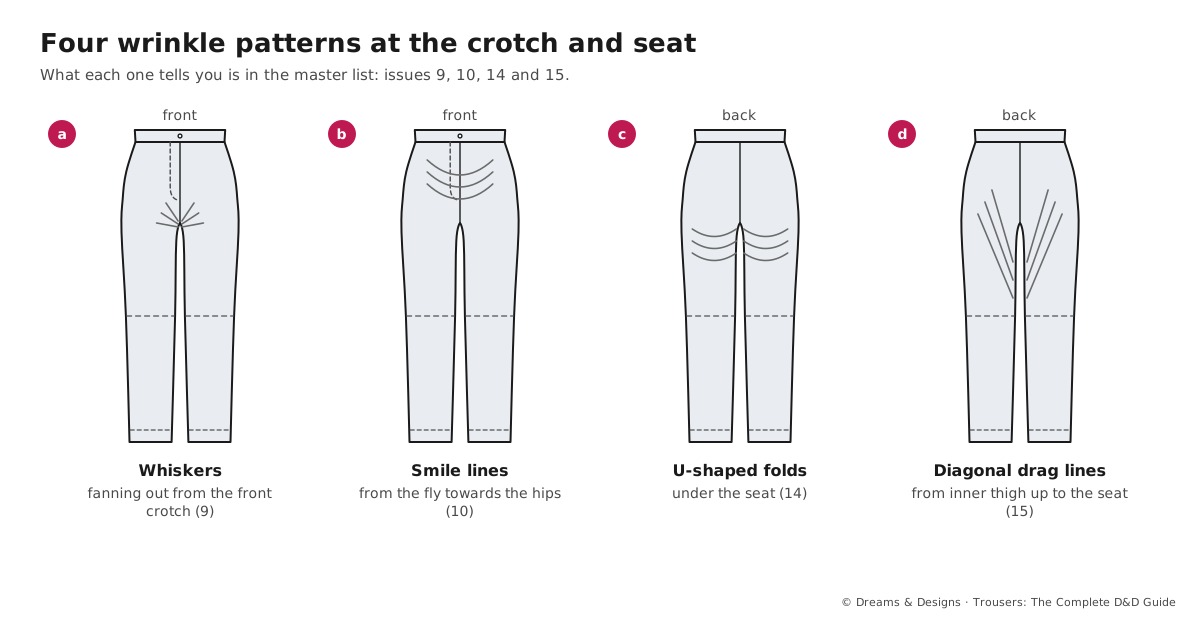
Who: mainly women; fuller thighs; short front rise. Symptom: horizontal or diagonal folds fanning out from the front crotch. Cause: front crotch too short or too shallow for the body, or too tight across the upper thighs.
- Let out the inseam at the top of the front leg.
- Lower the front crotch curve slightly (scoop a little deeper) and test.
- Add front rise or front thigh width on the pattern.
Prevention: measure crotch length front and back; check the front crotch on the hanger: a very shallow curve predicts whiskers.
10 · Smile lines from the fly
Who: mainly men; athletic or fuller hips; tight fits. Symptom: curved lines from the fly towards the hips. Cause: too tight across the hips, or too little front crotch room.
- Let out the side seams at the hip.
- Lengthen or deepen the front crotch slightly.
- Choose a cut with more hip room.
Prevention: size by seat and thigh, then take in the waist.
11 · Front crotch pulls into the body
Who: women and girls; full or low tummy; short front rise. Symptom: the centre-front seam pulls tight between the legs; uncomfortable when walking. Cause: front rise too short, or front crotch extension too long and the curve too deep, which drags the seam up.
- Add front rise; choose a higher-rise style.
- Shorten the front crotch extension slightly and straighten the curve.
- Choose softer cloth or a looser fit through the hip.
Prevention: toile check of the front crotch; sit-reach-bend test before buying.
12 · Front pouch or bagging below the fly
Who: flat tummies, petite bodies, slim men. Symptom: loose cloth bulges below the fly. Cause: front rise too long or front too wide.
- Shorten the front rise from the waist.
- Take in the front inseam at the top.
- Reduce front darts or pleats.
Prevention: flat-tummy adjustment on the pattern.
Seat and back crotch issues 13–17
13 · Seat pulls into the crotch
Who: full or high seats, women and men; athletic bodies. Symptom: the back pulls into the seat; the back waist dips. Cause: back crotch too short, back extension too short.
- Let out the centre-back seam and the back inseam near the crotch.
- Lengthen the back crotch extension (pattern; a tailor can sometimes add a small piece).
- Choose a curvy or athletic cut.
Prevention: full-seat adjustment on the block.
14 · Folds under the seat
Who: flat seats, slim men, older bodies. Symptom: U-shaped or horizontal folds below the seat; loose back thigh. Cause: too much back length and crotch depth.
- Take in the centre-back seam through the seat.
- Take in the back inseam at the top, tapering out.
- Fold out back length on the pattern.
Prevention: flat-seat adjustment; check the back in a photo every fitting.
15 · Diagonal drag lines from inner thigh to seat
Who: full inner thighs; full low seats. Symptom: lines run from the inner knee or thigh up towards the seat. Cause: back crotch extension too short for the inner thigh, or too little seat room.
- Let out the back inseam near the crotch.
- Lengthen the back crotch extension.
- Add width at the back thigh.
Prevention: measure thighs; full-inner-thigh adjustment on the block.
16 · Crotch hangs too low
Who: petite bodies, short torsos, children in adult sizes. Symptom: crotch seam well below the body; stride is restricted. Cause: rise too long.
- Shorten from the top: lower the waistband.
- Raise the crotch: take in the inseam at the top and reshape the curve.
- Choose petite or short-rise cuts.
Prevention: measure seated rise; shorten rise on the pattern.
17 · Crotch seam splits when squatting
Who: athletic men and women; children; work trousers. Symptom: seam or cloth tears at the crotch point. Cause: too little room for movement; weak seam; worn cloth.
- Re-sew with a double row or a flat-felled seam; bar-tack the crotch point.
- Add a gusset.
- Let out the back crotch for more room.
Prevention: squat test in every fitting; gussets in work, sport and children’s trousers.
Thigh, pocket and pleat issues 18–21
18 · Strain across the front thigh
Who: athletic bodies, curvy women, plus-size bodies. Symptom: fine horizontal lines across the thigh; the leg rides up. Cause: too little thigh room (circumference).
- Let out side seam and inseam equally.
- Choose a straight, wide or athletic cut.
- Size up and take in the waist.
Prevention: check the thigh measurement on size charts.
19 · Slant pockets gape open
Who: fuller tummies and hips, women and men. Symptom: pocket edges stand open. Cause: too tight across the hip or tummy; pocket edge cut on the bias with no stay.
- Let out the side seams at the hip.
- Add a stay tape along the pocket edge.
- Stitch the pocket closed or change to side-seam pockets.
Prevention: extend the pocket bag to the fly as a stay; tape bias pocket edges.
20 · Front pleats splay open
Who: anyone in pleated trousers that are too tight across the hip. Symptom: pleats open and pull when standing. Cause: not enough hip room.
- Let out the side seams.
- Size up and take in the waist.
- Stitch the pleats down a short way.
Prevention: pleats should lie closed when standing; check before buying.
21 · Inner thighs rub and wear through
Who: any body where the thighs touch; plus-size bodies; athletic thighs. Symptom: pilling, thinning or holes at the inner thigh. Cause: friction on every step.
- Patch inside with a strong, smooth cloth before a hole forms.
- Darn or mend with a matching fusible patch.
- Choose firm, tight weaves and smooth fibres.
Prevention: reinforce the inner thigh when sewing; flat, well-pressed inseams.
Tips, tricks and hacks
- Trace the crotch curve of a trouser that fits with a flexible ruler; compare with the pattern.
- Baste the crotch first in a toile; change it before anything else.
- Change in 1/4 inch (6 mm) steps on the curve; small changes do a lot.
- Use a long ruler on the inseam; keep its line smooth into the crotch.
- Stay-stitch the crotch curve before fitting; it stretches.
- Bar-tack the crotch point on every trouser.
- Add a gusset in active trousers rather than widening everything.
- Photograph from the back with legs a little apart.
- Remember front and back are separate: fix the one that shows the lines.
- Do not over-scoop; once cut, the curve cannot be put back.
Check yourself
- Can you describe the three things that can be wrong with a crotch curve?
- Could you tell folds under the seat from pulls into the seat, and their causes?
- Do you know why pleats splay open?
- Do you know how to protect the inner thigh?
Key terms
- Crotch extension: the flat part of the pattern reaching between the legs.
- Scoop: the depth of the crotch curve.
- Stay tape: a narrow tape that stops an edge stretching.
- Whiskers: folds fanning out from the front crotch.
- Smile lines: curved lines from the fly to the hips.