India is a land of draped clothes – the saree, the dhoti, the mundu – and yet it is also one of the great trouser countries of the world. The pyjama and the salwar began here or came here early, travelled the whole subcontinent, and gave English some of its words. This lesson follows India’s trousers from the Kushans to the dhoti pant, for women, men and children.
What you’ll learn
- How trousers came to India and settled into everyday dress.
- The salwar’s journey, from the north-west to the whole country.
- How Indian men moved between dhoti, pyjama and pant.
- How draped garments turned into stitched ones: dhoti to dhoti pants.
Arrival: riders from the north-west
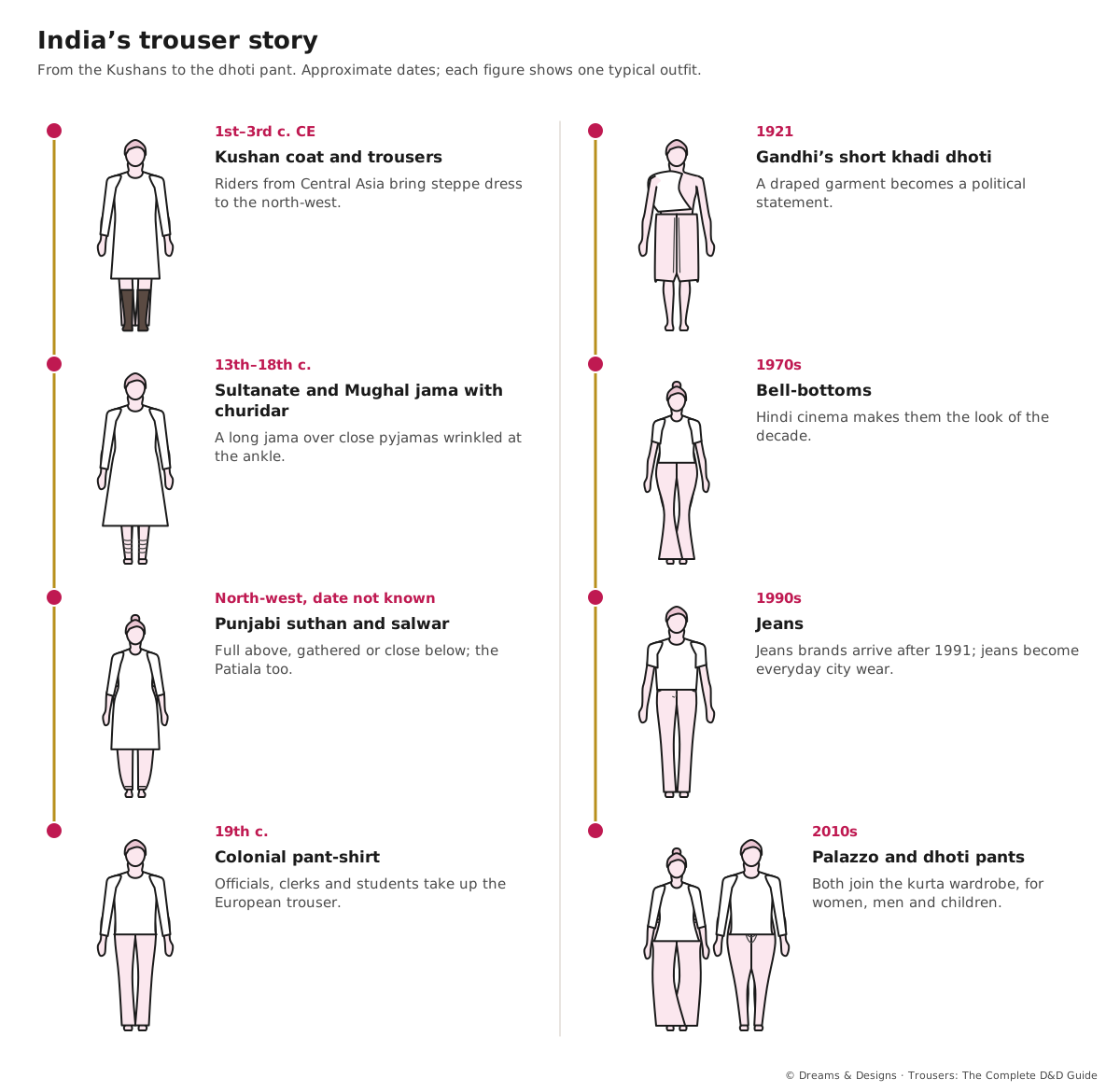
The first trousers in India came with peoples from Central Asia. The Kushans, who ruled the north-west in the first centuries CE, are shown in sculpture in long coats and riding boots, and many Kushan figures wear trousers. Later waves of Huns, Turks, Afghans and Persians brought their own stitched clothes. For a long time, trousers were the dress of rulers, soldiers and riders from the north and west, while most Indians wore draped cloth.
The court trouser: Sultanate and Mughal India
From about the 13th century, Sultanate and then Mughal courts made the stitched outfit fashionable in north India. Mughal paintings show men in the long jama over close pyjamas wrinkled at the ankle, the ancestor of the churidar. Court women wore pyjamas and wide trousers under long gowns and veils. Wider, flared court trousers, later the gharara and sharara, became the festive dress of Awadh (Lucknow) and Hyderabad.
The salwar’s journey
- From Persia and Central Asia: the word shalwar is Persian, and the wide drawstring trouser came to the north-west from that world.
- Punjab, Kashmir and the north-west: it settled into regional forms: the Punjabi suthan (full above, tight at the calf), the full salwar, and the deeply pleated Patiala salwar, traditionally linked to the princely state of Patiala.
- After 1947: Partition moved millions of Punjabi families across north India, and with them the salwar kameez.
- 1960s–90s: the “Punjabi suit” or “churidar set” spread to every state. Students, working women and travellers chose it for ease and modesty. In Kerala and Tamil Nadu, people often call any salwar suit a “churidar”.
- Today: the salwar kameez and its relatives (kurta with churidar, leggings, palazzo or cigarette pants) are among the most worn outfits by women across India, and the salwar kameez is the national dress of Pakistan.
Men: dhoti, pyjama, pant
For centuries most Indian men wore a dhoti, mundu or lungi, with the kurta pyjama for some communities and occasions. Under British rule, officials, clerks, lawyers and students took up the European trouser, and the “pant-shirt” became the city man’s wear. In 1921 Gandhi gave up his own fuller dress for a short khadi dhoti, making the draped garment a political statement. After Independence, the bandhgala or achkan with churidar became formal national dress, while trousers took over offices and the dhoti stayed for home, temple and ceremony.
In more depth: the 20th century and today
- Uniforms: khaki shorts and then trousers for police, army and school. For decades Indian schoolboys wore shorts until the higher classes, then trousers; schoolgirls wore skirts or pinafores, and in many states, salwar kameez in the higher classes.
- Film: 1970s Hindi cinema made bell-bottoms the look of the decade for young women and men alike.
- After 1991: the opening of the economy brought international jeans brands, and jeans became everyday wear for young women and men in the cities through the 1990s and 2000s.
- 2000s: stretch leggings took over from the stitched churidar for many women, under shorter kurtis. A film-led Patiala revival followed.
- 2010s: the palazzo, cigarette pants and dhoti pants joined the kurta wardrobe; trousers became standard for women in many offices, the police and airlines.
- 2020s: athleisure, co-ord sets and Indo-western festive trousers for women, men and children.
In more depth: transformation, draped to stitched
India keeps turning draped garments into stitched ones, and back again. This is a theme the whole book returns to (Part IX).
- Dhoti to dhoti pants: the draped dhoti, tied with a back tuck, already works like a trouser. Designers took its look, the soft folds and the low drop between the legs, and sewed it into a pull-on trouser with an elastic or drawstring waist. Dhoti pants are now worn by women, men and children, with kurtas, short tops and festive jackets.
- Pre-stitched dhoti and panche: ready-sewn dhotis with a waistband or Velcro make the ceremonial draped look easy for men and boys at weddings and pujas.
- Saree to pant-saree: the drape is sewn onto a trouser base, so it looks like a saree but moves like a trouser. It echoes the Maharashtrian nauvari saree, which is draped with a back tuck and already divides the legs.
- Lungi to wrap trousers: the lungi’s fabric and checks reappear in wrap-front and fisherman-style trousers.
- Lehenga to sharara: the sharara and gharara give the swirl of a skirt with the ease of two legs.
In more depth: children in India
Small children in many Indian homes have long gone bare-legged or in a short shirt in the heat, then into shorts (chaddi) or a frock. Boys wear kurta pyjama for festivals and weddings from babyhood, and now dhoti pants and mini bandhgala sets too. Girls wear frocks, then salwar suits or lehengas, with leggings under frocks as a modern habit. School shorts for boys and skirts or salwars for girls are slowly giving way to trousers for all in some schools. Parts III and X cover making for children.
In more depth: trousers in Indian dance, sport and faith
- Kathak dancers wear the churidar under the angarkha or anarkali; the Bharatanatyam costume often has a pleated “pyjama” style, sewn to look like a saree.
- Kabaddi, kho-kho and wrestling use shorts or close trousers for movement.
- The kachera, a cotton undergarment like shorts, is one of the five articles of faith worn by initiated Sikhs.
Tips for learners and teachers
- Remember the salwar’s journey in five words: Persia, Punjab, Partition, country, world.
- Look at a Mughal painting (in a museum book or online collection) and find the ankle wrinkles of the pyjama: that is a churidar.
- Ask an older relative what they wore to school, and when they first wore jeans.
- Teachers: give students a dhoti to drape, then show a dhoti pant pattern. The link becomes obvious.
Common misunderstandings
- “Trousers came to India with the British.” Indian trousers are much older; the British brought one kind, the tailored Western trouser.
- “The salwar is Punjabi, so it is not South Indian.” It began in the north-west but is now worn in every state.
- “Dhoti pants are a dhoti.” They borrow the look; they are sewn trousers.
- “Leggings are Western, the churidar is Indian.” Leggings replaced the churidar in daily wear because they are easy, but they play the same role.
For earning and teaching
India’s trouser story is the reason a D&D customer may ask for a churidar, a Patiala, a dhoti pant and a straight office trouser in the same week. A tailor who can make all of them, and explain where each comes from, stands out. In class, the draped-to-stitched story is a strong design exercise: take one draped garment and design its stitched version.
Sources and uncertain points
- How widely Kushan trousers were worn in India is uncertain; the sculptures show rulers and nobles.
- The date the salwar reached Punjab is not known; it is linked broadly to Persian and Central Asian contact over many centuries.
- The Patiala salwar’s link to the Patiala court is traditionally said.
- The spread of the salwar suit across India from the 1960s–90s is broadly described in dress histories; dates differ by region.
- The leggings, palazzo and dhoti-pant decades are approximate, from fashion reporting.
- Gandhi’s adoption of the short dhoti in 1921 (at Madurai) is well documented.
- Main source: D&D ebook Encyclopedia of Trousers for Women, ch. 4, much widened.
Check yourself
- Can you name the people who first brought trousers to north-west India?
- Can you describe the Mughal pyjama and how it relates to the churidar?
- Can you tell the salwar’s journey in five steps?
- Can you explain how a dhoti pant differs from a dhoti?
- Can you name two Indian garments that turned draped into stitched?
Key terms
- Jama: a long Mughal-era coat-gown.
- Suthan: an older Punjabi trouser, full above and close at the calf.
- Bandhgala, achkan: closed-neck formal coats worn with churidar or trousers.
- Nauvari: the nine-yard Maharashtrian saree, draped with a back tuck.
- Pant-saree: a saree drape sewn onto a trouser.