Part VII is the catalogue: 275 trousers in 20 families, from a plain straight trouser to a Sámi skin trouser. Every style has the same short entry, so once you can read one you can read them all. This lesson explains the headings, the flat sketches and the notes for women, men and children, and gives a quick map of the 20 families.
What you’ll learn
- What each of the seven headings in a style entry tells you.
- How to read the front flat sketch that goes with each style.
- How women’s, men’s, children’s and unisex versions are noted.
- How the 20 families are arranged, so you can find any trouser fast.
The shape of a family lesson
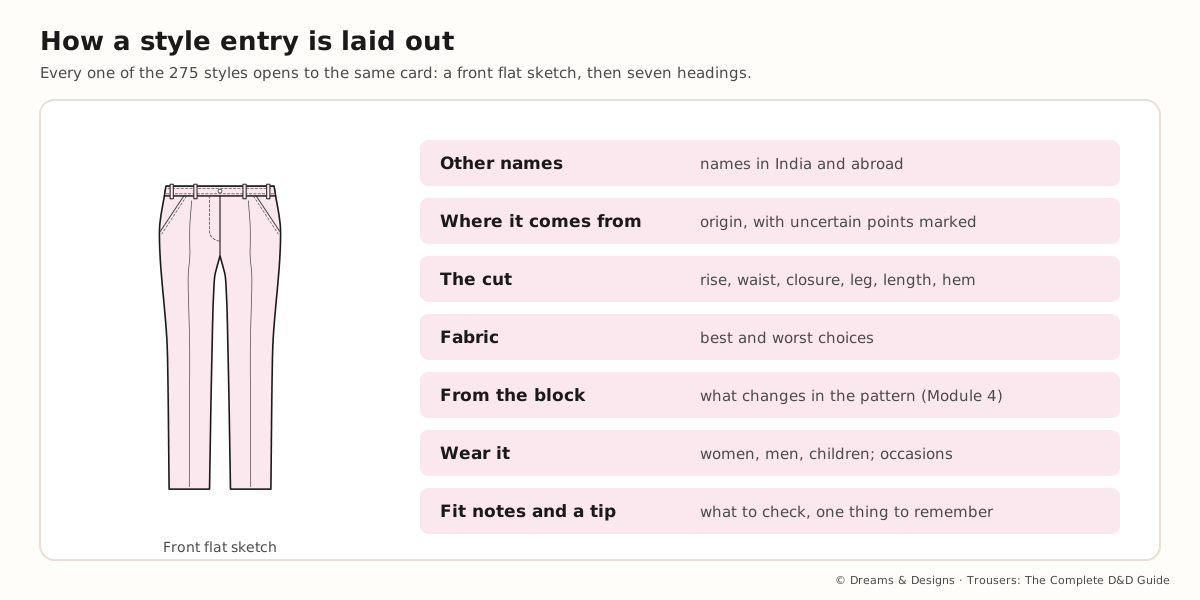
Each family has its own lesson, called “Every trouser:” followed by the family’s name. It opens with a short introduction: what links the styles, how to tell them apart, and where they show up in Indian fashion. Below that, every style sits in its own tap-to-open section. The closed line shows the style’s name and a one-line summary, for example Palazzo – very wide from the hip, floor-length, fluid. Tap it to open the full entry.
The seven headings
- Other names. What the style is also called: in other countries, by tailors, in shops, and in Hindi and Kannada where a real word exists. We never invent a translation. If Indians simply say “palazzo” or “bootcut”, the entry says so.
- Where it comes from. The origin, briefly. Dress history is full of good stories that are not quite true, so uncertain points are marked “sources differ”, “reported” or “traditionally said”.
- The cut. The shape in tailor’s terms: rise, waist, closure, leg shape (width at thigh, knee and hem), length and hem finish.
- Fabric. The best choices, and the ones that let the style down. Part II, starting with Fabric by style and occasion, gives the full reasons.
- From the block. What you change on the basic pattern to get this style, naming the Module 4 lessons that show how, such as From the block: taper, flare and wide legs.
- Wear it. Who wears it and where: women, men and children where relevant; the occasion; what goes on top, the kurta length, and shoes.
- Fit notes and a tip. What usually goes wrong for this style, and one thing a good tailor does.
The flat sketch
Each entry will carry a front flat sketch: a clean line drawing of the trouser laid flat, as a tailor or designer draws it, with no figure inside. All the sketches are drawn by the same D&D drawing script from a short list of settings, so they share one scale and one style. That makes them easy to compare: put two side by side and the difference you see is the real difference in the cut.
The settings are rise, waist, closure, leg, length, hem, crotch and details. You will meet the same words in every “The cut” paragraph. The sketches show the shape; they are not patterns, and they are not measured to any body.
The sketches are illustrations, drawn by code. Photos of real D&D work will be added as the studio makes each style.
Women, men, children and unisex
Almost every trouser can be made for anyone. The catalogue sorts styles by their shape, not by who wears them, and the “Wear it” heading notes the versions:
- Women: usually the women’s block, with more shaping from waist to hip, and often a side zip, back zip or elastic waist instead of a fly.
- Men: the men’s block, with more front crotch room, a straighter hip and, on tailored styles, a fly and a split back waistband.
- Children: the child blocks, with growth room, easy waists and safety notes (no long cords, secure buttons). See Children’s trousers: safety.
- Unisex: marked where the same pattern is sold to everyone, as with many joggers, pyjamas and scrubs.
Two families, Men’s styles and Children’s styles, hold the trousers made mainly for those wearers, such as the bandhgala trouser or a baby’s nappy-friendly pants. Anyone may wear any style.
The 20 families at a glance
| Family | What links them | Styles |
|---|---|---|
| Leg shapes | The shape of the leg, straight to balloon | 22 |
| Lengths | Where the hem falls | 10 |
| Waist and front | Rise, pleats and how it closes | 16 |
| Tailored and office | Suiting cloth, crease, careful finish | 10 |
| Work and uniform | Built for a job or an institution | 12 |
| Denim | Jeans in every cut | 18 |
| Active and sport | Movement, knits and sport rules | 20 |
| Home and life stages | Sleep, lounging, pregnancy, adaptive | 9 |
| One-piece | Trouser joined to a top | 8 |
| Evening and festive | Rich cloth and special nights | 9 |
| India and South Asia | Salwars, churidars, pyjamas, sharara | 25 |
| East and Southeast Asia | Hakama to Thai fisherman pants | 13 |
| Central and West Asia, Middle East and Africa | Tunban, şalvar, sirwal, sokoto | 11 |
| Europe | Regional dress, trews to vraka | 9 |
| Americas, Arctic and Pacific | Bombachas to sealskin | 8 |
| Men’s styles | Made mainly for men | 14 |
| Children’s styles | Babies to teens | 17 |
| Street and subculture | Zoot suit to techwear | 14 |
| Shorts, skorts and divided skirts | Short legs and skirt-like trousers | 14 |
| History’s trousers | Yanghai to hammer pants | 16 |
Some names appear twice on purpose. “Bootcut” is a leg shape and also a cut of jeans; “Boiler suit” is workwear and also a one-piece. Each entry describes the style from its own family’s point of view and points to the other.
How to use the catalogue
- To identify a trouser you have seen: start with the leg (Leg shapes), then the length (Lengths), then the waist (Waist and front). Most trousers are named by one of those three.
- To make one: read “The cut” and “From the block”, then go to the Module 4 lesson it names.
- To advise a customer: read “Fabric”, “Wear it” and “Fit notes”. They answer the questions customers ask most.
- To design: mix families. A cropped, double-pleat, wide-leg trouser takes one choice from each of the first three families.
Tips for learners and teachers
- Keep a notebook page per family. When you see a style in a shop, a film or a wedding, write its name and where you saw it.
- Learn the cut words first: rise, thigh, knee, hem, taper, flare. Every entry uses them.
- Teachers: give students two sketches and ask them to name the one setting that differs. It trains the eye fast.
- Compare the Indian and Western names for the same shape. A “cigarette pant” worn with a kurta and a “cigarette trouser” worn with a blazer are cut almost alike.
Common misunderstandings
- “Each name means one exact pattern.” No. Names are loose. Two shops may sell different cuts as “barrel” or “slim”. The entry gives the usual meaning and notes where names overlap.
- “Some styles are for some bodies only.” No. Fit notes say how a style behaves on different bodies, never who may wear it.
- “The sketch is the pattern.” No. The sketch shows the shape. The pattern comes from your block and the Module 4 lessons.
Sources and uncertain points
- Style names and their meanings vary between countries, decades and brands; the catalogue gives the most common use and marks disagreements.
- Hindi and Kannada names are given only where they are in real use; spellings are for a D&D teacher to check.
- Origins are marked “sources differ”, “reported” or “traditionally said” wherever the record is thin.
- Main source: D&D ebook Encyclopedia of Trousers for Women, ch. 9 and 19–35, widened to men, children and India.
Check yourself
- Can you name the seven headings of a style entry, in order?
- Which heading tells you what to change on the pattern?
- Can you say what the flat sketch shows, and what it does not?
- In which three families would you look first to name an unknown trouser?
- Where would you find a trouser made mainly for babies?
Key terms
- Style entry: the short, fixed-shape description of one trouser.
- Family: a group of styles linked by one feature, such as leg shape or region.
- Flat sketch (flat): a line drawing of a garment laid flat, without a body.
- Block: the basic fitted pattern every style is made from.
- Unisex: one pattern sold for everyone.