The salwar, the churidar and the pyjama are the everyday trousers of India and its neighbours, worn by women, men and children in every state. They are cut from straight panels, kalis and bias strips, held up with a nada, and almost always worn under a kurta or kameez. This lesson gives each of the eleven styles its own entry, from the Punjabi salwar to the kalidar pyjama.
What you’ll learn
- The six salwars, the churidar and the four pyjamas, each by its own name.
- How to tell them apart by fullness, ankle and cut.
- Which Module 4 draft each one comes from, and what changes.
- How each is worn by women, men and children, and with which kurta.
What links these styles
All eleven sit at the waist on a nada or elastic, with no fly. They are roomier at the seat than a Western trouser, so the wearer can sit cross-legged on the floor at home, in a temple or at a wedding. What separates them is the leg:
- Salwars are full at the top and narrowed to a mohri (ankle opening). The fullness comes from kalis, pleats or a draped front.
- The churidar is cut on the bias and longer than the leg, so it gathers at the ankle in rings.
- Pyjamas are straight or gently shaped, from the narrow Aligarh to the floor-sweeping farshi.
A quick test: look at the ankle. Gathered into a cuff means a salwar; rings of folds means a churidar; a plain open hem means a pyjama. Names change from region to region (in Kerala and Karnataka “chudidar” often means the whole suit), so always confirm a style with a picture. The regions behind these styles are in Trousers across India and South Asia; the drafts are in Module 4, Indian drafts: salwar, kali and Patiala and Indian drafts: churidar on the bias and kurta pyjama. The second half of the family, from the sharara to the shalwar, is in Every trouser: India and South Asia (sharara to shalwar).
Tap any style to open its entry.
Punjabi salwar – full from the waist, gathered on a nada, narrowed to an ankle cuff

Other names
Salwar, shalwar; सलवार in Hindi; ಸಲ್ವಾರ್ in Kannada. The ankle cuff is the poncha or mohri. With the tunic and scarf it is the salwar kameez or salwar suit.
Where it comes from
The word comes from Persian shalvar, and the shape belongs to the wide-trouser family of West and Central Asia (see Every trouser: Central and West Asia, Middle East and Africa). How and when it reached Punjab is not exactly known; it is generally linked with the centuries of Persian and Central Asian contact in north India, and sources differ on dates. The older Punjabi suthan, full above and close below the knee, is described as a relative. Today the Punjabi salwar is worn in every Indian state and is one of the most widely worn trousers in South Asia.
The cut
High rise on a nada, with a deep, low asan (crotch) for sitting on the floor. Each leg is a front panel, a back panel and a tapered kali at the side, so the top is very wide (about 68 in, 173 cm, all round for a 40 in hip) and gathers onto the nada. The leg narrows steadily to a mohri of about 14 in (35.5 cm). No fly and no side opening.
Fabric
Best: soft cotton, cambric, rayon, crepe, cotton silk and georgette over lining. Worst: stiff canvas, heavy denim and crisp organza, which stand out at the hips instead of falling.
From the block
The salwar is not made from the trouser block. It has its own draft of panels and kalis, given in full in Module 4, Indian drafts: salwar, kali and Patiala, and sewn in the order in Module 6, Order of construction: jeans, salwar and churidar. The nada casing is in Waistbands: elastic, half-elastic, nada and adjustable.
Wear it
Women: with a kameez or kurta to the knee or just above, and a dupatta; daily wear, college, office and festivals. Men: a plainer, slightly narrower version with a long kurta, especially in Punjab. Children: the same pieces scaled down, with elastic instead of a nada for young children. Shoes: juttis, kolhapuris, sandals, flats.
Fit notes and a tip
Check the sit test: no pull at the crotch when sitting cross-legged. The mohri should rest on the ankle bone and pass over the heel. A long kurta balances a slimmer salwar (smaller kalis); a short kurti balances a fuller one. Tip: mark the top of each kali before sewing, because they are very easily set upside down.
Patiala salwar – deep pleats from the waist, folds to the ankle, a band at the hem

Other names
Patiala, Patiala shahi salwar; पटियाला सलवार in Hindi. The ankle band is the patti.
Where it comes from
Named after Patiala, the former princely state and city in Punjab. It is traditionally said to have been worn at the Patiala royal court in the early twentieth century, and the style is often credited to that court; the exact story differs between sources. It became popular across north India with Punjabi film and bhangra, and is now worn far beyond Punjab, especially for festivals and weddings.
The cut
Each leg is one very wide piece, about 40 in (101.5 cm) across, with deep pleats folded on the back and sides of the top and a kali on the inner leg. The asan sits even lower than in the Punjabi salwar. The pleats fall in long folds that gather into a narrow band of about 16 in (40.5 cm) at the ankle, often with a button or loop opening. The folds take up length, so the leg looks slightly lifted.
Fabric
Best: soft cotton, cotton voile, rayon, crepe and soft silk, which fold well and press into pleats. Worst: thick or springy cloth, which makes the hips bulky. Allow about 3–4 m of 44 in (112 cm) cloth for an adult.
From the block
Its own draft: Module 4, Indian drafts: salwar, kali and Patiala. The pleats are planned as in Module 5, Pleats: accordion, sunray and Patiala. Press the pleats before stitching the nefa (casing).
Wear it
Women: classic with a short kurti, which shows the folds; also with a hip-length kurta and phulkari dupatta. Men: a men’s Patiala, worn with a kurta for bhangra and Punjabi festivals (see Every trouser: men’s styles). Children: Patiala sets for weddings and Lohri or Baisakhi; keep the band easy over the heel. Shoes: juttis.
Fit notes and a tip
The band should sit just above the ankle bone and pass over the heel. The folds should fall evenly at the back; if they open, tack them into the casing. Tip: notch every pleat on the pattern, so both legs match.
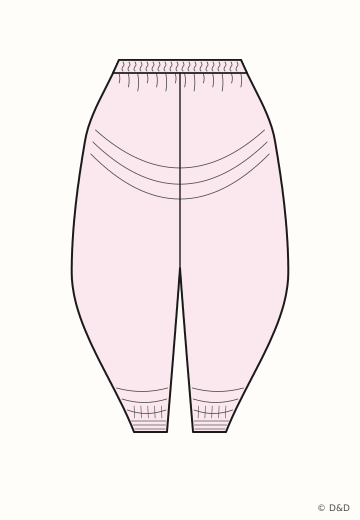
Afghani salwar – very full and soft, gathered into a narrow ankle band
Other names
Afghani pants, Afghani salwar; sometimes sold as “harem salwar”.
Where it comes from
In Indian shops, “Afghani” is a fashion name for a very full salwar gathered tightly at the ankle. It echoes the wide drawstring trousers worn in Afghanistan, such as the tunban (see Every trouser: Central and West Asia, Middle East and Africa), but the shop style is a modern Indian cut, not a copy of any one Afghan garment. It became popular in the 2010s.
The cut
High rise on elastic or a nada, a very low crotch and very full legs that balloon above a narrow banded or elasticated ankle. Fuller panels than a Punjabi salwar, usually with no separate kali.
Fabric
Best: rayon, viscose crepe, soft cotton and modal, which hang in soft folds. Worst: stiff cotton, which makes the balloon stand out.
From the block
Start from the Punjabi salwar in Module 4, Indian drafts: salwar, kali and Patiala: widen the panels, lower the asan 1–2 in and replace the mohri with a band or elastic casing. The drop-crotch shaping in Module 4, From the block: palazzo, harem, culotte and jogger is a useful comparison.
Wear it
Women: with short kurtis, crop tops and long shrugs; casual, college and travel. Men: a men’s version appears in fusion wear. Children: comfortable for play, with soft elastic at both waist and ankle. Shoes: sandals, juttis, trainers.
Fit notes and a tip
Too low a crotch catches on steps; test the stride. Tip: use a wider elastic at the ankle so it does not cut in.
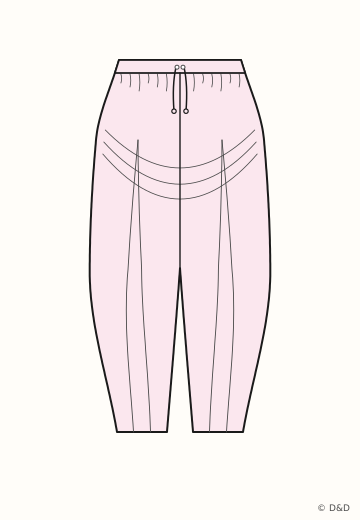
Pathani salwar – a full men’s salwar with a deep seat, worn with the Pathani kurta
Other names
Pathani, Pathani suit (with the kurta), Pakhtun or Pashtun shalwar. Pathan is the name used in South Asia for the Pashtun (Pakhtun) people.
Where it comes from
The style takes its name from the Pashtun communities of Afghanistan and north-west Pakistan, where wide shalwars are everyday men’s dress. In India, “Pathani suit” has come to mean a men’s set of a collared, often button-placket kurta with a full salwar, popular for Eid, festivals and weddings. The Indian Pathani is a loose interpretation; Pashtun dress itself varies by region.
The cut
High rise on a nada, very deep asan, full seat and thighs, tapering to a mohri of about 15–17 in (38–43 cm). Plainer than a Patiala: gathers, not pleats.
Fabric
Best: cotton, linen-look cotton, khadi, cotton blends and, for festivals, soft silk blends. Worst: very thin cloth that clings, or stiff suiting.
From the block
Use the Punjabi salwar draft in Module 4, Indian drafts: salwar, kali and Patiala on the man’s seat measurement, with a deeper asan (seated rise + 3 in) and a wider mohri. See also Every trouser: men’s styles, Men’s Pathani salwar.
Wear it
Men: with a Pathani kurta to the knee, in one colour; with a waistcoat for weddings. Women: the cut is borrowed for relaxed salwar suits. Boys: Pathani sets for Eid and family functions. Shoes: mojaris, peshawari chappals, kolhapuris.
Fit notes and a tip
The salwar should not pull at the back when the wearer sits or kneels, including for prayer. Tip: cut the nada wide and soft, as men’s waists take a lot of tension.
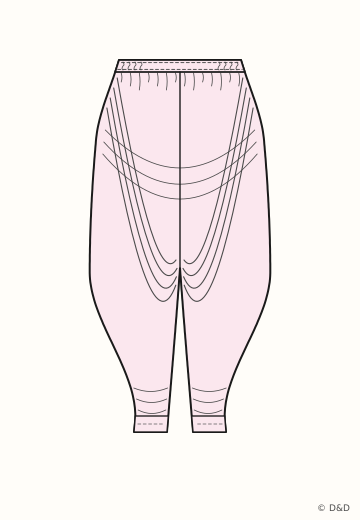
Dhoti salwar – a salwar with a draped cowl front, like a tied dhoti
Other names
Dhoti-style salwar, cowl salwar.
Where it comes from
A modern Indian fusion style, popular from about the 2010s, that borrows the look of a tied dhoti for a stitched salwar. It sits between the salwar and dhoti pants (see Every trouser: India and South Asia (sharara to shalwar)).
The cut
A salwar with extra width on the front panel, folded into the waist so it falls in curved cowl folds down the front of the leg. Low crotch; the leg narrows to a cuff or elastic ankle.
Fabric
Best: rayon, crepe, soft cotton silk and georgette, so the cowl drops. Worst: crisp cotton, which holds the folds flat and stiff.
From the block
Start from the salwar draft and add the dhoti front from Module 4, Indian drafts: dhoti pants, sharara and gharara. Drape the folds on the toile first (Module 5, Draped styles: dhoti pants, harem and drop-crotch).
Wear it
Women: with short or asymmetric kurtis, so the folds show; festive, mehendi and sangeet. Girls: lovely for dance and festivals. Shoes: juttis or flat sandals.
Fit notes and a tip
The folds should fall evenly on both legs. Tip: tack the folds into the waistband in their final position before fitting.
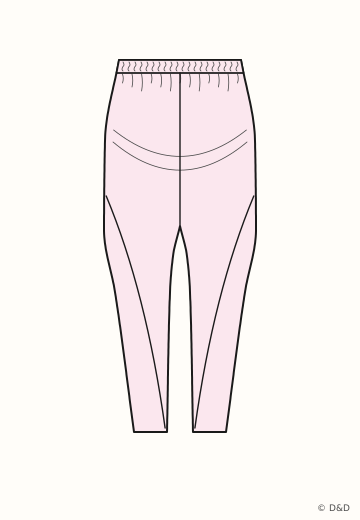
Tulip salwar – front panels overlap in a curved petal line on the leg
Other names
Tulip pants, petal salwar.
Where it comes from
A recent Indian fashion style, widely sold from about the 2010s. The name comes from the curved, overlapping front, like tulip petals. Its exact beginnings are not recorded.
The cut
A moderately full salwar on elastic or a nada. On the front of each leg, two curved panels cross over each other from mid-thigh to the hem, making a petal line and a little extra room. Narrow ankle, often slightly cropped.
Fabric
Best: cotton, cotton silk and rayon, which hold the curve. Worst: very sheer cloth, where the overlap shows through, and very heavy cloth, which makes it bulky.
From the block
Start from the salwar front panel in Module 4, Indian drafts: salwar, kali and Patiala. Draw the curved overlap line, add the overlap width to each half and face or hem the curved edges. Draft both front halves separately.
Wear it
Women and girls: with short, straight kurtis so the petal shows; casual, college and day functions. Shoes: flats and sandals.
Fit notes and a tip
The overlap should not gape when walking; add a small tack at the hem. Tip: face the curved edges instead of hemming them, for a cleaner curve.
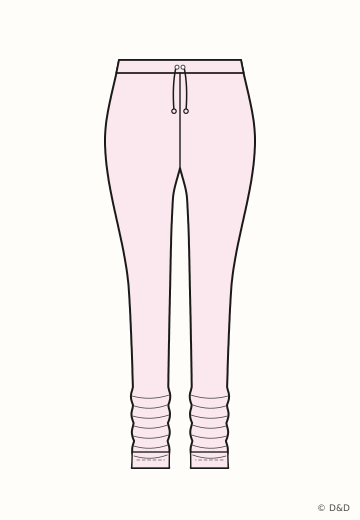
Churidar – bias-cut and longer than the leg, gathering in rings at the ankle
Other names
Churidar, chudidar, churidar pyjama; चूड़ीदार in Hindi; ಚೂಡಿದಾರ್ in Kannada. The name comes from churi (bangle), for the rings of fabric at the ankle. In Kerala and Karnataka, “chudidar” is also used for the whole salwar suit.
Where it comes from
The churidar is a north Indian court style, widely linked with Mughal and Awadhi dress, worn under the angarkha, achkan and later the sherwani by men and under long kurtas and anarkalis by women. Exact dates are not known. In the twentieth century it became the classic Indian formal trouser for both, and in the 1960s it was a fashion leg in India and abroad.
The cut
High rise on a nada, with a modest asan. The leg is cut on the true bias, fitted from the knee down, and drafted about 10–12 in (25–30 cm) longer than the leg below the knee. That extra length gathers into six to eight rings at the ankle. The ankle is smaller than the heel, so it has a short opening with hooks, loops or a small zip.
Fabric
Best: soft cotton, cotton lycra (for a ready-made knit version), rayon, cotton silk and silk. Worst: stiff cotton and thick brocade, which will not ring, and very loose weaves, which drop and twist. About 2 1/2 m of 44 in (112 cm) cloth for an adult; bias layouts use more than straight ones.
From the block
Its own draft on the bias: Module 4, Indian drafts: churidar on the bias and kurta pyjama. Finish the ankle as in Module 6, Hems: turn-ups, churidar ankles, raw edges and growth hems, and assemble as in Order of construction: jeans, salwar and churidar.
Wear it
Women: with anarkalis, long straight kurtas and kalidar kurtas; weddings, festivals, office and daily wear. Men: under the sherwani, achkan, bandhgala and long kurta, the classic north Indian wedding look (see Every trouser: men’s styles, Men’s churidar with sherwani). Children: festive sets, with less extra length (6–8 in) and elastic for young children. Shoes: juttis, mojaris, heels or flats.
Fit notes and a tip
The wearer should sit cross-legged and bend the knee without strain. Rings should fall evenly on both legs. Bias legs drop and narrow as they hang, so the knee and calf must still have ease after hanging. Muscular calves need the calf point placed at the fullest part, not halfway. Tip: hang the cut churidar for 24 hours before hemming, then level the ankles.
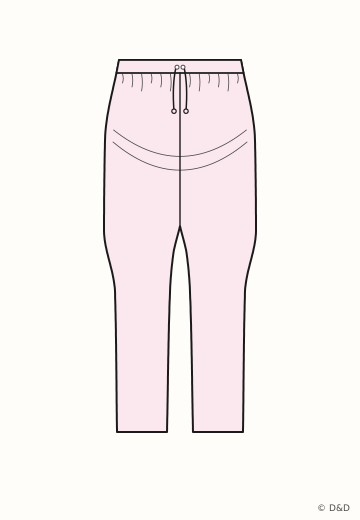
Kurta pyjama – a straight pyjama on a nada, worn under a knee-length kurta
Other names
Pyjama, paijama, kurta pajama; पायजामा in Hindi; ಪೈಜಾಮ in Kannada. The set is also called kurta pyjama or kurta paijama.
Where it comes from
The word comes from Persian pāy (leg) and jāma (garment). Pyjamas were worn in north India for centuries; British residents adopted them as sleepwear, which gave English “pyjamas”. In India the pyjama stayed day wear, and the kurta pyjama is now the common men’s festive and prayer set across India, Pakistan and Bangladesh (where it is worn with the panjabi).
The cut
High rise on a nada, roomy seat with a fairly deep asan, and a straight leg to a mohri of about 16 in (40.5 cm). Each leg is often cut as one piece folded at the outer leg, with no side seam.
Fabric
Best: cotton, cambric, khadi, mul, linen, cotton silk and raw silk for festivals. Worst: heavy suiting and stiff synthetics, which are hot and do not gather.
From the block
The straight pyjama draft is in Module 4, Indian drafts: churidar on the bias and kurta pyjama. It is one of the best first projects: few pieces, no fly and no fitting of the leg.
Wear it
Men: with a kurta to the knee or below, a Nehru jacket for weddings, and mojaris or kolhapuris; puja, Eid, Diwali, temple and family functions. Women: kurta pyjama sets in soft cotton for home and casual wear. Children: the festive outfit for boys across South Asia; use an elastic or half-elastic waist for small children (see Every trouser: children’s styles).
Fit notes and a tip
No pull at the seat when sitting on the floor; the hem should clear the heel when walking. Tip: mark front and back on one-piece legs, because they look almost the same.
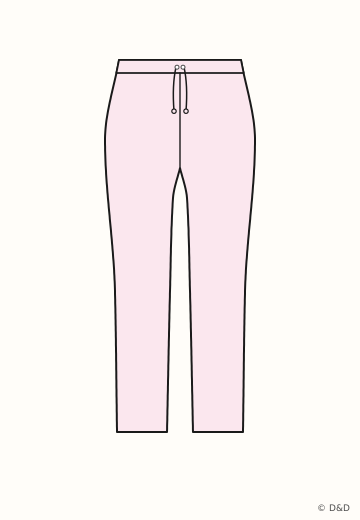
Aligarh pyjama – straighter and wider than a churidar, fitted at the top, for sherwanis
Other names
Aligarhi pyjama, Aligarh cut pyjama.
Where it comes from
Named after Aligarh in Uttar Pradesh. Its link with Aligarh Muslim University, where students and staff wore it with the sherwani, is widely said, though the date it took the name is not recorded. It is a north Indian formal style, worn especially in Muslim communities and at weddings.
The cut
A fitted top at the hip and seat, with little gathering on the nada, then a straight leg wider than a churidar: a mohri of about 20–22 in (51–56 cm). It does not gather at the ankle. Neat, plain and formal.
Fabric
Best: cotton, cotton silk, fine wool blends and raw silk, often white or matched to the sherwani. Worst: limp, clingy cloth, which loses the straight line.
From the block
From the straight pyjama in Module 4, Indian drafts: churidar on the bias and kurta pyjama, take in the top to fit closer at the hip and widen the mohri as described under Variations there.
Wear it
Men: with a sherwani or achkan, and with long kurtas for Eid and weddings. Women: the cut is used for straight pants under long kurtas. Boys: with a small sherwani for weddings. Shoes: mojaris, juttis or formal shoes.
Fit notes and a tip
It should hang straight from the seat without dragging lines. Tip: press a light crease down the centre front for a formal finish.
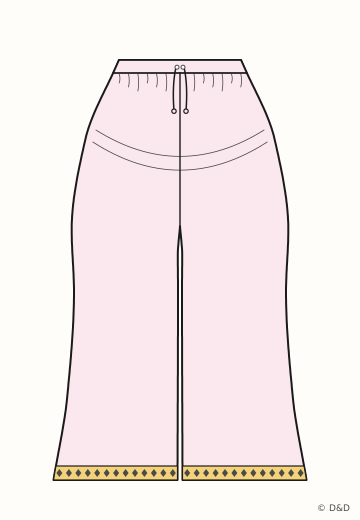
Farshi pyjama – very wide legs that trail on the floor
Other names
Farshi, farshi gharara (in some accounts). The name comes from farsh, the floor or floor covering.
Where it comes from
A court style of Awadh (Lucknow), worn by women of noble households in the eighteenth and nineteenth centuries, with the legs so long that they swept the floor and were held up when walking. Some writers treat it as a forerunner of the gharara; sources differ on how the two are related.
The cut
High rise on a nada, with very wide legs flaring from the hip to a hem that trails on the floor in front and behind. No knee join. Traditionally a border of gota or zari trims the hem.
Fabric
Best: silk, tissue, brocade with a soft hand, georgette and chiffon over lining. Worst: stiff fabric, which stands out instead of pooling on the floor.
From the block
Start from the sharara in Module 4, Indian drafts: dhoti pants, sharara and gharara and add length so the hem rests on the floor in the shoes worn, plus 2–4 in (5–10 cm) of trail.
Wear it
Women: with a short kurta and a long dupatta, for weddings, nikah and theatre, dance or heritage events. Girls: keep it ankle length so they do not trip. Shoes: soft juttis.
Fit notes and a tip
A floor-length hem is a trip hazard on steps; agree the trail with the wearer. Tip: level the hem on the wearer, in her shoes, after the trouser has hung for a day.
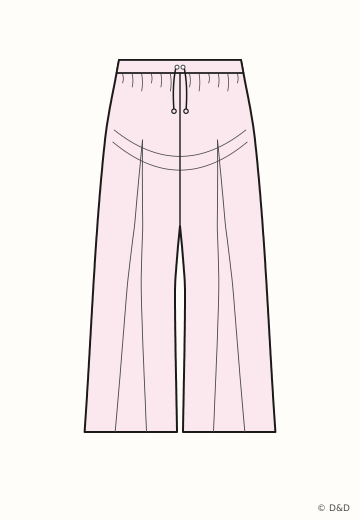
Kalidar pyjama – a pyjama widened with kali panels, flaring at the hem
Other names
Kalidar, kali pyjama. Kali means a tapered panel (literally a bud); kalidar means made with kalis. The word is better known for the kalidar kurta.
Where it comes from
Kalidar cutting, with many tapered panels, belongs to the north Indian tailoring of Awadh and Delhi. The name “kalidar pyjama” is used by tailors for a pyjama widened with kalis; how it is cut varies from tailor to tailor, and it is less clearly documented than the kalidar kurta.
The cut
A straight pyjama with one or more kalis set into each leg, so it stays neat at the hip but widens gently to the hem. Nada waist, roomy seat.
Fabric
Best: cotton, cotton silk, chanderi with lining and soft silk. Worst: very stiff cloth, which makes the kalis stand out.
From the block
Start from the straight pyjama in Module 4, Indian drafts: churidar on the bias and kurta pyjama. Slash the leg from hem to hip and insert a kali, or spread as in Module 5, Adding flare: slash-and-spread, godets and flounces.
Wear it
Women and men: with a matching kalidar or straight kurta; festive and wedding wear. Children: soft, comfortable festive sets. Shoes: juttis, mojaris.
Fit notes and a tip
Keep the kalis on the straight grain down their centre, or the legs twist. Tip: agree the cut with a picture; customers use the name for several shapes.
Sources and uncertain points
- When the salwar reached Punjab, and its relation to the suthan: sources differ.
- The Patiala’s link to the Patiala royal court: traditionally said; the details differ.
- “Afghani salwar”, “dhoti salwar” and “tulip salwar” are shop and tailoring names; their first use is not recorded.
- Aligarh pyjama and Aligarh Muslim University: widely said.
- Farshi pyjama and gharara: their relation is described differently by different writers.
- Kalidar pyjama: the name is used by tailors; cuts vary and documentation is thin.
- Main source: D&D ebook Encyclopedia of Trousers for Women, ch. 4, widened with general dress history.