Most people never sew their own alterations; they take trousers to a tailor. The result depends a great deal on what you bring and how you describe the problem. This lesson helps customers get exactly what they want, and helps tailors and students understand a customer’s words. It uses the fitting vocabulary from Part III.
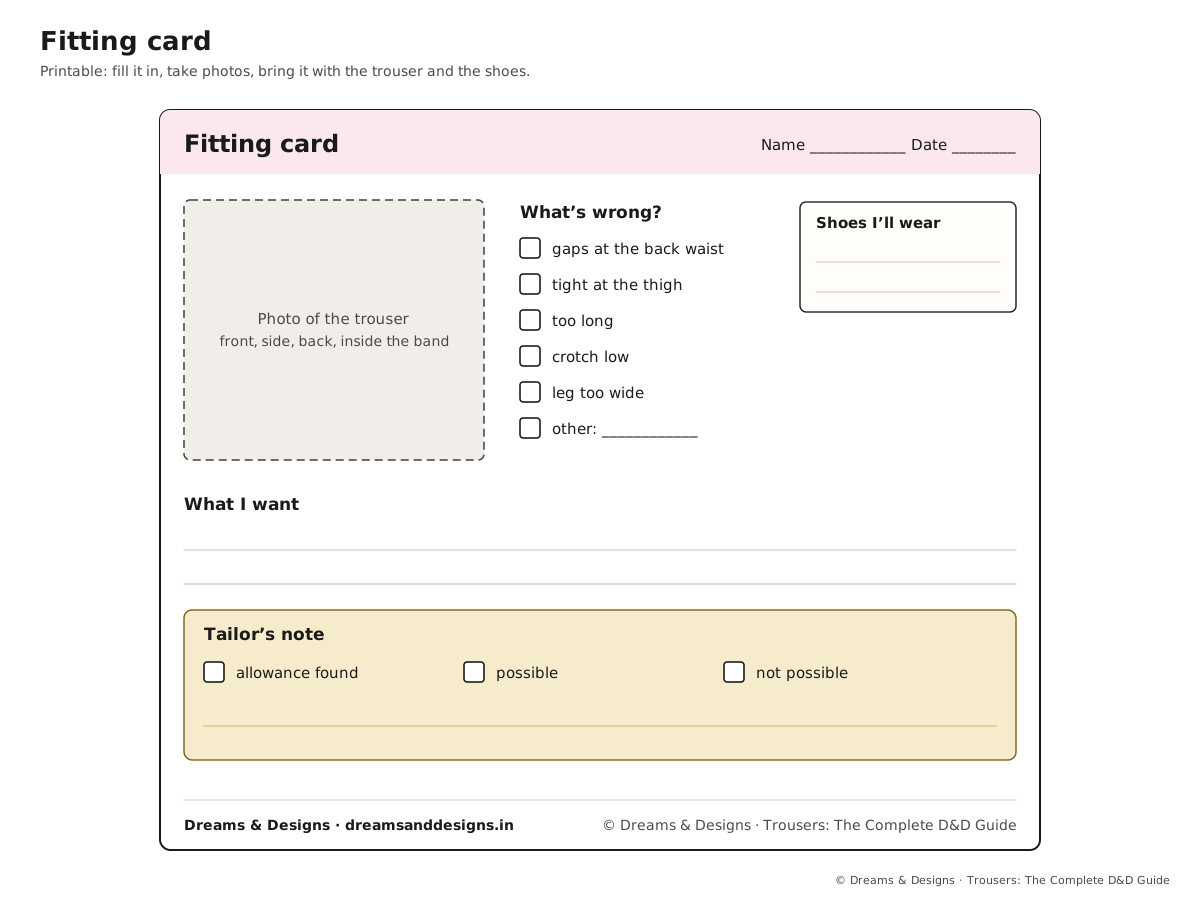
What you’ll learn
- What to bring to a fitting.
- How to describe a fit problem in words a tailor understands.
- What can and cannot be done, so expectations are realistic.
- How to check the trouser when you collect it.
What to bring
- The shoes you will wear with the trouser. Forgetting them is the most common reason for a second visit (from the D&D ebook).
- The undergarments or shapewear you usually wear; they change the waist and hip.
- The top or kurta if the trouser is part of a set, so lengths and borders balance.
- A trouser that fits well, if you have one. A tailor can copy its leg width, rise or length.
- For children: the child, in their usual shoes, and a sense of how fast they are growing.
- The occasion and date: office wear, a wedding, daily use.
Say it in fitting words
| You might say | Say instead | The tailor will probably |
|---|---|---|
| “It doesn’t fit at the back” | “It gaps at the back waist” | Take in the centre back, or a swayback wedge |
| “It’s too tight” | “Tight across the front thigh when I sit” | Let out the side seam or inseam, if allowance exists |
| “It looks baggy” | “Loose under the seat” | Take in the seat and back inseam |
| “Make it slim” | “Taper from the knee to a hem like this one” | Taper both seams |
| “Too long” | “Hem with a slight break on these shoes” | Shorten to the chosen break |
| “It hangs down” | “The crotch sits too low” | Shorten the rise from the top |
Pointing to the exact spot, or pinching the loose cloth, helps as much as words.
Realistic expectations
- Letting out depends on the cloth inside. Ask: “Is there enough to let this out, or should I choose a bigger size?” (from the D&D ebook).
- Some changes show: old stitch lines on dark, faded or shiny cloth.
- Some changes are not possible: raising a low-cut crotch, adding front rise, turning a wide leg into a skinny one in woven cloth.
- A good tailor will say “no” when an alteration would spoil the trouser. That is a sign of skill, not of unwillingness.
At the fitting: what happens
- You put the trouser on, with your shoes.
- The tailor looks from the front, side and back, and may ask you to sit, bend or walk.
- Pins or chalk mark the changes. Look in the mirror and say if anything feels wrong now, not later.
- The tailor checks the inside for allowance and tells you what is possible.
- You agree the changes and the collection date. Ask for the changes to be written on the slip.
- For big changes, ask for a second fitting (a trial) before final stitching.
Questions worth asking
- Is there enough allowance for what I want?
- Will the old line show?
- Will the pockets or pleats change shape?
- Can you keep the original jeans hem?
- Do I need a second fitting?
- Should I wash it first (new cotton or denim)?
- Can it be let out again later, for a child or a changing body?
When you collect: check before you leave
- Try it on, with the shoes.
- Sit, bend and walk.
- Look at the back in a mirror: waist, seat, hem.
- Check both legs are the same length (or deliberately different).
- Check seams inside are finished, threads trimmed, buttons firm.
- If something is wrong, say so calmly at once; most studios prefer to fix it then.
A message you can send ahead
Before visiting, a short message with photos saves time. For example:
“Hello. I have a pair of grey office trousers that gap about 1 inch at the back waist and are too long. I’ll wear them with black flat shoes. Could you let me know if the waist can be taken in and hemmed with a slight break? Photos of the front, side, back and the inside of the waistband attached.”
Photograph the inside of the waistband and seams too; it tells the tailor about allowance before you arrive.
Alterations at D&D
Dreams & Designs in Basaveshwaranagar, Bengaluru, alters trousers for women, men and children, including salwars, churidars and festive pieces. Express is a faster speed that can be chosen for selected jobs. Ask the studio what is possible for your trouser and when it can be ready; bring the shoes, and a trouser that fits well if you have one.
For Poornima to confirm: the wording of this paragraph, which alterations Express covers, and how customers should contact the studio. No prices or turnaround promises are given here.
For tailors and students: receiving a customer
- Listen first, then translate the words into circumference, length or shape.
- Read the inside before saying what is possible; see Before you alter: reading a trouser, and when not to.
- Write the agreed change on a slip or ticket, with the shoes noted.
- Show in the mirror what the pins will do.
- Offer a trial for rise, seat and large changes.
- Keep notes on regular customers: their usual hem length, shoe height, and preferences. Over time this makes every job quicker and better (from the D&D ebook: a single trusted tailor who knows your body gives the most consistent results).
- Treat every body with respect: describe the trouser, never the body, as the problem.
Tips for customers
- Bring the shoes.
- Bring a trouser that fits to copy.
- Use fitting words and point to the spot.
- Photograph the problem front, side and back before the fitting.
- Wash new cotton and denim before hemming, or ask the tailor.
- Allow time before an event; big changes may need a second fitting.
- Ask about allowance before buying an expensive trouser you plan to alter.
- Keep the slip with the agreed changes.
- Try on when collecting, not at home a week later.
- Stay with one tailor who learns your fit.
Problems and how to solve them
The hem is right standing but wrong with the shoes
- Return with the shoes and ask for a re-mark.
- Agree a length between two pairs of shoes.
- Prevention: always bring the shoes.
The waist is now too tight sitting
- Ask for it to be let out slightly at the centre back.
- Ask about elastic at the back of the band.
- Prevention: sit during the fitting.
You asked for “slim” and got “skinny”
- Ask whether allowance remains to let it out.
- Bring a reference trouser next time.
- Prevention: show a trouser or a photo of the leg width you want.
The tailor says it cannot be done
- Ask why, and what else is possible (inserts, elastic, a different size).
- Consider a second opinion for valuable pieces.
- Prevention: check allowance before buying.
The trouser is not ready for the event
- Ask what can be finished in the time left.
- Agree a temporary fix (tacked hem) for the day.
- Prevention: allow time, and agree the date in writing.
The old stitch line shows
- Ask for steaming and brushing.
- Wash cotton once.
- Prevention: ask “will the old line show?” at the fitting.
The child has grown before collection
- Ask for the growth hem to be left deep.
- Add adjustable elastic.
- Prevention: alter children’s trousers with room to grow.
Common misunderstandings
- “Any tailor can let anything out.” Only as far as the allowance allows.
- “A refusal means the tailor is lazy.” Often it means the change would spoil the trouser.
- “Fittings are a waste of time.” They prevent most second visits.
- “Altering is always cheaper than buying.” Not always; ask before committing.
For earning and teaching
For earning: clear communication is half of alteration work. A written slip, a mirror check and an honest “no” build loyal customers. Never promise a date you cannot keep.
For teaching: role-play the fitting: one student is the customer using everyday words, the other translates them into fitting terms and writes the slip.
Check yourself
- Do you know what to bring to a fitting?
- Can you describe a fit problem in fitting words?
- Do you know which changes may not be possible?
- Do you try the trouser on when collecting?
Quiz
- What is the most common reason for a second visit? Answer: forgetting the shoes.
- What should you ask before a let-out? Answer: whether there is enough allowance.
- Why bring a trouser that fits? Answer: the tailor can copy its measurements.
Key terms
- Fitting (trial): trying on with pins or tacking before final sewing.
- Slip (ticket): the written record of agreed changes.
- Allowance: the cloth inside the seams.
- Break: how the hem meets the shoe.
Sources and uncertain points
- Main source: D&D’s own trousers ebook, chapters 51–52 (what to bring; requests translated; realistic expectations; one trusted tailor; the shoe regret), widened to Indian trousers and children.
- The D&D paragraph needs Poornima’s confirmation.