Tailored trousers are the reference point of the whole trouser world: a structured waistband, a fly, a precise fit through the hip, and a pressed crease. This lesson covers ten tailored and office styles, from the suit trouser and chinos to the tuxedo trouser, the striped morning trouser and the Oxford bag.

What you’ll learn
- What makes a trouser “tailored”, beyond its shape.
- How the suit trouser, slacks, chinos and khakis differ.
- The formal trousers: tuxedo, morning-suit and pinstripe.
- What to change on the block, and which sewing lessons to use, for each.
What links these styles
A tailored trouser is defined less by its leg shape than by how it is made: a structured, interfaced waistband (often split at the centre back so it can be let out), a properly faced fly, pockets that lie flat, a crease set with steam, and a careful hand-finished or blind hem. The leg is usually straight or gently tapered, with a flat front or pleats.
To tell them apart, look at the cloth and the details: wool suiting and a matching jacket make a suit trouser; cotton twill makes chinos and khakis; a satin stripe down the side means a tuxedo trouser; grey-and-black stripes mean a morning-suit trouser. In India, the tailored trouser came with British rule and became the office standard as “pant-shirt” for men; today women’s formal trousers, bandhgala and Jodhpuri suits, and school and college uniforms all draw on the same craft.
Tap any style to open its entry.
Suit trouser – matched to a jacket, wool, creased, precisely fitted

Other names
Suit trousers, suit pants, dress trousers. In India “formal pant” or “suit pant”; a men’s two-piece is a “pant-coat” in Hindi-speaking regions.
Where it comes from
The lounge suit, a jacket and trousers of the same cloth, became standard men’s dress in the late nineteenth and early twentieth centuries. Women’s suits with trousers followed later in the century (see History: the twentieth century). In India the suit arrived with British rule; Indian tailors have since made it their own, and the bandhgala and Jodhpuri suits pair Indian jackets with suit trousers.
The cut
Mid or high rise. Flat front or one pleat. A structured waistband with interfacing, a curtain (an inner band facing) in fine work, and a split centre-back seam with a deep allowance for alteration in men’s trousers. Fly with an extended tab and a hook and bar. Slant or side-seam front pockets, jetted back pockets. Straight or gently tapered leg with a sharp pressed crease. Full length with a slight break; turn-ups optional.
Fabric
Best: worsted wool, wool blends, tropical-weight wool for Indian summers, wool-polyester suiting (Terry-wool, as it is often sold in India), fine linen or cotton for summer suits. A little elastane adds comfort for long days. Worst: very soft or stretchy fabrics that will not hold a crease.
From the block
Start from The men’s block or The women’s block: the framework and the front. Add the fly, the split back waistband and turn-ups using Men’s block details: fly, split waistband and turn-ups; pleats from Darts, pleats and yokes on paper. Sew with The fly-front zip, step by step, Single and double welt pockets and Waistbands: straight, contoured and faced.
Wear it
Men: with the matching jacket, a shirt, a tie or not; also with a bandhgala or Jodhpuri jacket at weddings and receptions; leather shoes. Women: with a matching blazer, a blouse or shell top; heels, loafers or flats. Children: boys’ suits for weddings, school functions; girls’ trouser suits too. Office, interviews, weddings, formal events.
Fit notes and a tip
The crease should run straight, unbroken, from hip to hem; a kink shows the thigh is too tight or too loose. The jacket hem should fall just over the trouser rise when buttoned. Tip: before a big day, sit in the trouser for 15–20 minutes to see how the fabric wrinkles, and keep the back seam allowance generous so it can be let out later.
Slacks / dress pants – smart trousers worn on their own, not as part of a suit

Other names
Slacks, dress pants (American), dress trousers, odd trousers (British tailoring: not part of a suit). In India “formals” or “formal pants”.
Where it comes from
“Slacks” comes from “slack”, meaning loose, and first described relaxed leisure trousers. By the mid-twentieth century it meant smart separate trousers for men and women.
The cut
Like a suit trouser, with slightly simpler finishing: flat front or single pleat, fly, belt loops, crease. Any neutral colour, chosen to go with many tops.
Fabric
Poly-viscose, wool blends, cotton twill, gabardine, stretch suiting.
From the block
The men’s or women’s block with a fly and pockets. See Men’s block details: fly, split waistband and turn-ups and Side-seam and slant pockets.
Wear it
Women and men; office, college, interviews. With shirts, polo shirts, knitwear, blazers; leather shoes or loafers.
Fit notes and a tip
Because they are worn with many tops, the length should suit the shoes worn most. Tip: check that pockets lie flat when seated.
Tuxedo trouser – formal evening trouser with a satin or braid side stripe

Other names
Dinner-suit trousers, evening trousers, black-tie trousers. “Tuxedo” is the American name; “dinner suit” is British.
Where it comes from
The dinner jacket appeared in the 1880s as a less formal choice than the tailcoat; the American name is traditionally traced to Tuxedo Park, New York. A single satin or braid stripe on the trouser goes with black tie; a double stripe has traditionally gone with white tie.
The cut
High rise, flat front or one pleat, no belt loops: worn with braces or side adjusters. A stripe of satin or grosgrain covers each outside seam. No turn-ups.
Fabric
Black or midnight-blue barathea, wool, wool-mohair; satin or grosgrain for the stripe to match the jacket lapels.
From the block
The suit trouser with no belt loops; add a stripe strip over the side seam. See Belt loops, tabs and adjusters for the side adjusters.
Wear it
Men and women; black-tie events, receptions, award nights. With a dinner jacket, a bandhgala in velvet or silk for an Indian take, or for women a tuxedo blazer or silk top (see Every trouser: evening and festive, Tuxedo suit). Patent or polished shoes.
Fit notes and a tip
Without a belt, the waist must fit exactly. Tip: sew the stripe on the trouser leg before the side seam is closed, so it lies perfectly straight.
Power-suit trouser – the women’s suit trouser cut to project authority

Other names
Power trousers, women’s suit trousers, trouser suit.
Where it comes from
Yves Saint Laurent’s women’s tuxedo, “Le Smoking” (1966), helped make tailored trousers formal wear for women. “Power dressing” is the name given to the strong-shouldered women’s suits of the 1980s, when designers such as Giorgio Armani cut suits on blocks shaped for women’s bodies (see History: the twentieth century).
The cut
A suit trouser on the women’s block: more waist shaping, room through the hip and seat, high or mid rise. Straight or wide leg, sharp crease. Made to match a jacket.
Fabric
Wool and wool blends, crepe, gabardine; softer tailoring fabrics for modern versions.
From the block
The women’s block: the framework and the front and The women’s block: the back, the checks and the toile; a wide leg from From the block: taper, flare and wide legs.
Wear it
Women; office, interviews, boardrooms, formal events. With a matching blazer, a blouse or a shell; heels, loafers or block heels.
Fit notes and a tip
The trouser and jacket must balance on the body: check where the buttoned jacket hem falls against the rise. Tip: if the trouser and jacket are made separately, set the rise to sit at or just under the jacket hem.
Morning-suit striped trouser – grey-and-black striped trouser for daytime formal wear
Other names
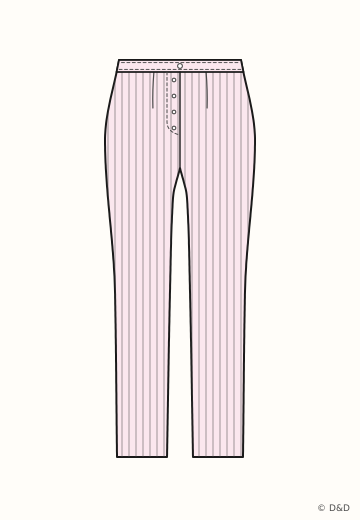
Morning trousers, striped trousers, cashmere-stripe trousers (the traditional cloth name; it does not mean the fibre).
Where it comes from
Morning dress (a tailcoat cut away at the front, a waistcoat and striped trousers) grew from nineteenth-century riding and day dress in Britain. It remains the daytime formal dress for some weddings, state and court occasions and, in Britain, events such as Royal Ascot. See also Every trouser: men’s styles, Formal morning trousers.
The cut
High rise, held by braces, no belt loops, no turn-ups. Straight leg. Fine vertical grey-and-black stripes.
Fabric
Worsted wool in the traditional striped cloth.
From the block
The men’s block, high rise, brace buttons inside the waistband, and stripes matched at every seam. See Prints, checks and stripes, and marking the pieces.
Wear it
Mostly men; daytime weddings and ceremonies, mainly in Britain and some Commonwealth and diplomatic settings. With a morning coat, waistcoat, shirt and tie; black oxford shoes.
Fit notes and a tip
With braces, the trouser hangs from the shoulders, so the rise must be measured with braces on. Tip: cut both legs on a single layer so the stripes match exactly at the crease.
Chinos – cotton twill trousers, smart-casual, flat or pleated

Other names
Chino trousers, chino pants. Often confused with khakis; see the next entry.
Where it comes from
Chino cloth is a cotton twill. The name is widely said to come from the Spanish chino (Chinese), after cotton twill from China bought for American soldiers in the Philippines around 1900; sources differ. Chinos became civilian casual wear after the Second World War.
The cut
Mid rise, flat front or one pleat, fly, slant pockets, welt back pockets. Usually slim or straight with a light taper. Lighter and smoother than khakis; sometimes no crease.
Fabric
Cotton twill or cotton with 2% elastane; garment-dyed for a soft look.
From the block
The men’s or women’s block with a slight taper. See From the block: taper, flare and wide legs and Side-seam and slant pockets.
Wear it
Women, men and children; office casual, college, travel. With shirts, polos, T-shirts, short kurtas; loafers, trainers, desert boots.
Fit notes and a tip
Cotton twill shrinks. Tip: pre-wash the fabric twice before cutting.
Khakis – sturdy twill trousers in the dust colour that named them

Other names
Khaki trousers, khaki pants. In Hindi and Urdu khaki (ख़ाकी) means dust-coloured, from the Persian khak, dust or earth; in India “khaki” also means the police uniform itself.
Where it comes from
Khaki uniforms are traced to the Corps of Guides, raised in 1846 at Peshawar in the British Indian Army, whose men dyed their uniforms a dust colour in the late 1840s. Khaki spread to armies worldwide and then to civilian dress.
The cut
Mid rise, flat front or pleated, fly, straight leg. Heavier and more workwear-like than chinos; “khakis” in America often just means chinos in khaki colour.
Fabric
Cotton drill or heavy twill in khaki, stone, olive or tan.
From the block
The straight block with fly and pockets; no special changes. See The men’s block.
Wear it
Men, women and children; casual, outdoor, school uniform (see Every trouser: work and uniform). With shirts, polos, safari jackets; boots or loafers.
Fit notes and a tip
Heavy drill is stiff at first. Tip: wash the made trouser once before final hemming; the length may drop or shrink.
Pleated wide trouser – high-waisted, deep pleats, generous wide leg

Other names
Wide pleated trousers, pleat-front wide-leg, “1940s trousers” (shop name).
Where it comes from
A mix of 1930s–40s menswear and women’s wartime and Hollywood trousers; a strong return in the 2020s.
The cut
High rise, double pleats, fly or side zip, wide straight leg, crease from pleat to hem, often turn-ups.
Fabric
Wool flannel, crepe, linen, heavy viscose, cotton twill.
From the block
Draft a wide leg and spread for double pleats. See From the block: taper, flare and wide legs and Darts, pleats and yokes on paper.
Wear it
Women and men; office, smart-casual. With tucked shirts, fitted knits, short jackets; loafers, heels.
Fit notes and a tip
Pleats on a wide leg should fall in line with the crease. Tip: press the crease from the inner pleat fold, so pleat and crease are one line.
Oxford bags – very wide, loose 1920s trousers from Oxford
Other names
Oxfords, bags.
Where it comes from
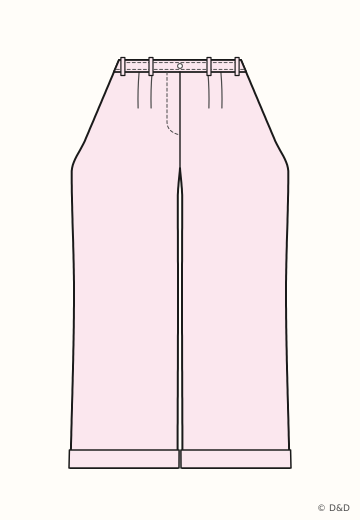
Very wide trousers worn by Oxford University students in the mid-1920s. It is traditionally said they began as trousers worn over knickerbockers after these were banned in lectures; this is not confirmed. Hem widths of 20 in (51 cm) or more are reported, and much wider for the extreme versions.
The cut
High rise, pleated, extremely wide straight leg, often with deep turn-ups. Full length, covering most of the shoe.
Fabric
Wool flannel, cotton twill, linen; pale colours were common.
From the block
Spread a wide leg further (see From the block: palazzo, harem, culotte and jogger for spreading) and add pleats. Keep the crease in the centre.
Wear it
Men and women; vintage and fashion-forward. With knitwear, tucked shirts, brogues.
Fit notes and a tip
So much width needs weight at the hem. Tip: a 2 in (5 cm) turn-up helps the leg hang straight.
Pinstripe trouser – suiting with fine vertical stripes
Other names
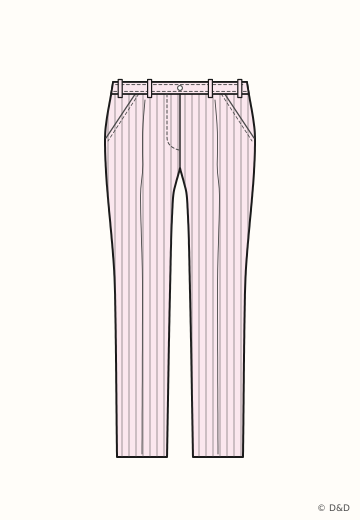
Pinstripe, pin-stripe, chalk stripe (a softer, wider stripe), banker’s stripe.
Where it comes from
Pinstripes are closely linked with banking and business suits in London and New York from the early twentieth century. The story that each bank had its own stripe is traditionally told but not confirmed.
The cut
Any suit-trouser cut; the stripe is in the cloth. Usually straight leg, flat front or one pleat, crease.
Fabric
Worsted wool or blends in navy, charcoal or black with white or coloured pinstripes.
From the block
Any tailored block. Match stripes at the side seams and centre back, and put the crease on a stripe. See Prints, checks and stripes, and marking the pieces.
Wear it
Women and men; office and formal. Often worn by people at senior levels; in many workplaces, plain cloth is the safer choice for a first interview.
Fit notes and a tip
Stripes show every crooked seam. Tip: cut on a single layer and mark the stripe you will use for the crease before cutting.
Sources and uncertain points
- Chinos: the Spanish chino origin and the Philippines story are widely repeated; sources differ.
- Khaki: the Corps of Guides (1846) and the dust-coloured uniforms of the late 1840s are well documented; exact dates of first dyeing differ.
- Tuxedo Park as the source of “tuxedo”: traditionally said, widely accepted.
- Oxford bags: the knickerbocker-ban story is traditionally said, not confirmed; reported hem widths vary.
- Pinstripes and individual bank stripes: traditionally told, not confirmed.
- “Terry-wool” is an Indian trade name for wool-polyester suiting, not a standard fibre name.
- Main source: D&D ebook Encyclopedia of Trousers for Women, ch. 19, 24, 31–33, 35; widened with general tailoring history.