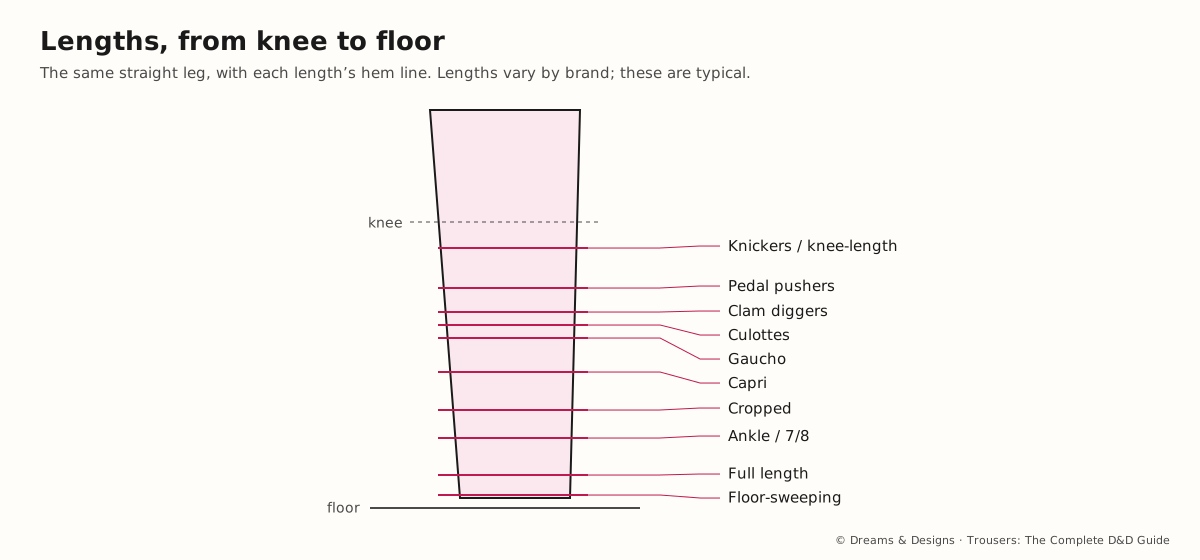
Where the hem falls changes a trouser as much as its width. The same wide leg is a palazzo at the floor, a culotte at mid-calf and shorts above the knee. This lesson goes down the leg from floor to knee: ten lengths, each with its name, its history and how to cut and wear it.
What you’ll learn
- The ten trouser lengths, from floor-sweeping to knee.
- Why a length that suits the leg depends on the ankle, calf and shoe.
- How to measure and mark each length on the pattern.
- Which lengths suit which occasions in India.
What links these styles
These names describe only length: any leg shape can be cut to any of them. A tailor measures length on the outside leg from the waist, but the eye reads it against landmarks on the body: the floor, the heel, the ankle bone, the narrowest part of the calf, the widest part of the calf, and the knee.
To tell them apart, find the landmark: full length and floor-sweeping cover the shoe; ankle ends at the ankle bone; cropped and capri sit above the ankle to mid-calf; pedal pushers, clam diggers, culottes and gaucho sit around the calf; knickers end at the knee. A length that ends at a narrow part of the leg draws a clean line; one that ends at the widest part of the calf draws a break there. In India, ankle-length trousers under kurtas are everywhere; the floor-length palazzo and sharara rule at festivals; and boys’ “half pants” at knee length are still common school uniform.
Tap any style to open its entry.
Full length – to the shoe, with a small break at the front

Other names
Full-length trousers, long trousers. In Indian schools, “full pants” as against “half pants”.
Where it comes from
Long trousers became standard men’s dress in Europe in the early nineteenth century, replacing knee breeches (see History: from hose and breeches to trousers).
The cut
The hem reaches the top of the shoe at the front, and about half-way down the heel counter at the back. The small fold where the front hem meets the shoe is the break: none, slight, half or full.
Fabric
Any. The heavier the fabric, the cleaner the break.
From the block
The block is full length. Measure the outside leg in the shoe to be worn. Angle the hem about 1/2 in (1.3 cm) longer at the back on a straight or tailored leg. See Measuring women, men and children.
Wear it
Women, men and children; office, formal, travel and everyday. With any top and shoe.
Fit notes and a tip
Full length is the length most often wrong in shop-bought trousers. Tip: a slight break suits most tailored trousers; narrower legs need less break, wider legs can take more.
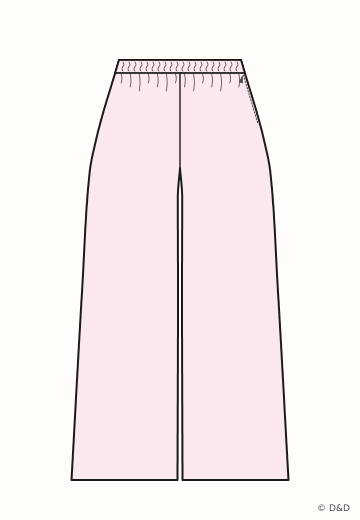
Floor-sweeping – long enough to touch or brush the floor
Other names
Floor-length, floor-grazing, puddle length (if it pools).
Where it comes from
Long, full trousers that hide the feet appear in many dress traditions, from the farshi pyjama and gharara of Lucknow to 1930s Hollywood evening wear (see Every trouser: India and South Asia (salwars, churidar and pyjamas) and Every trouser: India and South Asia (sharara to shalwar)).
The cut
Usually a wide leg, palazzo, sharara or flare. The hem just clears the floor in heels, or touches it. Shorter at the front than the back is common so the toes do not catch.
Fabric
Fluid fabrics: georgette, chiffon, crepe, silk, satin, velvet for winter evenings. Heavy, stiff fabrics trip the wearer.
From the block
Measure the outside leg to the floor in the exact shoe, then add nothing, or up to 1/2 in (1.3 cm) for a brush. Use a wide-leg or palazzo pattern; see From the block: palazzo, harem, culotte and jogger.
Wear it
Mostly women; festive, evening and weddings. With short kurtas, crop tops, capes or long jackets; heels or platforms.
Fit notes and a tip
Floor-sweeping hems wear out fast on rough floors. Tip: face the hem with a sturdy bias strip that can be replaced, and keep a matching pair of shoes just for this trouser.
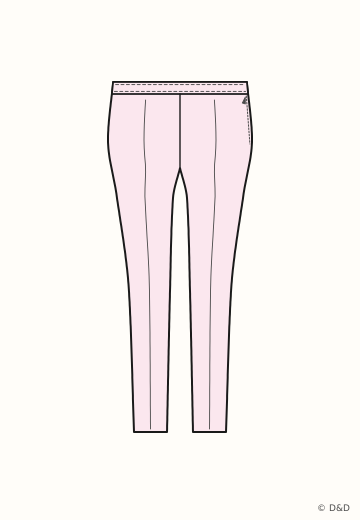
Ankle / 7/8 – ending at the ankle bone, ankle on show
Other names
Ankle length, ankle trousers, ankle grazer, 7/8 (seven-eighths) length.
Where it comes from
The 7/8 name describes the length as about seven-eighths of a full-length leg. Ankle trousers were a strong women’s look in the 1950s and have been a mainstream length since the 2010s, for women and men.
The cut
The hem ends at or just above the ankle bone. Usually slim, straight or cigarette legs, which need a narrow hem to show the ankle.
Fabric
Suiting, stretch twill, cotton, ponte, crepe.
From the block
Shorten the block by about 2 in (5 cm), or measure to the ankle bone. Narrow the hem so it does not flap. See From the block: taper, flare and wide legs.
Wear it
Women, men and teens. Office and smart-casual. In India, the most common length for cigarette pants and straight pants under kurtas. With loafers, flats, juttis and kolhapuris, which show the ankle.
Fit notes and a tip
Ankle trousers rise when the wearer sits. Tip: check the length seated; it should still reach the ankle bone.
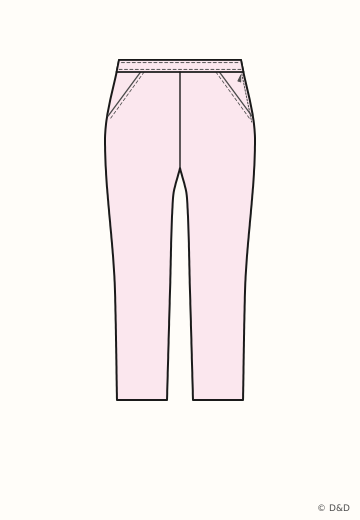
Cropped – deliberately shortened, ending above the ankle
Other names
Crop trousers, crops, cropped pants.
Where it comes from
“Cropped” is a general fashion word for any trouser cut short on purpose. The idea is old (capris, pedal pushers), and the label has been common since the 2000s.
The cut
Any leg shape, ending anywhere from mid-calf to just above the ankle. Wide cropped trousers are close to culottes.
Fabric
Any. Fabric with body keeps the hem crisp.
From the block
Shorten at the hem; on a tapered leg, check the new hem is still wide enough to pass the calf. See From the block: taper, flare and wide legs.
Wear it
Women, men and children; summer, office, smart-casual. With tucked tops, short kurtas, flats, sandals, loafers or heels.
Fit notes and a tip
The most common cropped complaint is a hem that lands at the widest part of the calf. Tip: even half an inch (1.3 cm) up or down, to clear the widest point, can change the whole look.
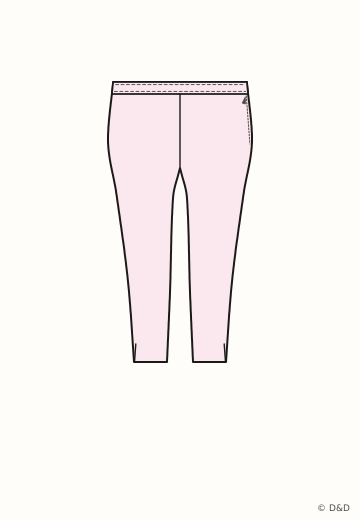
Capri – slim and fitted, ending at mid-calf
Other names
Capris, capri pants. Indian shops say “capri”, especially for women’s and girls’ three-quarter leggings and trousers.
Where it comes from
Named after the Italian island of Capri. The designer Sonja de Lennart is widely credited with creating them in the late 1940s; they became a famous 1950s and early 1960s look in films and on television.
The cut
Mid or high rise, slim through the leg, ending at mid-calf or just below. Often a small slit at the outside hem so the leg can move.
Fabric
Stretch cotton, cotton twill, linen blends, jersey for casual capri leggings.
From the block
Taper the leg, then shorten to mid-calf; add a 2–3 in (5–7.5 cm) side slit at the hem. See From the block: taper, flare and wide legs.
Wear it
Women and girls mainly; men’s versions exist as three-quarter trousers. Summer, travel, home. With short tops, tunics, short kurtis, ballet flats and sandals.
Fit notes and a tip
A capri should end just below the widest part of the calf, where the leg narrows. Tip: mark the hem on the body, not from a chart.
Pedal pushers – just below the knee, made for cycling

Other names
Pedal-pushers, clam-diggers (sometimes used for the same length), three-quarter trousers.
Where it comes from
From cycling: the length kept fabric clear of the bicycle chain. Popular for women and girls in 1940s and 1950s America.
The cut
High or mid rise, straight or slim leg, ending just below the knee, often with a turn-up cuff.
Fabric
Cotton twill, denim, gingham, linen, stretch cotton.
From the block
Narrow the knee and hem a little, cut to just below the knee plus a turn-up allowance. See Hems: turn-ups, churidar ankles, raw edges and growth hems.
Wear it
Women, girls and boys; summer, cycling, retro looks. With T-shirts, shirts tied at the waist, trainers or flats.
Fit notes and a tip
Too tight below the knee, and they ride up when cycling or bending. Tip: check the hem passes over a bent knee with a finger of room.
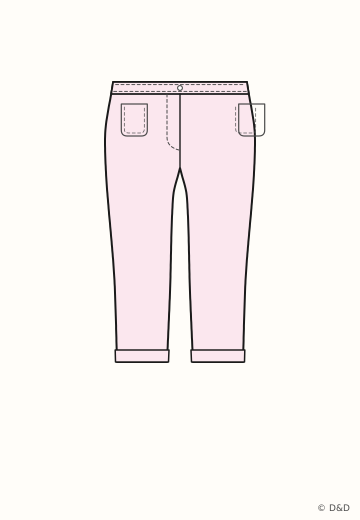
Clam diggers – mid-calf, loose, made for wading
Other names
Clamdiggers. The name is sometimes used for pedal pushers.
Where it comes from
Named, it is said, for people who dug for clams in shallow water with their trousers rolled up. A 1950s American beach and holiday style.
The cut
Mid rise, a relaxed straight leg, ending around mid-calf, often with a rolled or cuffed hem. Looser than a capri.
Fabric
Cotton drill, chambray, linen, canvas, denim.
From the block
Keep the straight block, cut to mid-calf and add a turn-up or a rolled cuff tacked at the seams. See Hems: turn-ups, churidar ankles, raw edges and growth hems.
Wear it
Unisex; holidays, beach, gardening. With T-shirts, striped tops, espadrilles, sandals.
Fit notes and a tip
A loose leg at mid-calf flaps. Tip: tack the rolled cuff at the side seam and inseam so it stays rolled in the wash.
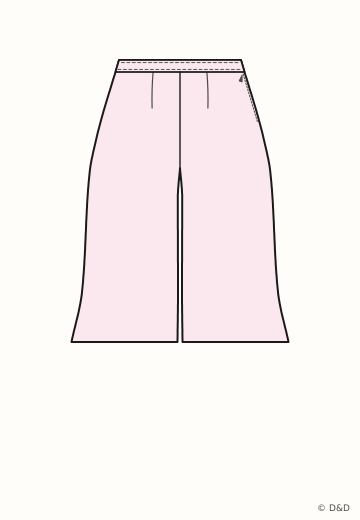
Culottes – wide, mid-calf or knee, looks like a skirt standing still
Other names
Culotte trousers, split skirt (loosely), divided skirt (an older, related garment; see Every trouser: shorts, skorts and divided skirts). Not to be confused with eighteenth-century culottes, which were men’s knee breeches (see Every trouser: history’s trousers).
Where it comes from
Culottes and divided skirts appeared again and again when full trousers were not yet accepted for women, for cycling and riding. The modern culotte is a strong 1970s and 2010s look.
The cut
High rise, fitted waist, side or back zip. Very wide, often A-line legs, from just below the knee to mid-calf. Standing still, the divided leg is hard to see.
Fabric
Crisp fabrics (cotton twill, linen, wool, crepe with body) for an A-line shape; fluid fabrics for a softer one.
From the block
Cut a wide leg to mid-calf, close the darts and let the hem open. Figures in From the block: palazzo, harem, culotte and jogger.
Wear it
Women and girls mainly; office, summer and smart-casual. With tucked tops, fitted knits, short kurtis; flats, block heels, ankle boots.
Fit notes and a tip
Culottes are judged walking, not standing. Tip: watch the customer walk in the toile; if the leg separation feels awkward, add a little more width at the hem.
Gaucho – wide, mid-calf, inspired by the gaucho’s riding trousers

Other names
Gaucho pants, gauchos.
Where it comes from
Named after the gauchos, the horsemen of the Argentine, Uruguayan and southern Brazilian pampas, whose loose bombachas inspired the look (see Every trouser: Americas, Arctic and Pacific). Gaucho pants were a 1970s fashion trend and returned in the 2000s.
The cut
High rise, often with pleats, widening to a mid-calf hem. Close to culottes; gauchos are often worn with boots and a wide belt.
Fabric
Suede-look fabrics, wool, corduroy, denim, cotton twill, crepe.
From the block
As for culottes, with pleats at the front waist. See From the block: palazzo, harem, culotte and jogger and Darts, pleats and yokes on paper.
Wear it
Mostly women; casual and boho looks. With tall boots, wide belts, tucked shirts or knits.
Fit notes and a tip
With tall boots, the hem should overlap the boot top, not stop short of it. Tip: fit with the boots on.
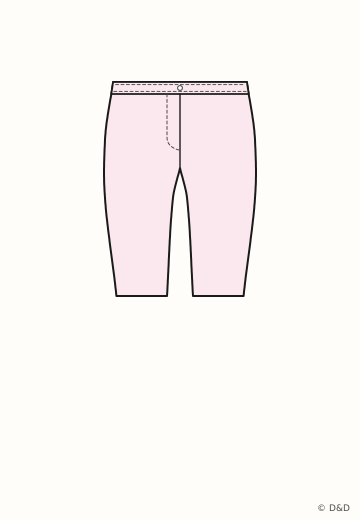
Knickers / knee-length – ending at the knee, plain or gathered
Other names
Knee-length shorts, knee pants, knickerbockers (the gathered kind, see Every trouser: history’s trousers). In India, boys’ knee-length school shorts are “half pants”; in Kannada, shorts are chaḍḍi (ಚಡ್ಡಿ). Note: in Britain “knickers” means women’s underwear, so use “knee-length” when writing for readers there.
Where it comes from
Knee-length trousers have a long history: boys wore “knee pants” or knickerbockers until their teens in the late nineteenth and early twentieth centuries. Indian school uniforms kept half pants for younger boys.
The cut
Any rise, straight or gathered leg, ending at the knee. The gathered version closes with a band just below the knee.
Fabric
Cotton drill, khaki twill, denim, linen, wool tweed for knickerbockers.
From the block
Cut the block at the knee line plus a hem; for a gathered version, add width and a knee band. See Children’s blocks: the child block.
Wear it
Children, especially school uniform; adults for summer and casual wear. With shirts, polo shirts, T-shirts; sandals, school shoes or trainers.
Fit notes and a tip
A knee-length leg should clear the knee when seated, not cut into it. Tip: for children, add a deep hem so the length can be let down as they grow.
Sources and uncertain points
- Sonja de Lennart as creator of the capri (about 1948): widely credited, but stated without full confirmation here.
- Clam diggers’ name: “it is said”, from wading for clams; the exact origin is not documented.
- Pedal pushers and clam diggers are used for overlapping lengths; definitions differ.
- The 7/8 label is a sizing convention, not an exact fraction.
- Main source: D&D ebook Encyclopedia of Trousers for Women, ch. 9, 22, 24, 28; widened with general dress history.