The 20th century changed trousers more than any other. Two world wars put women into trousers for work. Film stars and designers made women’s trousers glamorous. Men’s trousers rose, fell, widened and narrowed every few decades, and jeans went from work clothes to the world’s most worn garment. Children’s trousers changed too. This lesson covers 1900 to 2000 around the world; India’s own story is in the lesson History: India’s trouser story.
What you’ll learn
- How war work made women’s trousers normal.
- The designers and stars who made them fashionable.
- How men’s trousers changed decade by decade.
- How jeans and youth culture changed trousers for everyone.
Women: from work to couture
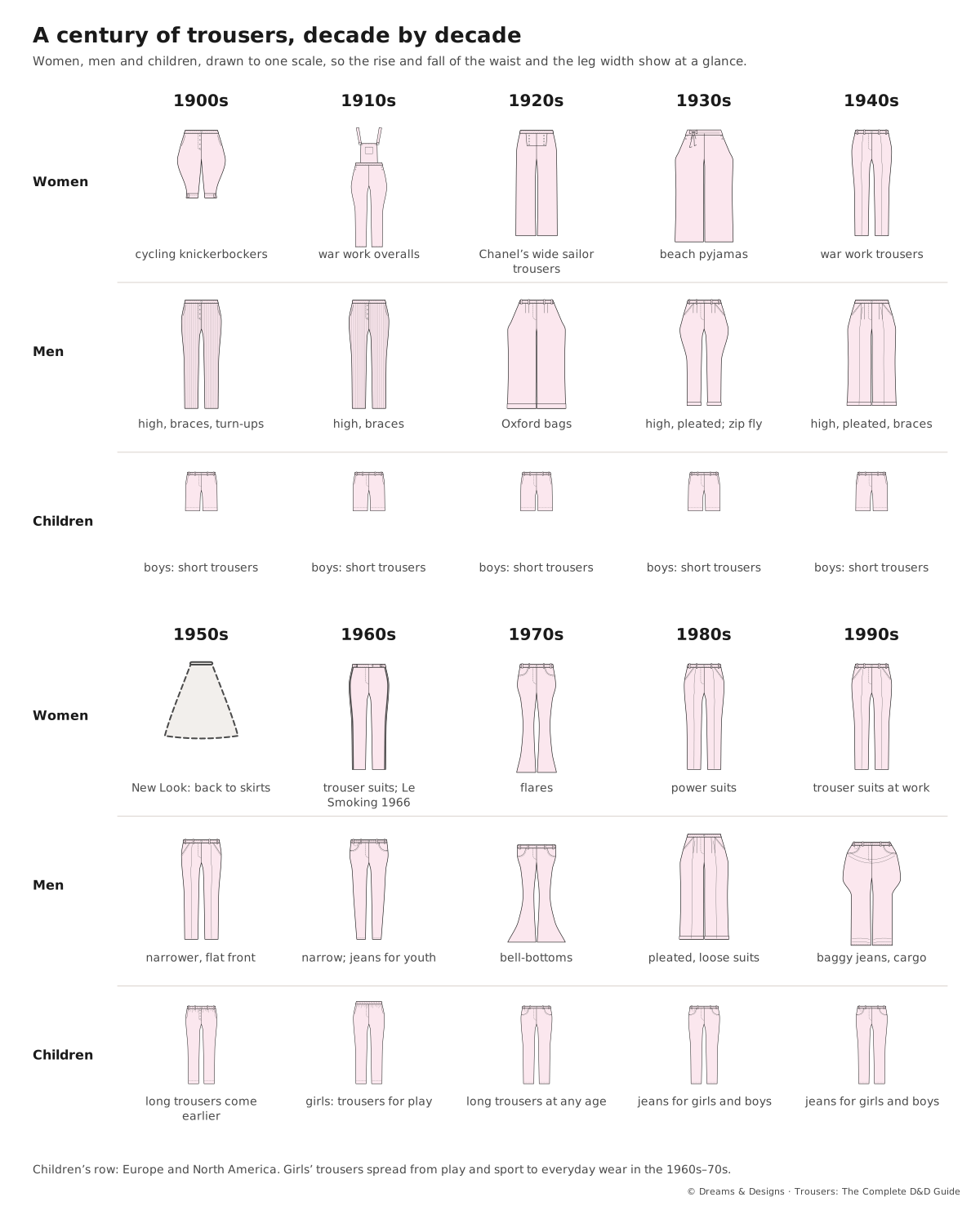
- The world wars (1914–18, 1939–45): women took jobs in factories, farms and transport, and wore overalls and trousers for safety. In the United States the poster figure “Rosie the Riveter” became the symbol. In Japan, the government encouraged women to wear monpe, loose farm trousers, during the Second World War.
- 1920s–30s: Coco Chanel wore and designed wide, sailor-style trousers and “beach pyjamas” for leisure. In the 1930 film Morocco, Marlene Dietrich wore a man’s white tie and tails; she and Katharine Hepburn wore tailored trousers off screen too.
- 1947–50s: Christian Dior’s “New Look”, with tiny waists and full skirts, pulled fashion back towards skirts. Progress was not a straight line.
- 1960s: André Courrèges showed trouser suits as couture in the mid-1960s, and in 1966 Yves Saint Laurent launched Le Smoking, a tuxedo for women. Trousers became high fashion.
- 1970s–90s: flares, then power suits. As more women entered offices and politics, the trouser suit became working wear. In 1993 two US senators, Carol Moseley Braun and Barbara Mikulski, wore trousers on the Senate floor, and the dress code was changed to allow them.
Men: up, down, wide, narrow
- 1920s: very wide “Oxford bags” at British universities.
- 1930s–40s: high-waisted, pleated trousers with braces; zip flies spread in the 1930s.
- 1950s–60s: narrower, flat-fronted trousers; jeans became the uniform of youth.
- 1970s: bell-bottoms and flares for women and men alike.
- 1980s–90s: pleated, loose suit trousers, then baggy jeans and cargo trousers from street and hip-hop style.
Jeans: the work trouser that took over
Riveted denim work trousers (see History: from hose and breeches to trousers) were worn by miners, farmers and cowhands. After the Second World War, films and music made jeans the symbol of youth, first in the United States, then across the world. By the end of the century jeans were worn by women, men and children on every continent, in every class.
In more depth: children
In Europe and North America in the early 1900s, boys wore short trousers until their early or mid teens; the first long trousers were a rite of passage. Over the middle of the century, long trousers came earlier, and by the 1970s boys wore them at any age. Girls’ trousers spread slowly: first for play, sport and cold weather, and from the 1960s–70s as everyday wear, with jeans for girls and boys alike. Many schools kept skirts compulsory for girls for much longer, and in some countries the right of girls to wear trousers to school was argued over well into the 21st century.
The century also brought the first safety thinking for children’s clothing: flame rules for nightwear and, near its end, concern about cords and drawstrings (see Children’s clothing safety standards).
In more depth: Asia and the wider world
- China: after 1949, the plain tunic suit with trousers (known abroad as the “Mao suit”) and work trousers were worn by women and men alike. Trousers became nearly universal for Chinese women.
- Japan: women students had worn hakama to school from the Meiji period; they still wear them at graduation. After the war, Western trousers became everyday wear.
- Turkey and Iran: state dress reforms in the 1920s–30s pushed men towards European trousers and hats, sometimes by law.
- Africa and the Caribbean: trousers spread with colonial schooling, uniforms and city work, while local trousers, such as the Yoruba sokoto, stayed in use, and later inspired African designers.
In more depth: the stories that are not true
A famous story says Marlene Dietrich was arrested in Paris in the 1930s for wearing trousers. No arrest record or newspaper report of the time has been found, so treat it as a legend. Another tells that Katharine Hepburn walked about the studio in her underwear when staff hid her trousers; it is widely repeated, reported in biographies, but hard to confirm. What is certain is simpler: both women wore trousers in public, often, when that was unusual.
Tips for learners and teachers
- Learn three anchors: war work (1940s), Le Smoking (1966), jeans everywhere (by 1990s).
- Look at old family photos: date them by the trouser width and rise.
- Draw one trouser per decade on the same body, side by side. The changes in rise and hem width tell the story.
- Teachers: ask students to bring a parent’s or grandparent’s memory of their first long trousers or first jeans.
Common misunderstandings
- “Women won the right to trousers once, and that was it.” The New Look shows fashion can go backwards; workplace and school rules lagged for decades.
- “Le Smoking was the first women’s trouser suit.” It was not the first, but it was the one that made the trouser suit couture.
- “Bell-bottoms were a women’s trend.” They were worn by women and men, and began as naval uniform.
- “Children always had their own fashion.” For most of history children wore small versions of adult clothes, or gowns.
For earning and teaching
Decade looks return again and again: high-waisted 1940s pleats, 1970s flares, 1990s baggy jeans. Knowing the original cut lets you make a better “revival” than a quick copy, and helps you explain a style to customers. For teaching, a decade fashion show (students sew or style one decade each) is a lively end-of-term project.
Sources and uncertain points
- The Dietrich arrest story is unconfirmed; treat as legend.
- The Hepburn hidden-trousers story is reported, not confirmed.
- The 1993 US Senate events: accounts differ on who wore trousers first.
- Japanese wartime monpe: encouraged by the state; how strictly enforced varied.
- Dates for boys’ first long trousers vary by country and class; the trend is clear, the dates are broad.
- Main source: D&D ebook Encyclopedia of Trousers for Women, ch. 2 and 3, checked and widened.
Check yourself
- Can you give two reasons why the world wars changed women’s trousers?
- Do you know what Le Smoking was, and when?
- Can you describe men’s trousers in the 1920s, 1950s and 1970s?
- Can you say how jeans went from work wear to everyday wear?
- Do you know which famous trouser story is a legend?
Key terms
- Oxford bags: very wide 1920s trousers.
- Monpe: Japanese loose farm trousers.
- Le Smoking: Saint Laurent’s 1966 women’s tuxedo.
- Power suit: a sharp, tailored trouser or skirt suit for work.
- Flares, bell-bottoms: trousers widening from the knee.