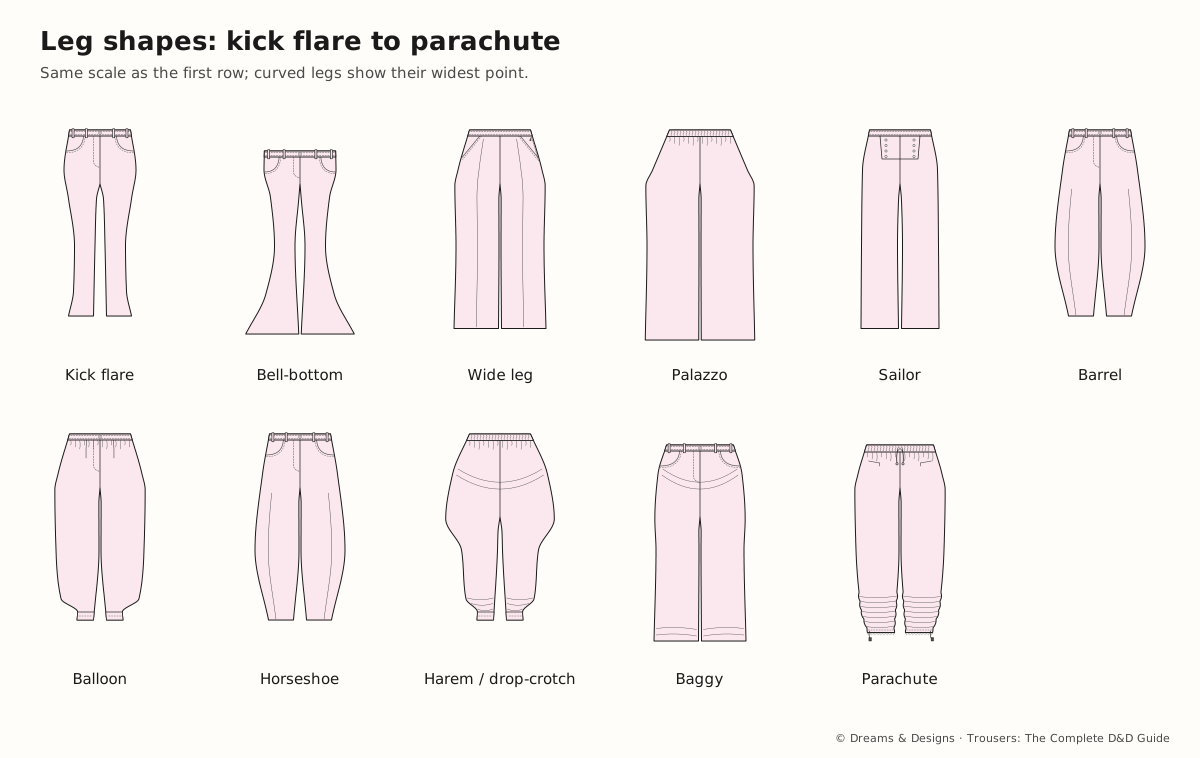
The second half of the leg shapes is the generous half: flares and bells, wide legs and the palazzo, and the curved and full shapes, from barrel and balloon to harem and parachute. These are the trousers that move. The narrow and straight shapes are in Every trouser: leg shapes (straight to flare).
What you’ll learn
- How the flared, wide and curved leg shapes differ.
- Why the palazzo and harem matter so much in Indian wardrobes.
- What to change on the block for each, from slash-and-spread to a dropped crotch.
- How fabric drape makes or breaks a full leg.
What links these styles
All eleven add width somewhere. The kick flare and bell-bottom add it below the knee. The wide leg, palazzo and sailor add it from the hip down. The barrel, balloon and horseshoe curve the leg: wider in the middle, narrower at the hem. The harem, baggy and parachute add room everywhere, sometimes with a lowered crotch.
To tell them apart, look for where the widest point is: at the hem (flares), all the way down (wide), at the knee (curved), or at the seat and thigh (harem and baggy). In India the palazzo is one of the most-worn trousers of the last decade, under kurtas of every length; the harem shape sits close to the dhoti pant and the Afghani salwar; and the bell-bottom is remembered as the trouser of 1970s Hindi film heroes.
Tap any style to open its entry.
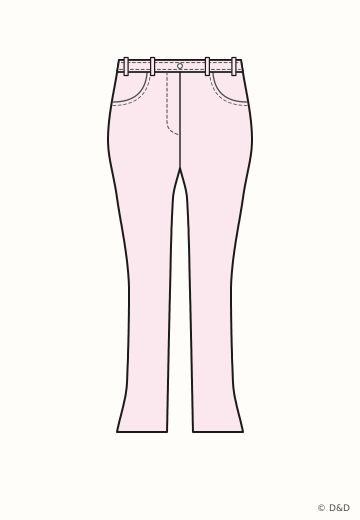
Kick flare – slim, cropped, with a small flare at the hem
Other names
Kick-flare, cropped flare, mini flare, kick crop (in denim).
Where it comes from
A 2010s fashion term, popular from about the middle of that decade, for a flare cut short so the little “kick” shows above the shoe.
The cut
High or mid rise, slim through thigh and knee, then a short flare starting at mid-calf. Cropped at or just above the ankle. The hem is often raw-edged in denim.
Fabric
Stretch denim, ponte, stretch twill, crepe. Firm fabric keeps the kick; soft fabric lets it flop.
From the block
Taper to mid-calf, then widen the hem 1–2 in (2.5–5 cm) each side of the crease; shorten to ankle. See From the block: taper, flare and wide legs.
Wear it
Mostly women and teens. Office and smart-casual. With ankle boots, loafers, heels, block heels; tucked shirts or short kurtas.
Fit notes and a tip
The crop length decides everything: the flare should end above the ankle bone, not at the widest part of the calf. Tip: try it with the actual shoe before marking the hem.
Bell-bottom – fitted above the knee, then a dramatic bell-shaped flare

Other names
Bells, bell-bottoms. Indians say “bell-bottom” for most strong flares.
Where it comes from
Sailors wore flared trousers in the nineteenth century (see Every trouser: work and uniform, Navy bell-bottoms). Fashion adopted them in the 1960s, and they became the symbol of the 1970s worldwide, from hippie dressing to Hindi cinema.
The cut
Low or mid rise, close through the hip and thigh, narrow just above the knee, then a big flare. The hem can be twice the knee width. Long, nearly touching the floor.
Fabric
Denim, cotton twill, crepe, jersey, polyester crepe (much used in the 1970s). Fabric with drape lets the bell swing.
From the block
Raise the knee line, narrow the knee, then slash and spread from the knee to the hem, or add a godet. See Adding flare: slash-and-spread, godets and flounces.
Wear it
Women, men and children; casual, parties, retro and theme events. With fitted shirts, short tops, platforms or heeled boots.
Fit notes and a tip
A big hem collects dust and catches on heels. Tip: face the hem with a bias strip instead of a deep turn, so the flare stays light and swings.
Wide leg – wide from the hip to the hem, falling in soft folds

Other names
Wide-leg trousers, wide trousers, wide pants.
Where it comes from
Wide trousers have deep roots in global dress, from South and Central Asian trousers to 1930s Hollywood. They returned strongly in the 1970s and again in the late 2010s and 2020s, after the years of skinnies.
The cut
Usually high rise, so the waist holds the shape. The side seam falls straight from the hip and the inseam straight from the crotch point, so thigh, knee and hem are about the same, and wide. Full length.
Fabric
Fabrics with drape: viscose, wool crepe, linen, soft cotton, cotton-modal. Stiff twill keeps a wide shape but moves less.
From the block
Drop the side seam straight from the hip line and the inseam straight from the crotch point. See From the block: taper, flare and wide legs.
Wear it
Women, men and children. Office, travel, smart-casual and evening. With tucked or fitted tops, short or mid-length kurtas, blazers, heels or flats.
Fit notes and a tip
A wide leg depends on a waist that fits exactly: even a little extra ease makes it look shapeless. Tip: hemmed to graze the top of the shoe, a wide leg looks neat on every height.
Palazzo – very wide from the hip, floor-length, fluid

Other names
Palazzo pants, palazzos, palazzo pyjamas (the 1960s name). In India “palazzo” is used as is, in every language; a looser kind is sold as a “palazzo pyjama” (see Every trouser: home and life stages).
Where it comes from
From the Italian palazzo, a palace. The Rome designer Irene Galitzine is widely credited with launching “palazzo pyjamas” as elegant evening trousers in 1960. Very wide, loose trousers are much older, in South Asia, Central Asia and the Middle East. In India, the palazzo became hugely popular with kurtas from about the mid-2010s and is now an everyday staple; the Indian version has its own entry in Every trouser: India and South Asia (salwars, churidar and pyjamas) and Every trouser: India and South Asia (sharara to shalwar).
The cut
High rise. An elastic or drawstring waist, or a flat front with a faced waist and side zip. Little shaping at the hip; the leg is very wide from the hip down, wider than a wide leg, so it moves like a divided skirt. Floor length, or just clearing the floor in the shoe worn.
Fabric
The drape is everything. Best: rayon, georgette, crepe, chiffon (lined), silk, cotton mul and soft cotton for summer, modal. Worst: stiff cotton, heavy denim or anything that stands out from the body like a tent.
From the block
Start from the wide leg, take the waist straight up for an elastic casing, and slash and spread the leg from hem to hip. The worked figures are in From the block: palazzo, harem, culotte and jogger. The project Beginner: women’s elastic-waist palazzo makes one from start to finish.
Wear it
Women: with short kurtis, straight or A-line kurtas to the knee or calf, crop tops, and in co-ord sets with a matching top. Evening palazzos in silk or crepe are covered in Every trouser: evening and festive. Men: less usual, but wide, fluid trousers in the same cut are worn as resort and festive wear. Children: girls’ palazzo sets with kurtis are popular for festivals. Shoes: flats, kolhapuris, wedges or heels.
Fit notes and a tip
The waist must fit and the length must suit the shoe; nothing else is fitted. A palazzo hemmed for heels will drag when worn with flats. Tip: try the shoes the customer will really wear, and if she switches heights, sew a small hidden snap inside the hem so a fold can be secured for flats.
Sailor – high-waisted and wide, with a buttoned front flap

Other names
Sailor trousers, sailor pants, fall-front trousers, broadfall trousers (in older naval and workwear use).
Where it comes from
From naval uniform trousers, which closed with a front flap (the “fall” or “broadfall”) buttoned to the waist instead of a fly. Women’s fashion borrowed the shape from the 1920s and 1930s, and it returns often with nautical looks. See also Every trouser: work and uniform (Navy bell-bottoms) and Every trouser: Europe (Breton sailor trousers).
The cut
High rise, fitted waist, wide or slightly flared leg. The front opens as a flap buttoned at both sides, often with two rows of buttons. Full length.
Fabric
Cotton twill, linen, wool, denim, crepe. Navy, white and cream are traditional.
From the block
Draft a wide leg. Instead of a fly, cut the front with a flap: two vertical openings from the waist, faced, with the band split to button. Button work is in Button plackets and side openings.
Wear it
Women and girls mainly, smart-casual and summer. With tucked-in striped tops, blouses, espadrilles, loafers or sandals.
Fit notes and a tip
A flap gapes if the high waist is loose. Tip: interface the flap and band edges firmly, and put a button at each corner first, then add the rest evenly between.
Barrel – curved out at the knee, narrowing at the hem

Other names
Barrel-leg, barrel-fit. Sold also as “curved leg” or “bow leg” trousers. The names barrel and horseshoe overlap.
Where it comes from
A 2020s fashion revival, especially in jeans from about 2023. Similar curved shapes appeared in 1980s and 1990s fashion.
The cut
High rise. Easy through the thigh, widest at the knee, then curving in to a narrower ankle hem, so the leg looks like a barrel. Often with curved side or inseams, or a knee seam that shapes the curve.
Fabric
Medium to heavy cotton twill and rigid denim, which hold the curve. Soft fabrics hang straight and the shape disappears.
From the block
Widen the knee, keep or narrow the hem, and draw the side seam as a smooth outward curve; for a strong curve, add a horizontal knee seam and spread it. See From the block: taper, flare and wide legs and Adding flare: slash-and-spread, godets and flounces.
Wear it
Women, men and teens; casual and smart-casual. With short or tucked tops, cropped jackets, loafers, ballet flats or chunky trainers.
Fit notes and a tip
Curves exaggerate any twist in the leg. Tip: cut both legs on the exact same grain line, and mark the crease before you sew.
Balloon – full through the leg and gathered in at the hem

Other names
Balloon trousers, balloon-leg, cocoon trousers (a near cousin).
Where it comes from
A recurring fashion shape, strong in the 1980s and again in recent years. Older trousers gathered at the ankle, such as harem and Turkish trousers, share the idea (see Every trouser: history’s trousers).
The cut
High rise, pleated or gathered at the waist, very full through the leg, then drawn in at the hem by pleats, darts, a cuff or a band so the leg puffs out like a balloon. Usually ankle or cropped.
Fabric
Fabrics with body: taffeta, cotton poplin, linen, wool, scuba for strong shapes; soft crepe for a gentler puff.
From the block
Slash and spread the leg from waist to hem (parallel spreading), then gather or pleat the hem into a band. See Adding flare: slash-and-spread, godets and flounces and Darts, pleats and yokes on paper.
Wear it
Mostly women; children’s versions are playful party wear. With fitted tops and simple shoes; avoid a lot of volume above.
Fit notes and a tip
The puff should start below the hip, not at it. Tip: interface the hem band, or the volume falls over it.
Horseshoe – legs curving out from the hip like a horseshoe

Other names
Horseshoe-leg, curved-leg, bow-leg. Many shops use horseshoe and barrel for the same thing; when they differ, the horseshoe has the stronger curve, starting higher.
Where it comes from
A recent fashion name (2020s), from the shape the two legs make together, like an upside-down horseshoe. Sources disagree on how it differs from the barrel.
The cut
High rise. The curve begins at the hip and runs all the way down, widest at the knee and narrowing to the hem. Shaped seams down the front or side are common, because a curve this strong cannot come from the side seam alone.
Fabric
Rigid denim, heavy twill, canvas, wool. Must hold its shape.
From the block
As for the barrel, but add a style seam down the front leg and curve both edges. Toile it first. See Adding flare: slash-and-spread, godets and flounces.
Wear it
Women and men, fashion-forward casual. With cropped tops, short jackets and flat shoes.
Fit notes and a tip
Because the curve is designed in, a horseshoe must never be “fixed” straight by a tailor who thinks it is a mistake. Tip: write “designed curve” on the order slip.
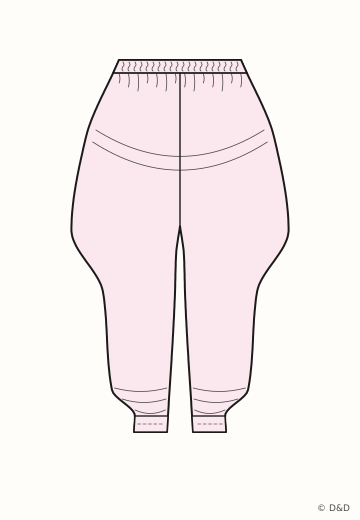
Harem / drop-crotch – low crotch, full through the leg, gathered at the ankle
Other names
Harem pants, drop-crotch, low-crotch, Aladdin pants (shop name), Afghani pants (Indian shop name for one kind, see Every trouser: India and South Asia (salwars, churidar and pyjamas) and Every trouser: India and South Asia (sharara to shalwar)). The very low version is sometimes called a “sarouel” (see Every trouser: Central and West Asia, Middle East and Africa).
Where it comes from
The shape comes from the full, ankle-gathered trousers of South, Central and West Asia: the salwar, şalvar and their cousins. “Harem” is a European name of the early twentieth century: the Paris designer Paul Poiret showed “harem” trousers around 1910–11, drawing on European fantasies of the East. D&D uses the name because the trade does, while naming the real traditions where we can. The 1990s hammer pant is a later version (see Every trouser: history’s trousers).
The cut
High rise with an elastic or drawstring waist, no fly. The crotch drops well below the body, from a few inches to near the knee. Very full at the seat and thigh, gathered into a cuff or elastic at the ankle.
Fabric
Soft jersey, rayon, cotton mul, crinkle cotton, viscose, linen blends. Stiff fabric makes a low crotch stick out.
From the block
Lower the crotch line, redraw the crotch curve shallower, slash along the crease to add gathers, and gather into an ankle cuff. Figures in From the block: palazzo, harem, culotte and jogger; a draped method in Draped styles: dhoti pants, harem and drop-crotch.
Wear it
Women, men and children; casual, travel, yoga and dance, festive Indo-western. With short kurtas, fitted tops or T-shirts; flats, sandals or trainers.
Fit notes and a tip
The lower the crotch, the shorter the stride. Tip: for children, keep the drop modest so they can run and climb.
Baggy – loose everywhere, worn long and relaxed

Other names
Baggies, loose fit, relaxed fit (a milder version), oversized.
Where it comes from
Very loose trousers became the mark of 1990s hip-hop, skate and rave styles, and returned with the 2020s revival of the 1990s (see Every trouser: street and subculture and Every trouser: denim).
The cut
Mid or low rise, sometimes worn low on the hip. Generous ease everywhere; the crotch sits a little low. The leg is wide and straight, and long enough to stack in folds on the shoe.
Fabric
Denim, cotton twill, canvas, nylon, fleece. Medium weight hangs best.
From the block
Add ease at side seam and inseam, lower the crotch slightly, and take the leg straight down from the widest point. See From the block: taper, flare and wide legs.
Wear it
Unisex; teens and young adults especially; children’s versions too. With T-shirts, hoodies, oversized shirts and chunky trainers.
Fit notes and a tip
Baggy still has to fit at the waist, or it slides down. Tip: add a half-elastic back or an inside adjuster, so a loose look stays up without a tight belt.
Parachute – light, loose nylon trousers with toggled or elastic ankles

Other names
Parachute pants, parachutes.
Where it comes from
Named after the light, slippery nylon used for parachutes. Popular in the early 1980s, especially with breakdancers, and revived from the early 2020s.
The cut
Mid rise, elastic and drawcord waist. Loose and light through the leg, gathered at the ankle by elastic or a toggled cord so the leg can be worn straight or balloon-shaped. Many zips, pockets and seams.
Fabric
Nylon taslan, ripstop, polyester microfibre, light poly-cotton. Thin and swishy is the point; heavy cotton turns it into a cargo.
From the block
Start as for a jogger with extra ease, add channel casings at the ankle for a cord, and add style seams and zipped pockets. See From the block: palazzo, harem, culotte and jogger and Patch and cargo pockets.
Wear it
Unisex, mostly teens and young adults; street and dance. With crop tops, hoodies, trainers.
Fit notes and a tip
Nylon frays, slips and melts. Tip: use a new microtex needle, a cool iron with a press cloth, and finish seams with a French or flat-felled seam.
Sources and uncertain points
- Irene Galitzine and the 1960 “palazzo pyjamas”: widely credited in fashion histories; exact first showing not confirmed here.
- Paul Poiret’s harem trousers, about 1910–11: well documented, though the exact first collection differs between sources.
- Barrel and horseshoe are recent shop names with no agreed difference.
- Kick flare, parachute and balloon dates are approximate.
- The palazzo’s rise in India from the mid-2010s is widely reported in Indian fashion writing; no single source is cited.
- Main source: D&D ebook Encyclopedia of Trousers for Women, ch. 9, 20, 23, 24; widened with general dress history.