Trouser making means long hours of cutting, sewing and pressing. A well-set workspace protects your back, eyes and hands, keeps sharp tools and hot irons safe around children, and keeps your cloth dry through the monsoon. None of it needs a big room or a big budget.
What you’ll learn
- How to set table, chair and light for your height and body.
- Safe habits with needles, pins, blades, the iron and electricity.
- How to protect cloth and tools from damp, termites and festival lamps.
- How to make the space safe when children share it.
Three stations
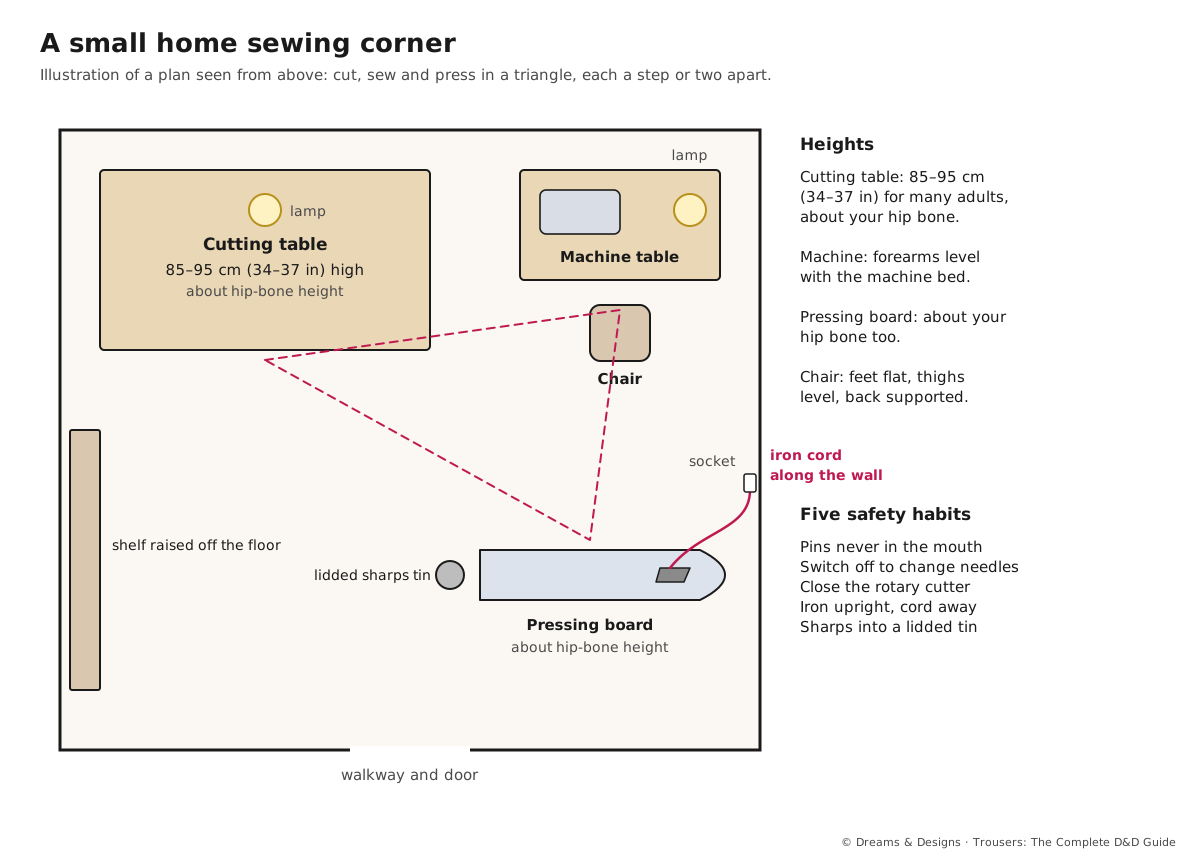
Arrange your space as three stations close together: cut, sew, press. Trousers move between them dozens of times: sew a seam, press it, sew the next. Keeping them within a step or two saves time and your back.
Heights and posture
- Cutting table: about the height of your hip bone, so you can cut without bending. For many adults this is around 85–95 cm (34–37 in). A board on a dining table, or blocks under its legs, can raise it.
- Machine table: your forearms level with the machine bed, shoulders relaxed.
- Chair: feet flat on the floor or the treadle, thighs level, back supported. A firm cushion helps on a high table.
- Pressing board: at about the height of your hip bone too; most boards adjust.
- If you sew seated in a wheelchair, choose a table with knee space and the machine’s foot control or a knee lever within easy reach; tools on a low shelf to the side.
Avoid cutting on the floor. It is common in Indian homes and workshops, but long kneeling and bending strains knees and back. If you must, kneel on a folded cloth and change position often.
Light
- A bright, white LED lamp over the machine and another over the cutting table, placed so your hands do not throw shadows.
- Daylight is best for judging colour. Check matching thread and cloth by a window.
- Rest your eyes: every 20 minutes or so, look at something far away for a few seconds.
The five safety habits
- Pins never in the mouth. Use a magnetic dish or a wrist pin cushion.
- Switch off the machine before changing the needle, foot or threading.
- Close the rotary cutter every time you put it down.
- Iron upright and switched off when you leave it, with the cord out of the walkway and out of children’s reach.
- Broken needles and blades go into a lidded tin, never loose into the bin.
Electricity, heat and fire
- Sockets: plug the iron and machine into properly earthed sockets. Avoid long chains of multi-plugs; an iron draws a lot of power.
- Monsoon damp: keep cords and plugs off wet floors; dry your hands before touching switches. Ask a qualified electrician whether your wiring has earth-leakage protection.
- Steam burns are worse than they look: point the iron away from your hand when steaming, and let the iron cool before refilling it.
- Festival lamps: keep diyas, candles and agarbatti well away from the cutting table, fabric stacks and finished festive orders. Busy festival weeks are when workrooms are fullest of cloth.
- Lint is flammable: clean it from the machine and the floor regularly.
- Keep a fire blanket or a small extinguisher near the pressing station, and know how to use it.
- Burn tests (see Natural fibres for trousers) are done over a steel plate or water, by an open window, with tweezers, never near cloth.
Hands, back and eyes
- Breaks: stand, stretch and walk every 45–60 minutes.
- Hands: shears with soft handles, a rotary cutter for long straight cuts and a thimble for hand sewing all reduce strain. Stop if you feel numbness or tingling, and get it checked.
- Back: keep work close to your body; do not reach far across a wide table.
- Neck: raise the machine slightly on a board, or lower the chair, so you are not looking down steeply.
- Eyes: a magnifier lamp helps for fine work; reading glasses for close work if you need them. Sew dark cloth in the best light.
- Feet: on a treadle, change the foot that leads now and then.
Dust, chemicals and fumes
- Fibre dust: overlocking and cutting fleece, felt and some synthetics make fine dust. Air the room; a simple mask helps on long production runs.
- Fusible interfacing gives off a little smoke and smell when pressed; ventilate.
- Dyes, bleach and stain removers: gloves, open window, never mix chemicals, and store them out of children’s reach.
- Spray adhesives and fabric stiffeners: outdoors or with the window open.
Protecting cloth and tools
- Damp: store cloth on raised shelves or in sealed boxes, not on the floor; add silica gel or a cloth bag of chalk.
- Termites and insects: keep cloth off walls and floors, check corners after the rains, and use neem leaves or cedar for wool and silk.
- Light: sunlight fades cloth; keep stacks covered.
- Tools: dry shears and blades after humid days; a light wipe of machine oil prevents rust.
- Customers’ cloth: label every order bag with the name, date and contents; store separately from your own stock.
Children in the workspace
- Lock away blades, needles, pins and small notions (buttons, snaps, beads are choking hazards).
- Unplug the iron and the machine when you step away.
- Teach children to sew with blunt-ended needles and safety scissors, supervised.
- Keep the iron for adults until a child is old enough and shown how, with supervision.
- Put a clear rule in place: nothing on the cutting table is a toy.
Step by step: set up a small sewing corner
- Choose a corner with a window for daylight and a socket that is properly earthed.
- Set the machine table and chair, and adjust until forearms are level with the machine bed.
- Place the pressing board within one step of the machine.
- Use a board on a dining table, raised if needed, as the cutting table.
- Add one lamp over the machine and one over the cutting area.
- Put a magnetic pin dish, a sharps tin and a lint bin by the machine.
- Store cloth on a raised shelf with silica gel, and tools in a closed box.
- Route the iron cord so nobody can trip on it or pull it.
Tips, tricks and hacks
- A self-healing cutting mat on a dining table protects the table and makes rotary cutting safe.
- A wrist pin cushion keeps pins on you, not on the floor.
- A strong magnet swept across the floor finds dropped pins and needles.
- Mark your shears’ storage place; tools returned to one spot are not left on chairs.
- A timer for breaks helps when an order is urgent.
- Anti-fatigue mat or a folded rug at the cutting table helps on hard floors.
- Bed-risers under the table legs raise it cheaply to cutting height.
- Clip-on lamps move to wherever the work is.
- A first-aid box with plasters and burn gel lives by the pressing station.
- A clean-down routine at the end of each day: pins counted, iron off, blades closed, lint cleared.
- What professionals do differently: they treat the workspace as a tool. Good studios fix heights, light and storage once, so every trouser after that is faster and safer.
Problems and how to fix them
Back pain after a cutting session
- Raise the cutting table with blocks or a board.
- Cut in shorter sessions with stretches between.
- Prevention: hip-height table; no floor cutting for long jobs.
Sore neck and shoulders after sewing
- Lower the chair or raise the machine so you look ahead, not down.
- Relax the shoulders and rest the forearms on the table.
- Prevention: correct chair height and breaks every hour.
Tired eyes on dark cloth
- Add a second lamp from the side.
- Use contrasting tacking thread and chalk.
- Prevention: sew dark trousers in daylight hours when you can.
A needle broke while sewing
- Stop, switch off, find every piece (use the magnet), and put them in the sharps tin.
- Check the needle plate and hook for damage before sewing again.
- Prevention: never sew over pins; use the right needle for the cloth; do not pull the cloth.
A small burn from the iron
- Cool it at once under cool running water for at least 10–20 minutes.
- Cover with a clean, non-fluffy dressing. Get medical help for large, deep or blistering burns, or burns on a child.
- Prevention: point steam away, keep fingers clear, rest the iron upright.
Cloth smells musty after the rains
- Air it in shade and wash before cutting if it is washable.
- Move storage off the floor and away from outside walls.
- Prevention: silica gel, sealed boxes and regular checks.
Pins found in a finished trouser
- Check every seam and hem by hand before pressing and delivery.
- Count pins in and out for each job.
- Prevention: use fewer pins, or clips; finish each seam by removing all pins.
Beginner mistakes and myths
- Myth: posture only matters for professionals. One long weekend project is enough to hurt a back.
- Mistake: leaving the iron face down on the board.
- Mistake: keeping pins between the lips while fitting.
- Mistake: storing cloth in plastic bags in a humid room; damp gets trapped inside.
Practice drills
- Beginner: measure your hip-bone height and your current table height. Note the difference.
- Improver: set up the three stations and time one seam: sew, press, return. Rearrange and time again.
- Confident: write a one-page safety card for your workspace and pin it up.
As a hobby, for earning, for teaching
As a hobby: a comfortable corner means you sew more often and enjoy it.
For earning: staff stay healthier and work faster in a well-set room. Check with the relevant authorities and an adviser about workplace rules that apply to a studio with employees; this lesson is practical guidance, not legal advice.
For teaching: start every first class with the five safety habits and a tour of the stations. Repeat them at the start of the second class.
Check yourself
- Is your cutting table near your hip-bone height?
- Do you switch off the machine before changing the needle?
- Is your iron cord out of the walkway and out of children’s reach?
- Do broken needles go into a lidded tin?
- Is your cloth stored off the floor with something to absorb damp?
Quiz
- What are the three stations? Answer: cut, sew, press.
- Where do pins go when you are fitting? Answer: a pin dish or wrist pin cushion, never the mouth.
- What is the first thing to do for a small burn? Answer: cool it under cool running water for 10–20 minutes.
- Why keep diyas away from the cutting table? Answer: cloth catches fire easily.
Key terms
- Ergonomics: fitting the work to the body.
- Sharps tin: a lidded container for broken needles and blades.
- Self-healing mat: a cutting mat whose surface closes after a cut.
- Earthed socket: a socket with a connection to earth for safety.
- Silica gel: small packets that absorb damp.
Sources and uncertain points
- The D&D ebook has no workspace chapter; this lesson draws on general sewing-room, ergonomic and home-safety practice, adapted for Indian homes and the monsoon.
- Table heights are common guides; fit them to your own body.
- The “every 20 minutes” eye-rest habit is widely recommended; it is a comfort habit, not a medical treatment.
- Burn first aid follows widely published first-aid guidance; for anything serious, get medical help.
- Workplace rules for studios with staff are a legal question for an adviser, not answered here.