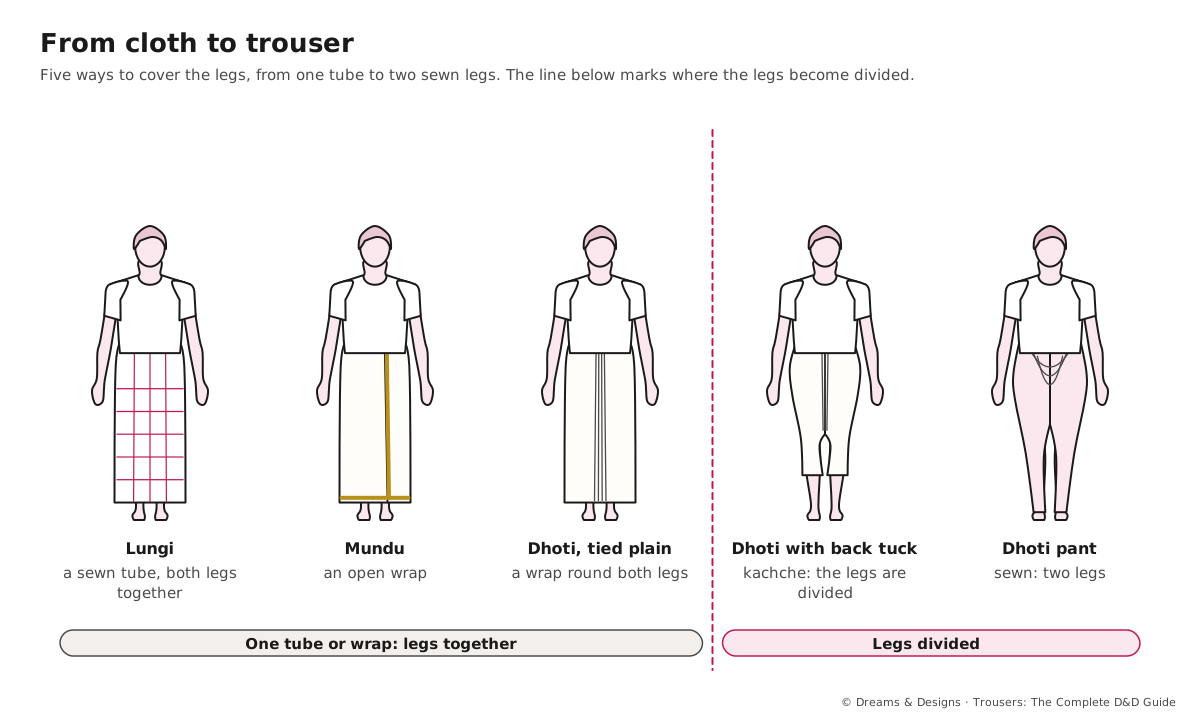
Before trousers, and alongside them, people covered their legs with a single cloth: wrapped, tucked or tied. India is the world’s great home of these garments: the dhoti, panche, veshti, mundu and lungi. Some stay one tube for both legs; some, tied with a tuck between the legs, become “draped trousers”. This lesson places them beside the trouser, so you can see what each does, and how designers turn one into the other.

What you’ll learn
- The draped lower garments of India and the world, and their names.
- Which ones stay one tube, and which divide the legs.
- Why they last alongside trousers.
- How they became stitched trousers: dhoti pants, pre-stitched dhotis, wrap trousers.
India’s draped lower garments
| Garment | Where, who | Legs |
|---|---|---|
| Dhoti / dhotar / dhuti | North, west and east; men | Divided when tied with a back tuck |
| Panche (Kannada) | Karnataka; men | One wrap, or divided as kacche panche |
| Veshti (Tamil) | Tamil Nadu; men | One wrap, usually |
| Mundu | Kerala; men (and women’s mundu set) | One open wrap |
| Lungi / kaili | South, east, coast; men, at home and work | One sewn tube |
| Nauvari saree | Maharashtra; women | Divided by a back tuck |
| Tehmat | Punjab; men | One wrap |
The tuck that makes a trouser
Tie a dhoti plain, and it is a wrap round both legs, like a skirt. Pass one end between the legs and tuck it at the back waist, and each leg is now wrapped separately. This back tuck, called kachche (Kannada), kaccha or kaach in other languages, turns a flat cloth into a garment that works like a trouser: you can walk fast, ride, climb, dance and work. The Maharashtrian nauvari saree uses the same idea for women, and so does the sampot chong kben of Cambodia.
Why the wraps last
- Climate: loose, unstitched cotton is cool in heat and humidity.
- One size fits many: a wrap adjusts to any waist and any body, through pregnancy, illness or age.
- Ceremony and faith: an unstitched new cloth is often preferred for pujas, weddings and temple visits; some temples ask men to wear a dhoti or mundu.
- Thrift: a whole loom-width cloth, never cut, lasts for years and can be reused.
In more depth: the world’s wraps
- Southeast Asia: the sarong (Indonesia, Malaysia), the longyi (Myanmar), the pha sin (Laos, women), the chong kraben (Thailand, tied with a back tuck).
- Sri Lanka and the Maldives: the sarong for men.
- The Pacific: the sulu, lavalava, pāreu.
- East Africa: the kikoi and kanga.
- Scotland: the kilt, a pleated wrap, grew from the older belted plaid.
- Ancient Egypt and the Mediterranean: the kilt-like shendyt, and later the toga and tunic.
In more depth: from wrap to stitched trouser
This is one of the clearest examples of transformation in Indian fashion (Part IX).
- Dhoti pants: the look of a tied dhoti, with front pleats, deep drop and soft folds at the leg, sewn into a pull-on trouser. Now worn by women, men and children, especially for festivals and weddings.
- Dhoti salwar: a salwar cut with a dhoti-style draped front.
- Pre-stitched dhoti, panche and veshti: sewn with a waistband, elastic or Velcro so they look tied but go on in seconds; popular with boys and with men who never learnt the tie.
- Pocket veshti: a veshti with a sewn pocket, a small, practical change.
- Lungi-inspired wrap trousers and lungi checks on trousers.
- Pant-saree and pre-draped nauvari: the women’s versions of the same move.
These are not imitations: they keep the drape’s look and meaning while adding the ease of a stitched garment. Designers working in this space describe it as keeping a tradition alive for people who no longer have time, or teachers, for the tie.
In more depth: children
Boys often wear their first panche, veshti or mundu for a naming ceremony, a thread ceremony, a festival or a family wedding, usually pre-stitched now so it stays on during play. Girls may wear a mini nauvari or pattu pavade (a long skirt). Small children’s dhoti pants with elastic waists are popular festive wear.
Tips for learners and teachers
- Learn to tie a dhoti with a back tuck before you draft a dhoti pant; your pattern will be truer.
- Measure the fabric of a real dhoti or mundu. Note its length and width: those numbers guide your dhoti-pant draft.
- Ask families how they tie: there are many regional and family ways.
- Teachers: run a “tie and draft” class: students tie a dhoti on each other, photograph it, then trace the shape onto paper.
- Treat temple and ceremonial dress rules with respect; describe them, do not judge them.
Common misunderstandings
- “A dhoti is a skirt for men.” Tied with a back tuck it divides the legs; tied plain it is a wrap, not a skirt.
- “A lungi and a mundu are the same.” A lungi is usually sewn into a tube and often coloured or checked; a mundu is an open, usually white or cream cloth with a border.
- “Wraps are old-fashioned.” Millions wear them daily, and designers keep reinventing them.
- “Dhoti pants are a dhoti.” They borrow the look; they are sewn trousers.
For earning and teaching
Pre-stitched panche and veshti sets, dhoti pants for children and adults, and pant-sarees are steady wedding and festival orders. A tailor who understands how the draped original falls can make a stitched version that looks right. Teaching the tie alongside the sewing makes a memorable workshop for families before a wedding.
Sources and uncertain points
- Names and tying methods vary by region, community and family; the table gives common forms.
- Kannada kachche and related terms in other languages: spellings to check with a D&D teacher.
- Temple dress rules differ from temple to temple and change; check locally.
- The kilt’s growth from the belted plaid is the usual account in dress history.
- Main source: D&D ebook Encyclopedia of Trousers for Women, ch. 4, widened with Indian dress knowledge.
Check yourself
- Can you name five Indian draped lower garments and their regions?
- Can you explain how a back tuck turns a dhoti into a “draped trouser”?
- Do you know the difference between a lungi and a mundu?
- Can you give three reasons wraps are still worn?
- Can you name three stitched garments that grew from draped ones?
Key terms
- Kachche (kaccha, kaach): the back tuck between the legs.
- Panche, veshti, mundu, dhoti: regional draped lower cloths.
- Lungi: a sewn tube wrap.
- Pre-stitched dhoti: a dhoti sewn to look tied.
- Nauvari: nine-yard saree tied with a back tuck.