Trousers carry many myths: about history, about bodies, about sewing and about sustainability. Some are half-true, some are simply wrong, and some are stories repeated so often that they sound like facts. This lesson sets out the common ones, with the facts as far as they are known, and marks the points where sources still disagree.
What you’ll find here
- Myths about history and culture.
- Myths about bodies, fit and sizes.
- Myths about sewing and cloth.
- Myths about care, sustainability and business.
A few to start
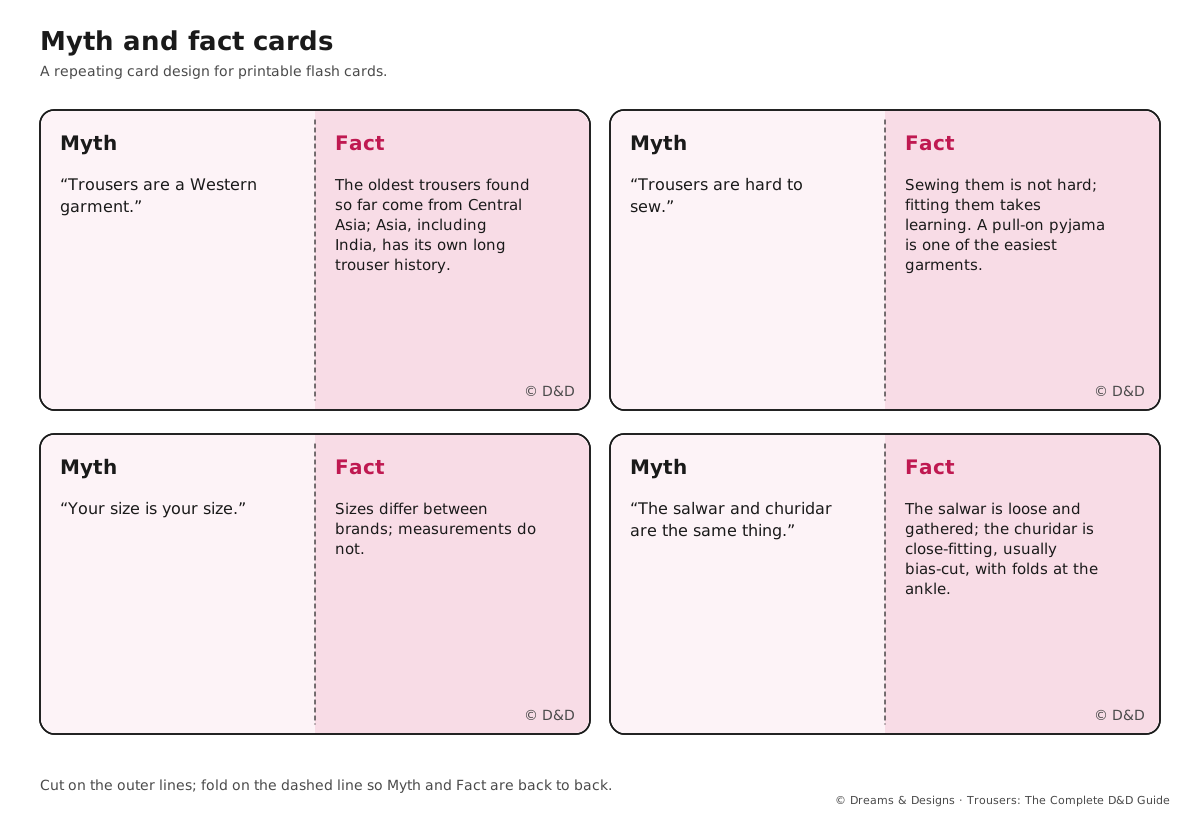
- Myth: “Trousers are a Western garment.” Fact: the oldest trousers found so far come from Central Asia (the Yanghai finds, in present-day China, dated by researchers to roughly 3,000 years ago, as published). Asia, including India, has its own long trouser traditions.
- Myth: “Trousers are hard to sew.” Fact: sewing them is not hard; fitting them takes learning. A pull-on pyjama is one of the easiest garments there is.
- Myth: “Your size is your size.” Fact: sizes differ between brands; measurements do not.
History and culture
- Myth: “Women only began wearing trousers in the twentieth century.” Fact: in many parts of Asia, including South Asia, women wore salwars, pyjamas and other trousers for centuries. In Europe and America women’s trousers became widely accepted in the twentieth century.
- Myth: “It was illegal for women in France to wear trousers until 2013.” Fact, with care: an 1800 Paris police ordinance required permission for women to dress as men. It had long been ignored when it was formally declared no longer in force in 2013. Sources differ on how to describe it; it was a Paris ordinance, not a national law.
- Myth: “Marlene Dietrich was arrested in Paris for wearing trousers.” Fact: a popular story, but no contemporary record supporting it has been found, as reported.
- Myth: “The salwar and churidar are the same thing.” Fact: the salwar is loose and gathered; the churidar is close-fitting and usually bias-cut, with folds at the ankle.
- Myth: “The Patiala salwar has a single known inventor.” Fact: its origin is linked to the princely state of Patiala, but details are traditionally said rather than documented.
- Myth: “Traditional styles never change.” Fact: they change all the time: lengths, widths, cloths and decoration follow fashion within the tradition.
Bodies, fit and sizes
- Myth: “There is a perfect trouser body.” Fact: there is no problem body, only patterns that do not yet fit. Every body can have trousers that fit.
- Myth: “Dark colours and vertical lines are the only choices for larger bodies.” Fact: any colour and line can be worn. Proportion and colour change where the eye goes; the choice is the wearer’s.
- Myth: “Bigger sizes just need everything bigger.” Fact: bodies change shape, not just size; rise and crotch grow much less than waist and hip.
- Myth: “India has one standard size chart everyone follows.” Fact: brands mostly use their own; national survey work (INDIAsize) aims at Indian body data, and its adoption is still to be checked.
- Myth: “Children’s trousers should be bought big to grow into.” Fact: a little growth room is sensible; too-long legs and loose waists can make children trip. Use adjustable waists and growth hems instead.
- Myth: “Pregnant people must wear shapeless trousers.” Fact: panelled, adjustable and wrap styles fit well through pregnancy and after.
Sewing and cloth
- Myth: “You need expensive tools.” Fact: a sound basic machine, sharp shears, a tape and an iron make almost every trouser in this course.
- Myth: “Pressing is optional.” Fact: pressing as you sew is what makes home sewing look professional.
- Myth: “Stretch cloth means you don’t need to fit.” Fact: stretch hides some fit problems and creates others, such as baggy knees and seat.
- Myth: “A burn test proves fibre content.” Fact: it is a useful guide, not proof, especially for blends. Ask for the supplier’s documents.
- Myth: “Silk is always fragile.” Fact: some silks are delicate; others, such as raw silk and some Indian silks, are quite sturdy.
- Myth: “The more pins, the better.” Fact: too many pins can distort the cloth; pin where it matters and use weights for cutting.
Care, sustainability and business
- Myth: “Natural fibres are always the sustainable choice.” Fact: every fibre has impacts; how it is grown, processed, worn and cared for matters more.
- Myth: “Sustainable means expensive, and cheap means unsustainable.” Fact: price is a weak guide. Fit, quality and how often it is worn matter most.
- Myth: “Washing jeans in the freezer kills bacteria.” Fact: this is widely repeated, but freezing is not a reliable way to clean. Wash or air them.
- Myth: “Dry-clean-only means you can never wash it.” Fact: the label is the maker’s safe advice; some can be hand-washed with care, but there is a risk. Test first, or follow the label.
- Myth: “A tailor’s price is just the cost of the cloth plus a little.” Fact: labour, fittings, overheads and losses are real costs (see Costing a trouser: the method and worked examples in Module 12).
- Myth: “Robots sew most clothes.” Fact: people sew almost all trousers today.
Sources and uncertain points
- Yanghai trousers: dates as published by the research team (Quaternary International, 2014); later work may refine them.
- The Paris ordinance and the Dietrich story: as reported by several news sources; accounts differ.
- Origins of named regional styles: often traditionally said; see the style entries in Module 7.
- INDIAsize: see Size systems and the India size survey in Module 1 for what is still to check.
For teachers
- Use these as a quick quiz at the start of a class: read a statement and ask, “myth or fact?”
- Ask learners to bring a “fact” they have heard and check it together.
- Model good habits: say “sources differ” when they do.
Check yourself
- Can I explain why sizes differ between brands?
- Can I name one trouser myth from history and the fact?
- Do I know why the rise grades less than the hip?
- Do I say “sources differ” when they do?