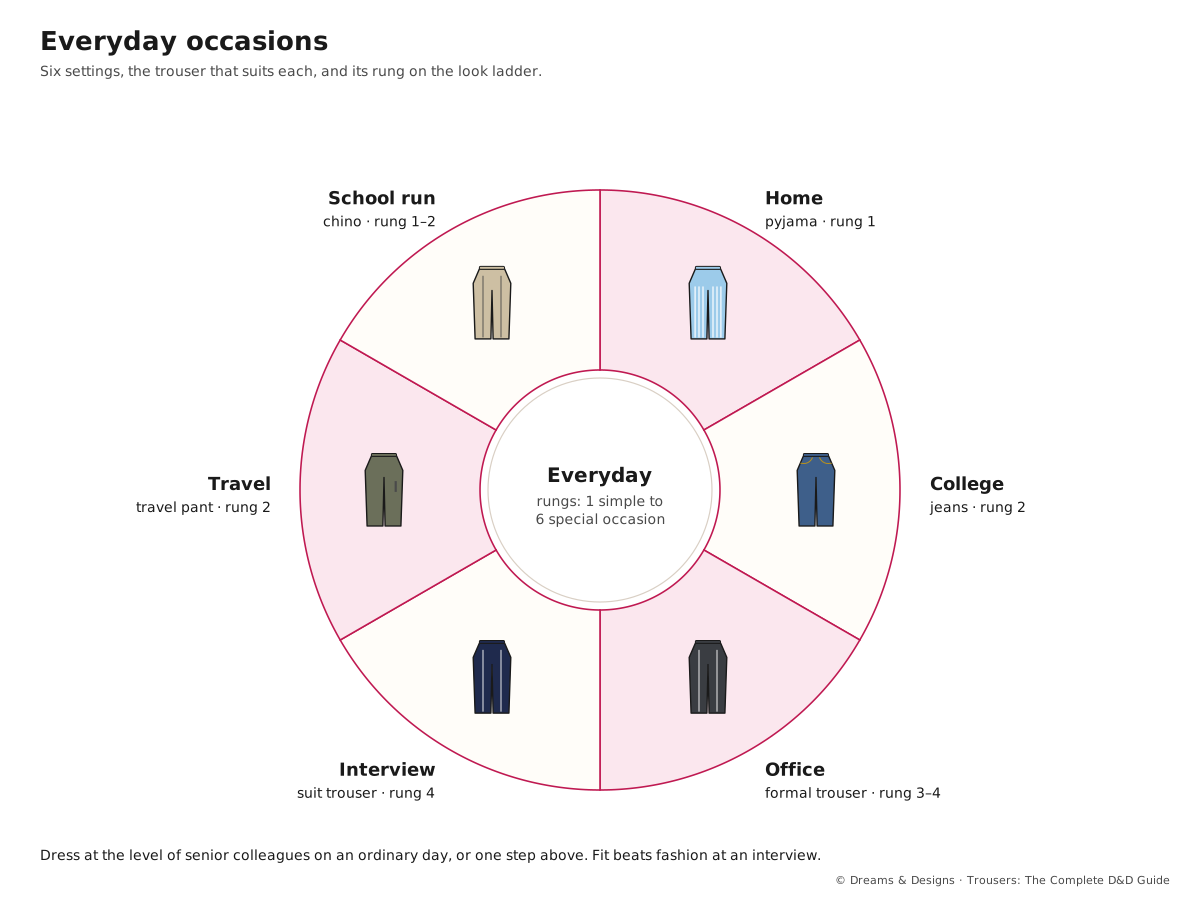
This is the first of four lessons on dressing for the occasion. It covers everyday life: office, interview, college, school, travel and home. The next three cover weddings and festivals, religious places, and parties, black-tie, funerals, beach and gym.
What you’ll learn
- Which trousers suit each everyday setting in India, for women, men and children.
- How to read a workplace’s dress code.
- The interview checklist stylists use.
- Travel and home trousers that work hard.
Office
Offices in India range from strict to very relaxed, and the same city can hold both. Look at what senior colleagues wear on an ordinary day, then dress at that level or one step above.
- Formal offices (banks, law firms, government, many corporates): tailored trousers in navy, charcoal, grey, black or beige, with shirts, blouses or kurtas. For women, cigarette pants, straight pants or tailored wide legs with straight kurtas or shirts; for men, flat-front or pleated trousers with a belt and leather shoes. Many Indian workplaces accept a sober kurta with straight pants or churidar as formal.
- Business casual (most IT and service offices, including much of Bengaluru): chinos, straight cotton trousers, smart jeans on some days; polos, shirts, kurtis; loafers, sneakers in good condition.
- Creative and start-up offices: almost anything clean and comfortable, including palazzos, culottes, joggers in smart cloth and printed trousers.
- Uniform and workwear jobs (hospitals, hotels, airlines, factories, kitchens): the trouser is chosen for safety and movement first. The ebook’s rule: test it through the actual tasks – bending, kneeling, reaching – before ordering a full set.
Interview
The ebook is clear: fit beats fashion. A well-fitted plain trouser at the right rise, with a clean hem that suits the shoe, looks more capable than a fashionable one that pulls or pools.
- Colour: navy and charcoal are slightly more approachable than black, and just as serious. Matte cloth, not shiny.
- For women: a trouser suit, tailored trousers with a shirt or blouse, or a plain kurta with straight pants or churidar.
- For men: suit trousers with a jacket for formal roles; tailored trousers or chinos with a pressed shirt for business-casual employers.
- Video interviews: darker, less shiny cloth shows better on camera, as the ebook notes. Fine stripes and small checks can shimmer on screen.
College and school
- College: jeans, chinos, cargo pants, joggers, palazzos and kurtis are everyday wear on most Indian campuses. Some colleges have dress codes, especially for labs, workshops and placement days.
- Labs and workshops: full-length trousers, no flowing hems, closed shoes.
- Placement and presentation days: treat as an interview.
- School: uniform trousers in hard-wearing poly-cotton or polyviscose, with reinforced knees and a growth hem.
Travel and home
- Travel: trousers that resist creases, stretch a little, have a secure zip pocket and look fine after a long sit: ponte knits, cotton-stretch twill, travel nylon blends, terry-wool. See Packing trousers and dressing for the seasons.
- Home: soft cotton pyjamas, lounge pants, joggers, salwars and palazzos. Keep one set “visitor-ready” for unexpected guests and video calls.
Step by step: the interview trouser check
From the ebook’s stylist checklist, done a few days before:
- Sit in the trousers for fifteen to twenty minutes (the length of the journey), then stand and check for creases and seat shine.
- Check the rise and waist sitting and standing: no gaping, no digging.
- Wear the actual shoes and check the hem break.
- Check pockets lie flat with nothing in them.
- Photograph the outfit under indoor light and daylight.
- If wearing a jacket: buttoned, no shirt or top should show between the jacket hem and the trouser waist unless intended.
- Pack a small steamer or plan a quick press for the morning.
The ebook’s biggest warning: never wear a trouser for the first time on the important day.
Women, men and children: quick guide
| Setting | Women | Men | Children |
|---|---|---|---|
| Formal office | Cigarette or straight pant, kurta or shirt | Wool-blend trouser, shirt, belt | Not relevant |
| Business casual | Chinos, palazzo, kurti | Chinos, polo or shirt | Not relevant |
| College, school | Jeans, cargo, palazzo | Jeans, chinos, joggers | Uniform trouser, growth hem |
| Travel | Ponte or stretch-twill pant | Stretch chino, travel trouser | Joggers, soft pull-ons |
| Home | Cotton pyjama, palazzo | Pyjama, lounge pants | Soft cotton pyjama |
Tips, tricks and hacks
- Dress for the room: look up the company’s photos or ask the recruiter what people wear.
- Two pairs of the same office trouser halve the morning decisions.
- A little stretch (2–3% elastane) makes a long office day more comfortable without looking casual.
- Air-conditioned offices: a light layer matters more than a heavy trouser.
- Bengaluru commutes: dark trousers hide road dust and two-wheeler grime.
- Monsoon days: quick-dry cloth and a hem that clears wet shoes.
- Seat shine on office trousers means it is time to rotate; see Module 11 on care and repairs.
- School trousers: buy or stitch two at once from one cloth lot.
- Video calls: plain, mid-to-dark tops; trousers matter less, but wear proper ones in case you need to stand up.
- What professionals do differently: they rehearse the outfit – sitting, walking, travelling – before a big day.
Common misunderstandings
- “Interviews need a black suit.” Navy or charcoal is equally serious and often warmer.
- “Kurtas are not office wear.” In most Indian workplaces, a sober kurta with tailored trousers or churidar is fully professional.
- “Casual offices have no dress code.” They have an unwritten one; clean, fitted clothes still matter.
- “Workwear can be any old trouser.” Safety jobs often need specific cloth, colours or finishes.
For earning and teaching
For earning: office and school trousers are steady, repeat orders. Keep each customer’s measurements and preferred cloth on file.
For teaching: role-play an interview fitting: learners run the seven-step check on each other.
Sources and uncertain points
- Main source: D&D’s ebook, chapters 31, 32, 34 and 35, widened to Indian workplaces, colleges and schools.
- Workplace and campus norms vary widely and change; the guide reflects common practice.
Check yourself
- Can you read an office’s dress level from what senior staff wear?
- Can you list the interview trouser check?
- Do you know which trouser features help in travel?
- Could you advise a college student for a lab day and a placement day?
Quiz
- What does the ebook say beats fashion at interviews? Answer: fit.
- How long should you sit in an interview trouser to test it? Answer: about fifteen to twenty minutes.
- What is the first rule for uniform and workwear trousers? Answer: test them through the actual tasks of the job.
Key terms
- Business casual: smart but no suit or tie.
- Seat shine: a shiny patch from wear on the seat.
- Travel trouser: a crease-resistant, quick-dry trouser with secure pockets.
- Dress code: the written or unwritten rule for what to wear.