The longest-lasting trouser is usually the one already in the cupboard, cared for and worn for years (from the D&D ebook). This closing lesson of Part XI brings washing, storing, mending and altering together into one habit. It helps you decide when to repair and when to replace, gives practical ideas for upcycling a trouser into something new, and explains how to let go of trousers well when their time is up.

What you’ll learn
- How small care habits add up over a trouser’s life.
- How to decide between repairing, altering, upcycling and replacing.
- Practical upcycling ideas for trousers, including Indian reuse traditions.
- Ways to pass on, donate or recycle trousers you no longer wear.
Small habits, long life
No single habit makes a trouser last; together they can turn one season into many years (from the D&D ebook):
- Wash less and gently: cool water, inside out, air dry. See Washing and drying trousers by fabric.
- Hang or fold well, clean and dry. See Storing trousers: hanging, folding, monsoon damp and pests.
- Rotate: wearing the same pair every day wears it out fast; three or four pairs in turn share the wear.
- Mend early: a loose seam or button today, not a hole next month.
- Alter instead of abandoning: a trouser that no longer fits can often be made to.
Repair, alter, upcycle or replace?
| Situation | Usually | Why |
|---|---|---|
| Seam, hem or fastening has failed | Repair | Quick, cheap in time, nearly always worth it |
| Fit has changed a little | Alter | If the allowance and the cloth allow |
| Knees or seat worn, rest sound | Patch, or make into shorts | Most of the trouser is still good |
| Cloth thin all over, faded, pilled | Upcycle parts, or recycle | Repairs will not hold |
| Several big fit problems, low-cost trouser | Replace, and pass the old one on | Work may outweigh the trouser’s value |
The D&D ebook’s rule of thumb: structural problems (seams, hems, hardware) are worth repairing on almost any trouser; damage across a large area of a low-quality trouser may not be.
Upcycling: five good ideas
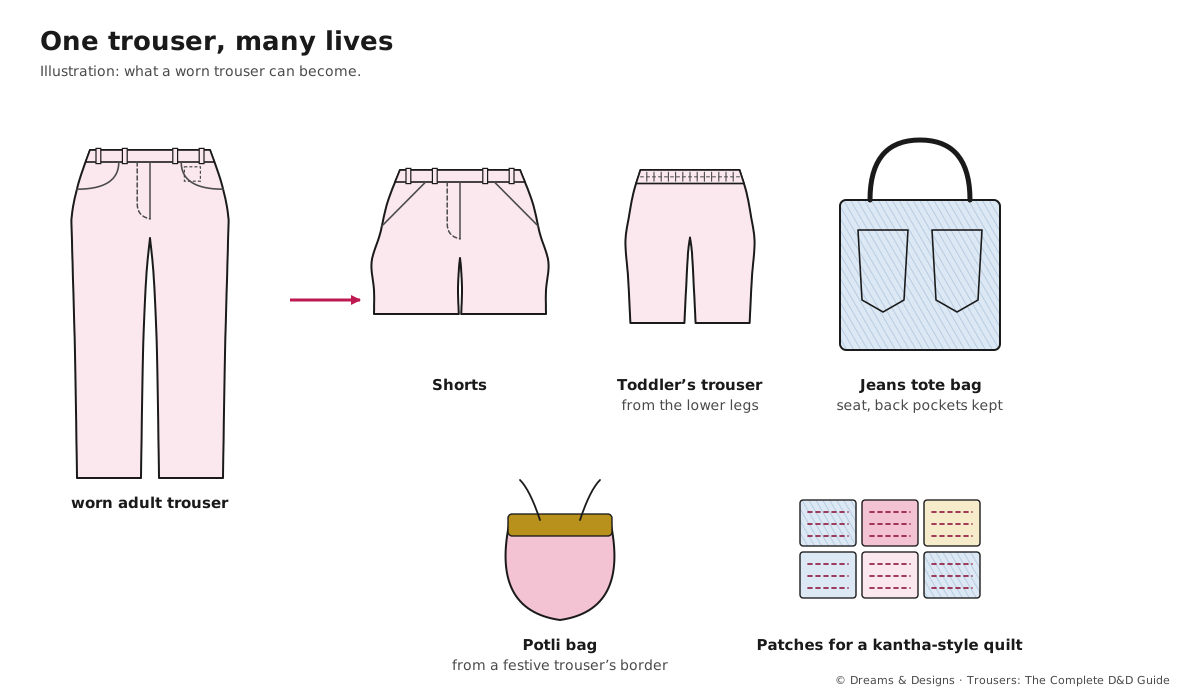
- Shorts or three-quarter pants from trousers worn at the hem or knees.
- A child’s trouser from the lower legs of an adult trouser; see Children’s trousers: letting down, letting out and handing on.
- A tote or sling bag from jeans, keeping the back pockets and waistband as features.
- A potli or pouch from a festive trouser’s border or embroidered mohri.
- Patches and quilts: squares for patchwork, or layers for a kantha or kaudhi-style running-stitch quilt, a long Indian tradition of reusing old cloth.
In more depth: trousers into shorts, step by step
- Try the trouser on; mark the new length plus 1 1/2 in (4 cm) for a hem, or 4 in (10 cm) for a turn-up.
- Lay flat; measure from the crotch down the inseam to the mark on both legs, so they match.
- Cut straight across, or slightly curved up at the inseam for shorter shorts.
- Hem with a double fold, or fold up twice as a turn-up and tack at the seams.
- Keep the cut-off legs: they are patch cloth, a child’s trouser or a bag.
In more depth: investment pieces and quick-turnover pieces
Not every trouser needs to last ten years. A trend piece bought for a season is a reasonable choice, as long as you know that when you buy it (from the D&D ebook). Investment trousers – a good wool suit trouser, a well-made pair of jeans, a festive set – deserve the full care in this Part. Check quality before buying (see Quality checks for ready-made trousers and your own work): finished seams, enough allowance to alter, a firm waistband and reinforced stress points all predict a longer life.
In more depth: letting go well
- Hand on: to family, friends, neighbours or a younger child. Wash, mend and fold first.
- Donate: to charities and collection drives that want wearable clothes. Ask what they accept; worn-out trousers are a burden to them.
- Exchange: clothes-swap events and community groups.
- Sell second-hand: good-quality trousers sell online and in resale shops.
- Textile recycling: some brands and organisations collect worn textiles for recycling; check what they actually do with them.
- At home: cut cotton trousers into cleaning cloths; remove zips and buttons first and keep them for repairs.
Indian reuse traditions
- Handing down within families has always extended the life of clothes.
- Kantha (Bengal) and kaudhi (north Karnataka and Maharashtra, as commonly described) layer old cloth with running stitch into quilts and covers.
- Exchanging old clothes for steel utensils with door-to-door traders is a long-standing practice in many Indian cities (reported; still seen in some areas).
- Rags and dusters from worn cotton are a normal end for household cloth.
Designers in India also work with upcycled cloth; see Part IX, Transformation in Indian fashion: fusion, sculptural and upcycled work. For sustainability in the wider trade, see Part XII, Sustainability and fair pay.
Tips for learners and teachers
- Keep a mending basket and empty it each week.
- Rotate trousers so no pair carries all the wear.
- Save zips, buttons and hooks from trousers you retire.
- Save good cloth from worn trousers for patches.
- Photograph upcycled pieces with their “before”; it inspires others.
- Teachers: an upcycling project uses free materials and teaches cutting around wear.
- Repair before donating; it makes the gift useful.
- Choose fabrics that can be mended when buying or making.
- Leave seam allowance in your own trousers for future alteration.
- Label children’s trousers with height ranges for handing on.
Common misunderstandings
- “Old trousers are rubbish.” Most have sound cloth, zips and buttons worth keeping.
- “Donating anything helps.” Worn-out clothes are hard for charities to use; donate wearable ones.
- “Recycled means it becomes new clothes.” Often textiles are down-cycled into insulation or rags; ask.
- “Mending is only for saving money.” It also keeps clothes you love and reduces waste.
For earning and teaching
For earning: repair and upcycling services, and upcycled products such as bags and pouches, are a growing area. Cost each piece by time and materials (see Part XII, Costing a trouser: the method and worked examples); this course gives no prices. Be honest in labels that a product is made from used cloth.
For teaching: a “one trouser, three things” class – shorts, a bag, patches – fits into one afternoon.
Sources and uncertain points
- Main source: D&D’s own trousers ebook, chapters 61, 62 and 66 (cumulative care; rotation; investment and trend pieces; quality signs; repair or replace; the most sustainable trouser is the one already owned).
- Kaudhi’s region and the utensil-exchange practice are as commonly described; sources differ.
- What textile recyclers do with collected clothes varies; ask each one.
Check yourself
- Do you rotate your trousers?
- Can you decide between repair, alteration, upcycling and replacing?
- Can you turn a trouser into shorts?
- Do you know three good ways to let go of a trouser?
Quiz
- Which problems are nearly always worth repairing? Answer: seams, hems and fastenings.
- Name two upcycling ideas for worn jeans. Answer: shorts; a tote bag; patches; a child’s trouser.
- What should you do before donating a trouser? Answer: wash and mend it, and check the charity accepts it.
Key terms
- Upcycling: making a used item into something of equal or greater use.
- Down-cycling: turning textiles into lower-value uses such as rags or filling.
- Rotation: wearing several trousers in turn.
- Kaudhi: a patched, running-stitch quilt tradition of the Deccan; spellings vary.
- Potli: a small drawstring pouch.