Where a trouser sits on the body, and how long the body is above and below that point, changes both comfort and how the whole outfit reads. This lesson explains rise and the torso-to-leg line for every body, and gives you three quick tests that fitters use before choosing a rise.
What you’ll learn
- Low, mid and high rise, and what each does for comfort.
- How torso length and leg length change the rise you choose.
- Why the same labelled rise sits differently on different people.
- The sit-reach-bend test, the pinch test and the squint test.
The three rises
- Low rise sits on or near the hip bones, several inches below the natural waist. Most freedom at the waist, least support; it can gap or slip when you bend.
- Mid rise sits at or a little below the natural waist. It suits the widest range of bodies and activities with the fewest compromises.
- High rise sits at or above the natural waist. Most support and coverage; useful for seated work, cold weather and many postpartum bodies, but it can feel tight in active movement unless the cloth stretches.
Traditional Indian trousers mostly sit at the natural waist with a nada (drawstring) or elastic: the salwar, churidar and pyjama are high to mid rise by nature, with a deep, roomy crotch.
Torso and legs
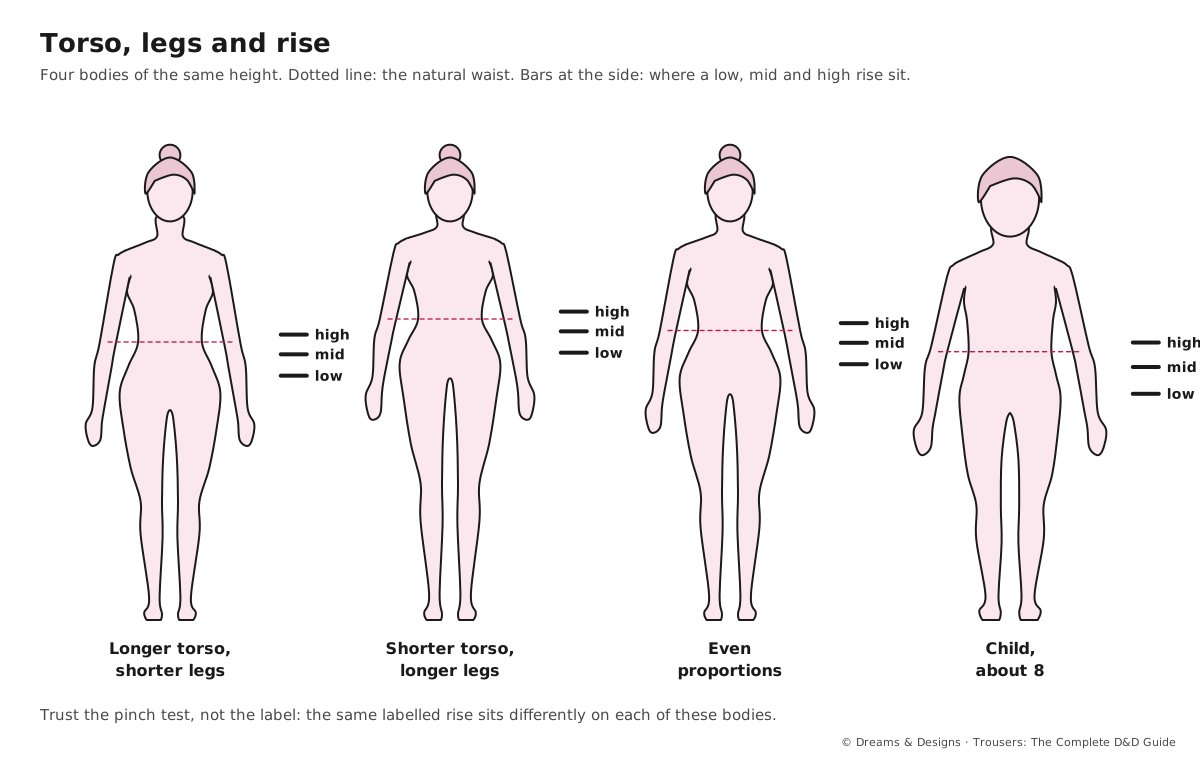
Two people of the same height can divide that height very differently. Stand side-on to a mirror and look at where your natural waist falls between shoulder and floor.
- Longer torso, shorter legs: a higher rise moves the visual waist up and lengthens the leg line. A clean hem with little break helps too.
- Shorter torso, longer legs: a mid rise leaves room between the waistband and the ribs. A very high rise can feel cramped when sitting.
- Even proportions: any rise works; choose for comfort and the occasion.
These are starting points, not rules. Comfort, work, faith, climate and simple liking matter as much as proportion.
Why labels mislead
Brands measure “high rise” from their own fit model. On a person with a lower natural waist, a high rise sits at the waist; on a person with a short waist, the same trouser reaches the ribs. Trust the test, not the label.
Three tests to do every time
- Sit-reach-bend. Sit fully, bend as if to tie a shoe, reach overhead and take a long stride. Watch for back gaping, digging in, the trouser pulling down at the back, and the crotch catching. A trouser that fails any one of these fails in real life.
- Pinch test. Find your natural waist by bending sideways. Measure from there down to where the waistband actually sits. That number is your true rise on your body.
- Squint test. Stand back from the mirror and soften your eyes. Look at the whole shape: where the eye lands first, and whether the outfit reads as one line or is cut in half.
In more depth: rise for men and children
Men
Classic men’s tailoring sat at the natural waist and was held up by braces (suspenders); the waistband followed the body and the fly was long. From the 1960s men’s trousers moved lower, and today many men wear a mid rise at or just below the navel. A man with a full stomach often finds a low rise rolls under the stomach and a true waist rise sits over it more comfortably, especially with side adjusters or braces. Kurta pyjama and Pathani salwar sit at the waist with a nada and a roomy crotch, which is why they are so comfortable seated.
Children
Children have no waist-to-hip difference to hold a trouser up. A rise that is too low slides down; a rise that is too high and tight presses on a round tummy. Most children’s trousers use a rise that reaches the natural waist (or the top of the nappy in babies), held with elastic or an adjustable button-elastic inside the waistband. For babies, the back rise must be long enough to cover the nappy when the baby sits or crawls.
Front and back rise are separate choices
A trouser can have a higher back rise and a lower front rise. That is how seated and adaptive trousers are cut, and it is also how many people with a full tummy or a full seat get comfort without changing the look from the front. See the lesson Older bodies, seated and adaptive wear.
The rule of thirds
Many stylists divide the body into thirds rather than halves. An outfit split at about one third and two thirds, such as a short top with a high-rise trouser, or a long kurta over a slim ankle trouser, tends to look more balanced and longer than one split exactly in the middle. Again, a tool, not a law.
Volume and balance
A wide trouser often balances a closer top; a slim trouser can carry a fuller top. Oversized on oversized, and fitted on fitted, are both deliberate looks too. Knowing the principle lets you break it on purpose. The full styling story is in Part VIII, Proportion and silhouette.
Tips, tricks and hacks
- Keep a fit note on your phone: true rise from the pinch test, best inseam, and two or three brands that fit you.
- Try a new rise sitting down first. Most rise problems show only when seated.
- Measure a trouser that fits from crotch seam to waistband top, front and back. Use those numbers when you buy online.
- Use a mirror behind you or a phone timer photo to see the back waist while seated.
- Match rise to the top: a high rise with a long kurta is hidden, so choose it only for comfort; with a tucked shirt it becomes a design line.
- For a long torso, choose a longer zip and rise rather than a lower waist; it gives coverage when bending.
- For a short torso, a contoured waistband (curved, not straight) sits better below the ribs.
- For active days, choose mid rise in stretch; for desk days, a high rise often feels steadier.
- Braces solve many men’s rise problems at a stroke, because the trouser hangs from the shoulders rather than gripping the waist.
- In children’s wear, add 1–2 cm extra back rise over the chart for crawlers and active children; the back pulls down most.
Problems and how to fix them
The back pulls down when sitting
Cause: back rise too short for the seat or for a deep forward bend.
- Choose a higher back rise or a different brand block.
- Have a tailor add a back yoke or let out the centre-back seam at the waist, if there is allowance.
- Prevention: always do the sit-reach-bend test before buying.
The waistband sits on the ribs
Cause: a short torso in a high or ultra-high rise.
- Choose mid rise.
- Shorten the rise from the top: remove the band, cut down, re-attach (tailor’s job on tailored trousers).
- Prevention: use the pinch test, and buy by your true rise.
Low rise gaps at the side
Cause: the waistband sits where the hip has already started to curve, and a straight band cannot follow.
- Choose one step higher in rise.
- A contoured band, recut by a tailor.
- Prevention: avoid straight-cut low-rise bands if you have a high hip curve.
Common misunderstandings
- “High rise is only a fashion.” It is also the traditional rise of most Indian and older Western trousers, and a comfort choice.
- “Low rise lengthens everyone’s legs.” It can, on a long torso; on a short one it may simply feel insecure.
- “One rise suits me for life.” Pregnancy, age, weight change and work all change the best rise.
For hobby, earning and teaching
As a hobby: do the pinch test on every trouser you own and write the numbers down. Patterns in your favourites appear quickly.
For earning: offering a “rise check” at the counter, with the customer seated, sets your service apart from a simple hem shop.
For teaching: line up learners in the same style trouser and photograph them side-on. Compare where the waistband lands against each natural waist.
Sources and uncertain points
- The rule of thirds is a styling convention, not a measured standard.
- Dates for men’s rise moving lower (about the 1960s) are general fashion history and varied by country.
- Rise labels have no shared industry definition; brands differ.
Check yourself
- Do you know your true rise from the pinch test?
- Can you describe the four moves of the sit-reach-bend test?
- Could you suggest a rise for a long torso and for a short torso, and say why?
- Do you know why front and back rise can be different?
- Do you know why children’s rises need extra at the back?
Key terms
- Rise: crotch seam to top of waistband.
- True rise: where the waistband sits on your body, measured from your natural waist.
- Torso-to-leg ratio: how height is shared above and below the waist.
- Break: how the hem meets the shoe.
- Nada: drawstring through a casing, used in salwar and pyjama.