A size chart turns a body into a size, and a size into a set of pattern measurements. This lesson gives typical women’s and men’s trouser charts, the usual India, UK, US and EU conversions, and shows how a pattern maker uses a chart: to pick a starting size, to check a customer’s measurements, and to build a size range.
What you’ll learn
- How to read a body-measurement size chart, and how it differs from a garment chart.
- Typical women’s and men’s trouser sizes, with India, UK, US and EU equivalents.
- How to choose the starting size for a draft or a bought pattern.
- Why every chart here is “typical”, and what to check before using one.
Body charts and garment charts
A body chart lists the body measurements a size is made for. A garment chart lists the finished trouser’s measurements, which include ease. A size 14 with a 40 in (101.5 cm) hip on the body chart may measure 42–44 in (106.5–112 cm) at the hip as a garment. Always ask which kind of chart you are reading. Module 1, Size systems and the India size survey, explains why brands disagree; here we use the charts.
Women: a typical chart
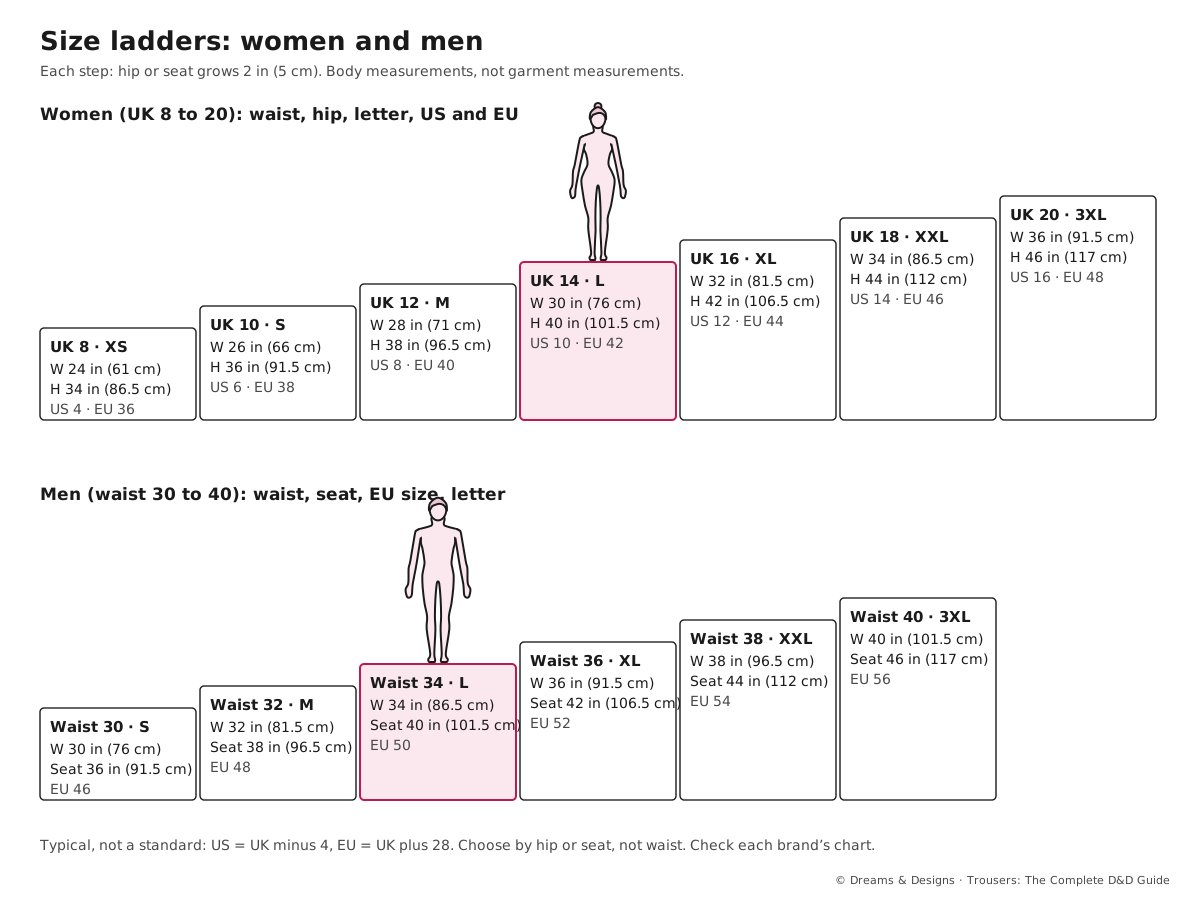
| Size (UK) | Waist | Hip | Also called |
|---|---|---|---|
| 8 | 24 in (61 cm) | 34 in (86.5 cm) | XS · US 4 · EU 36 |
| 10 | 26 in (66 cm) | 36 in (91.5 cm) | S · US 6 · EU 38 |
| 12 | 28 in (71 cm) | 38 in (96.5 cm) | M · US 8 · EU 40 |
| 14 | 30 in (76 cm) | 40 in (101.5 cm) | L · US 10 · EU 42 |
| 16 | 32 in (81.5 cm) | 42 in (106.5 cm) | XL · US 12 · EU 44 |
| 18 | 34 in (86.5 cm) | 44 in (112 cm) | XXL · US 14 · EU 46 |
| 20 | 36 in (91.5 cm) | 46 in (117 cm) | 3XL · US 16 · EU 48 |
The usual conversions: US = UK minus 4, EU = UK plus 28. Indian brands often use letters or UK numbers; the letter for a given size varies a lot between brands. Our worked-example woman (waist 30, hip 40) is a UK 14 on this chart.
Men: a typical chart
| Waist size | Seat | EU size | Letter |
|---|---|---|---|
| 30 in (76 cm) | 36 in (91.5 cm) | 46 | S |
| 32 in (81.5 cm) | 38 in (96.5 cm) | 48 | M |
| 34 in (86.5 cm) | 40 in (101.5 cm) | 50 | L |
| 36 in (91.5 cm) | 42 in (106.5 cm) | 52 | XL |
| 38 in (96.5 cm) | 44 in (112 cm) | 54 | XXL |
| 40 in (101.5 cm) | 46 in (117 cm) | 56 | 3XL |
India, the UK and the US all label men’s trousers by waist in inches, often with an inside-leg length (W34 L32). The label waist is frequently 1–2 in smaller than the garment really measures. Our worked-example man is a 34.
Choosing a starting size
- For trousers, choose by the hip or seat, not the waist. It is easier to take in a waist than to add room at the seat.
- If the waist is two or more sizes away from the hip, plan a waist adjustment (darts, side seams) on the pattern.
- Check rise and length separately; charts give them only roughly.
- For your own draft, you do not need a size at all: you draft from the person’s measurements. The chart matters when you buy patterns, sell ready-made, or grade.
All figures in this lesson are typical, not a standard. Real brand charts differ; check the brand’s own chart before buying or selling. A standard method: a D&D teacher checks the figures before you rely on them.
In more depth: the other numbers on a chart
| Women’s size (UK) | Seated rise | Inside leg (regular) | Thigh |
|---|---|---|---|
| 10 | 10 1/2 in (26.5 cm) | 29 1/2 in (75 cm) | 21 1/2 in (54.5 cm) |
| 12 | 10 3/4 in (27.5 cm) | 29 1/2 in (75 cm) | 22 1/2 in (57 cm) |
| 14 | 11 in (28 cm) | 29 1/2 in (75 cm) | 23 1/2 in (60 cm) |
| 16 | 11 1/4 in (28.5 cm) | 29 1/2 in (75 cm) | 24 1/2 in (62 cm) |
| 18 | 11 1/2 in (29 cm) | 29 1/2 in (75 cm) | 25 1/2 in (65 cm) |
Notice the pattern: hip grows 2 in (5 cm) a size, thigh about 1 in (2.5 cm), rise about 1/4 in (6 mm), and inside leg not at all within one height group. Those steps are the grade rules used later in Grading across sizes. Petite, regular and tall ranges change the lengths, usually by about 2 in (5 cm) on the inside leg.
Men’s charts often add the inside leg as a separate number (L30, L32, L34) because men’s leg lengths vary independently of waist. For men, seated rise grows about 1/4 in (6 mm) per waist size; our 34 has 10 1/2 in (26.5 cm).
In more depth: making your own studio chart
- Collect the measurement cards of your real customers (names removed).
- Group them by hip or seat in 2 in (5 cm) steps.
- For each group, find the middle value of waist, rise, thigh and knee.
- Compare with the typical chart above. Where your customers differ (for example, more waist-to-hip difference, or a shorter rise), your studio chart is more useful than any imported one.
- Review it once a year.
This is what large surveys such as INDIAsize do at national scale, and what a small studio can do at its own scale.
Tips, tricks and hacks
- Size by hip, fit the waist. The most useful rule for trousers.
- Read the garment chart when buying online; compare it with a trouser you own, measured flat.
- Double flat measurements. A trouser measured flat across the waist shows half; double it.
- Stretch cloth fits smaller sizes; check the chart is for the same fabric type.
- Men’s “34” is a name, not a promise. Measure the waistband.
- Between sizes? Take the larger for the hip, and take in.
- Professionals keep one master chart in a fixed place, dated, so every cutter uses the same numbers.
- Use cm or inches, not both, on a working chart; convert once, carefully.
- Write the ease on the chart for each of your house styles, next to the body sizes.
- Teach customers their own numbers, not their size: numbers travel between brands, sizes do not.
Problems and how to fix them
Bought trousers fit the waist but not the hip
Cause: sized by waist; the brand’s waist-to-hip difference is smaller than the body’s.
- Buy by hip and take the waist in.
- Look for “curvy” cuts with more hip room.
- Prevention: check hip on the garment chart first.
Same size, different brands, different fit
Cause: each brand drafts from its own base body and ease.
- Compare garment measurements, not labels.
- Keep a note of which brands fit which family member.
- Prevention: measure a well-fitting pair and shop by its numbers.
Conversions do not match the shop’s chart
Cause: conversions are conventions, and brands round differently.
- Use the shop’s own chart.
- Convert from body measurements, not size numbers.
- Prevention: treat US/UK/EU tables as a rough guide only.
Waist two sizes smaller than hip
Cause: a body with more waist-to-hip difference than the chart assumes.
- Draft from measurements, not a size.
- On a bought pattern, blend from one size at the hip to another at the waist.
- Prevention: note the waist-to-hip difference on the card.
Chart rise is too short or too long
Cause: charts assume one torso length.
- Use the person’s seated rise in the draft.
- Shorten or lengthen the bought pattern at its rise line.
- Prevention: always measure rise, whatever the chart says.
Customer insists on a size number
Cause: a size feels like part of who they are.
- Label your garments by your own house code, not numbers.
- Talk about measurements privately and kindly.
- Prevention: never comment on a size; no size is good or bad.
Chart from abroad does not suit local customers
Cause: imported charts are based on other populations.
- Build a studio chart from your own customers.
- Follow news of INDIAsize results for Indian body data.
- Prevention: review your chart every year.
Beginner mistakes and myths
- Mixing body and garment charts. Adding ease to a garment chart doubles the ease.
- Myth: “There is an official Indian size for every trouser.” Not yet in general use; brands choose.
- Myth: “UK 14 is the same everywhere.” Only roughly, and less so over the years (vanity sizing).
- Using letter sizes for drafting. Letters cover two or three numeric sizes; draft from numbers.
Practice drills
- Easy: find your women’s or men’s size on both charts by hip or seat; note where your waist falls.
- Easy: convert three sizes from UK to US and EU.
- Medium: measure three ready-made trousers and work out their ease against the chart sizes on their labels.
- Hard: build a small studio chart from ten cards (names removed) and compare it with this one.
For hobby, earning and teaching
As a hobby: knowing your numbers makes online shopping and pattern buying much less of a gamble.
For earning: a studio size chart built from your own customers is a real business asset for ready-made or small-batch work; it also shortens fittings.
For teaching: have learners measure three bought trousers of the “same size” from different brands. The differences teach more than any lecture.
Sources and uncertain points
- All charts here are typical working figures, rounded for teaching. They are not a published standard.
- US/UK/EU conversions are common conventions; brands vary, especially for EU men’s sizes.
- Indian letter sizes vary most of all between brands.
- For INDIAsize and the standards, see Module 1, Size systems and the India size survey.
Check yourself
- Can you explain the difference between a body chart and a garment chart?
- Do you choose trouser size by hip or seat?
- Can you convert UK 12 to US and EU?
- Do you know why charts are “typical, not standard”?
- Could you start a studio chart from your own customers?
Key terms
- Body chart: the body measurements each size is made for.
- Garment chart: the finished trouser’s measurements.
- Ease: the difference between garment and body.
- Vanity sizing: smaller size numbers on larger garments over time.
- Size range: the set of sizes a pattern or brand is made in.